




Astronomers have discovered 27 potential exoplanets in binary systems

Launched on April 18, 2018, TESS is a satellite designed to observe 200,000 stars across the universe in search of exoplanets. Recently, a study conducted by astronomers has led to the discovery of 27 potential exoplanets in binary star systems. In other words, each of these exoplanets orbits two stars.
To find these new worlds, researchers used a method known as apsidal precession, as explained by Margo Thornton, a doctoral candidate at the University of New South Wales in Sydney and lead author of the study:
"We developed a survey to search for planets using stellar eclipses that is not limited to the orientation of the planet’s orbit."
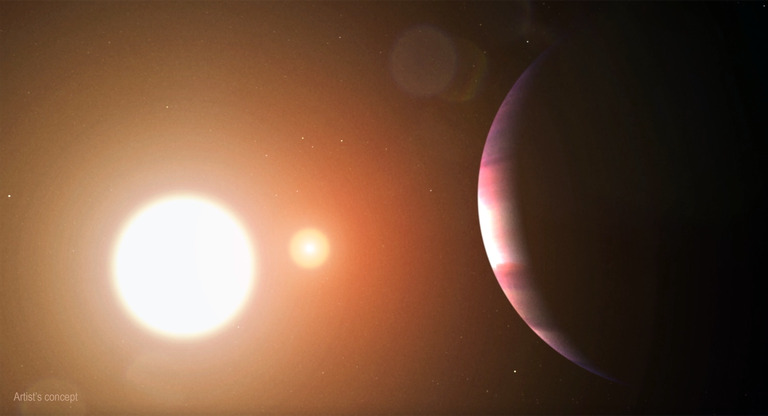
As a result, thanks to the cameras aboard the TESS satellite, which capture images of space every three minutes, researchers were able to detect new celestial objects. Indeed, among the 1,590 binary systems, 27 appear to contain exoplanets. According to scientists’ estimates, the smallest could be 12 times more massive than Earth, while the largest could have a mass of about 10 times that of Jupiter.
However, these estimates could change. It must be said that astronomers do not know the composition of these planets or their distance from their stars. In other words, no one knows if any of these new worlds could potentially harbor life. Therefore, further studies must be conducted to confirm their existence, but also to better understand them.
Source(s)
Image source: NASA's Goddard Space Flight Center/Chris Smith (USRA) - NASA Hubble Space Telescope - Unsplash
 Add as a preferred source on Google


