




A million tokens is fewer words than you think: We measured it

The objection turns up reliably as soon as someone mentions a second brain. Current language models can process a million tokens, some of them even more. So why sort, tag and link notes at all when you can just hand the whole pile to the AI?
The answer comes down to a number that almost nobody checks. Tokens are the chunks a model splits text into, and the unit it bills by. How much text a million of them holds depends on the language and on the method doing the splitting, the tokenizer. So we measured it instead of guessing.
How we counted
We started from two texts with identical content: the German and English versions of one of our own magazine articles. The German version had 1,134 words, and the English version had 1,276 words. Both counts cover body text and subheadings only, without captions or a list of sources. Anything between two spaces counts as a word. Both versions were processed using the js-tiktoken library, version 1.0.20, once with the o200k_base encoding that OpenAI uses for its current models, and once with cl100k_base, the older encoding used by GPT-4 and GPT-3.5.
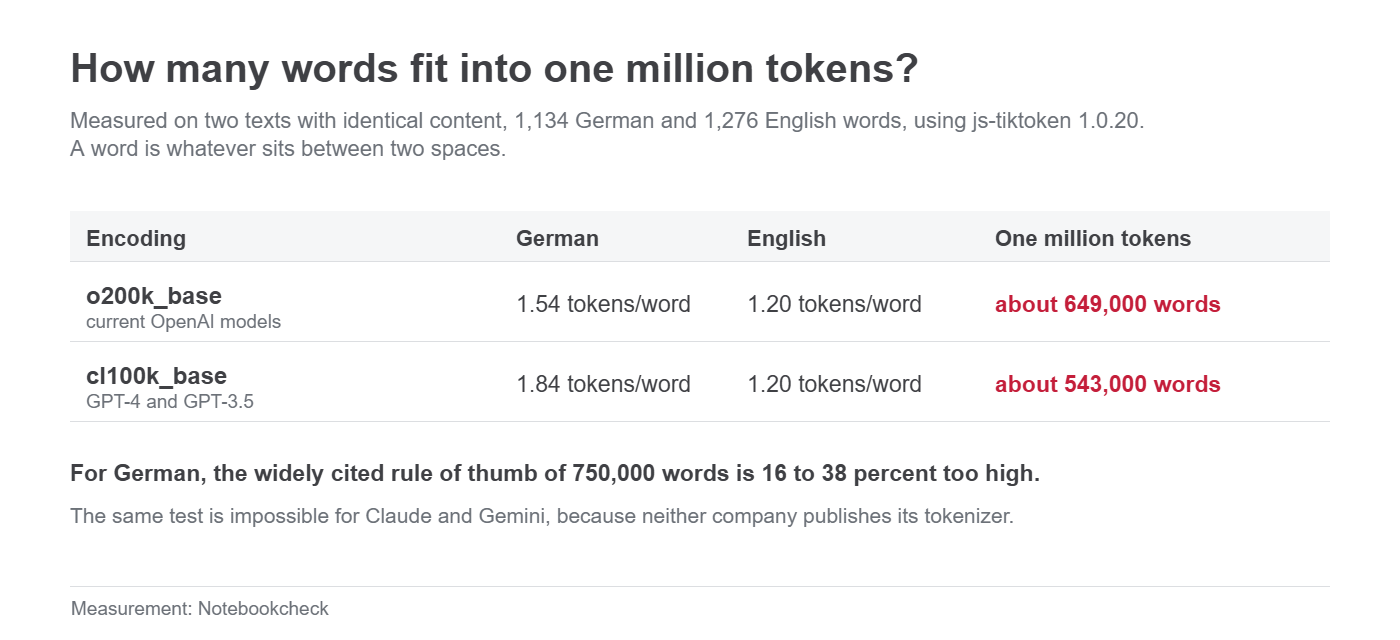
The widely cited rule of thumb is that one million tokens equals 750,000 words. For English, this estimate is too conservative; for German, it is significantly too generous. The comparison between the two encodings says more. The same German text comes to 1,747 tokens with one and 2,088 with the other. A twenty percent gap, purely because a different method does the splitting. The English text remained virtually unchanged, at 1.200 versus 1.202 tokens per word. The progress in tokenizers went almost entirely to languages other than English.
For Claude and Gemini the same test is not possible, because Anthropic and Google do not publish their tokenizers. Anthropic does note in its pricing documentation, however, that Claude 4.7 and newer models use a different method that generates about 30 percent more tokens for the same text than their predecessors. The figures below are therefore an order of magnitude, not a precise landing.
What this means for a real-world collection
We measured a collection that has grown over the years: around 470 notes, extrapolated to 350,000 to 400,000 words. That fits into a context window, just barely, and it keeps growing.
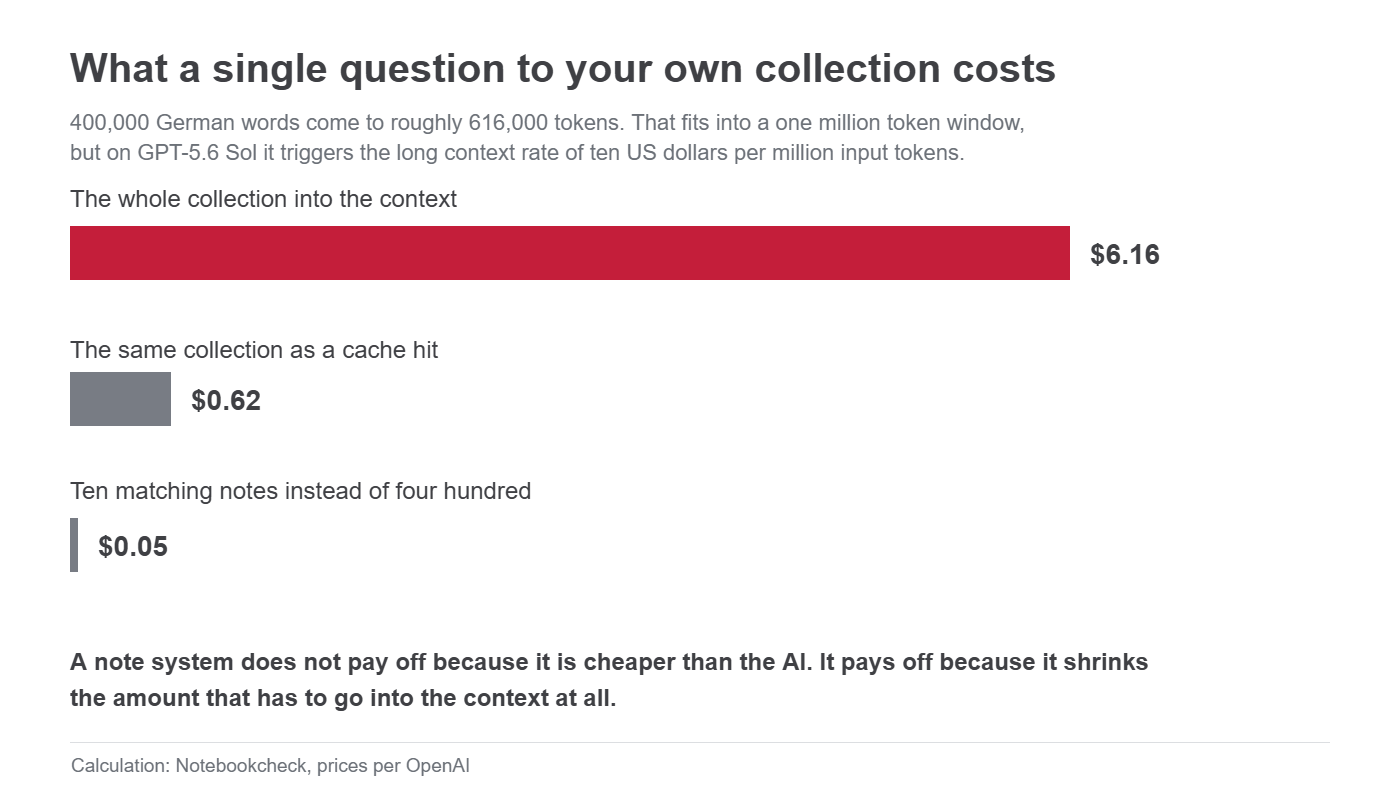
But a context window is refilled and paid for again with every single question. The model does not remember. It reads from the start every time. With GPT-5.6 Sol one million input tokens cost five US dollars, and from 272,000 tokens in a single request it is ten. 400,000 German words come to roughly 616,000 tokens, which lands them in the expensive tier, so $6.16. Per question. Ten questions in one afternoon add up to about $60. Notion Business, the most expensive subscription in our system comparison, costs 19.50 euros per user per month.
There are two caveats. This calculation covers the API, the interface developers use to address a model directly, not the consumer subscriptions. Users of ChatGPT Plus or Claude Pro do not pay per token but eventually reach usage limits. And there is caching. For a cache hit, OpenAI and Anthropic charge only a tenth of the input price, which turns $6.16 into 62 cents. Depending on the setting, though, the cache only lasts five minutes to an hour.
Why sorting still pays off
The point is not that a note system would be cheaper than the AI. It makes the pile smaller that has to go into the context at all. A decent full-text search, or a semantic index that searches by meaning rather than by keyword, hands the model ten relevant notes instead of four hundred.
That turns 616,000 tokens into roughly 9,000 and $6.16 into five cents. For the tokens that is a ratio of 67 to 1, for the price 123 to 1, because the small request stays below the expensive 272,000 token threshold. On top of that comes an effect no price table shows. A model that reads ten relevant notes answers more precisely than one ploughing through four hundred.
The real limit is rarely the context window
If you do not work through the API, you hit a different wall much sooner anyway. With ChatGPT the number of files per project depends on the plan: five with the free plan, 25 with Go and Plus, and 40 with Pro, Business, and the education plans. Gemini Notebook allows 50 sources per notebook on the free Standard plan, 100 on the Plus plan, and 300 on the Pro plan. A single source may hold up to 500,000 words.
What stands out is how inconsistent these numbers are. OpenAI lists 25 files for the Plus plan in its projects help page, but 20 in the file uploads help section, and both pages were last updated in the same week. If you plan to rely on it, check the number in your own account rather than trusting the documentation.
That shifts the question. What decides whether a collection can be queried is not the million tokens, but whether the tool takes it in at all. And that is exactly where your own note system earns its keep, because it does not pick what goes in, only what comes out.
What argues against the whole idea
A second brain still costs effort, and the programs have quirks worth knowing before you start. Obsidian and Joplin also run on phones, but they do not sync in the background. Obsidian answers that question in its own sync FAQ with a plain no. Files only sync while the program is running. On a computer you barely notice, because the app is usually open. But type a note on the go, swipe the app away, and it will not reach your computer until you open the app on your phone again. This applies to Obsidian Sync, the paid in-house service. If you keep the folder in iCloud or sync it with Syncthing instead, that service does the job for you. Notion caps single files at 5 MB on the free plan. And with Gemini Notebook, Google offers no way back. Delete a notebook and the sources go with it. Only the Gemini conversations move back into the chat list.
So the best advice is to collect notes for two weeks and then decide. If you end up with thirty notes, you do not need a system, you need a folder. If you end up with three hundred, you will notice for yourself what is missing when you search.
Source(s)
OpenAI: API Pricing, Anthropic: Pricing for Models and Features, js-tiktoken 1.0.20, Notion: Pricing Plans, Notion: Images, Files, and Media, Obsidian: Sync FAQ, Joplin: Synchronization, Google: Gemini Notebook Limits, Google: Deleting Notebooks, OpenAI: Projects in ChatGPT, OpenAI: FAQ on File Uploads
 Add as a preferred source on Google


