




A deep crater on Psyche may hold secrets of planetary cores
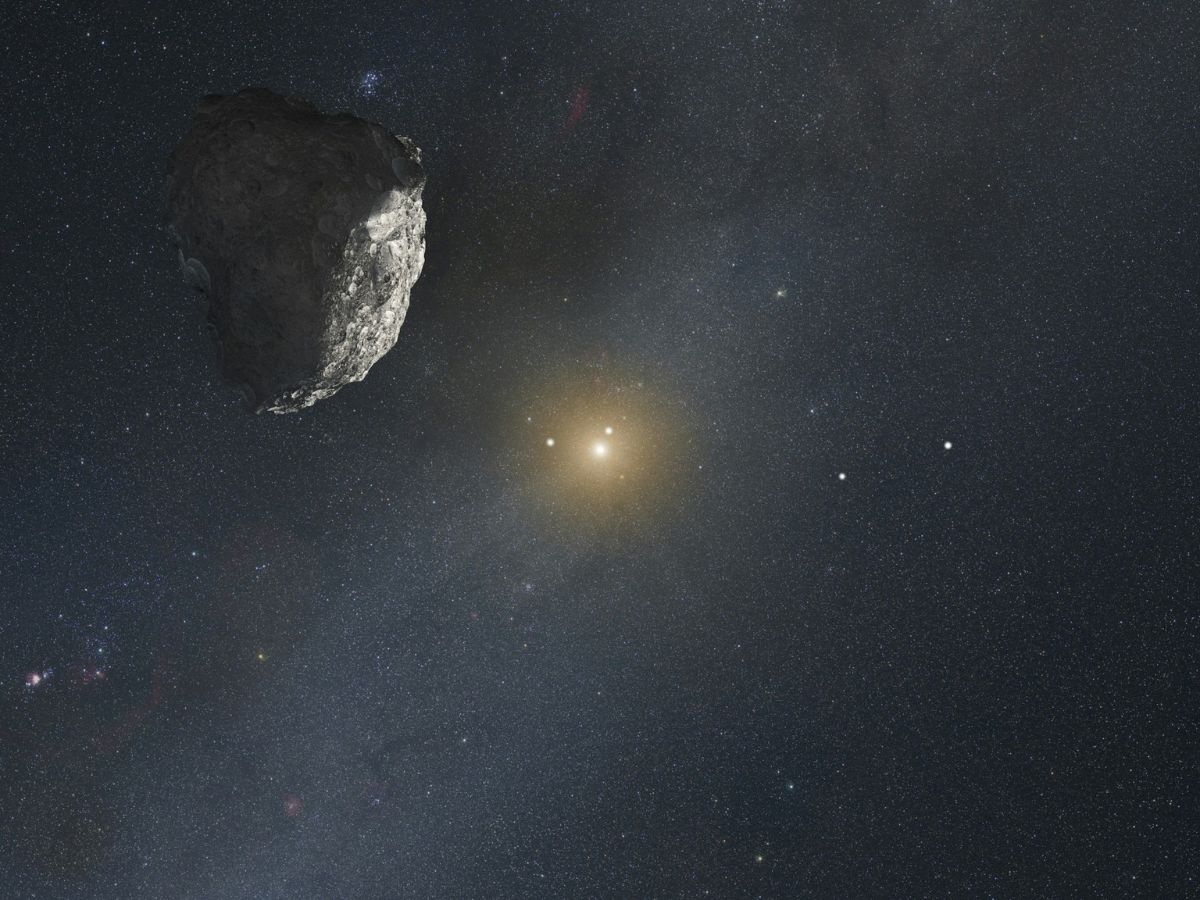
Asteroid Psyche is an unusual asteroid. Sitting in the asteroid belt between Mars and Jupiter, it is about 140 miles wide. Most asteroids are silicate-rich or carbon-rich, but Psyche is rich in metals, making it the largest known metal-rich asteroid.
Scientists have raised questions about whether Psyche is a fragment of a planetary core. If it is an exposed core, it would give insight into planetary cores. There are also speculations about how it was formed. A speculation is that it was once a part of a larger body in which the outer rocky layers were stripped away due to violent collisions, leaving only the metallic core. Another hypothesis is that massive impacts had shattered Psyche, randomly mixing the metal and rocks together. Some also think that Psyche is a partially formed, metal-rich planet.
To study this asteroid, NASA launched the Psyche mission in 2023, and it is slated to arrive at the asteroid in 2029. This spacecraft will measure the surface composition, gravity, magnetic field, and density variations.
To try and predict the outcome, scientists have created a 3D model of Psyche and tested it in different scenarios. They also varied the impact speed and size of the impacting object. Another important factor is its porosity. A porous asteroid would absorb impact energy, forming deeper craters. Various sizes of impactors were tested on two models: a metallic-core model and a mixed rock–metal model. The simulation revealed that a 3-mile-wide impactor can create the observed crater.
The simulation also predicted subtle differences in crater shape, ejecta pattern, density variation, and metal distribution on the surface. When the spacecraft arrives in 2029, scientists will compare real observations with simulations. This will give insights into how planetary interiors were formed and what early collisions were like.
 Add as a preferred source on Google


