 Deutsch
 Español
 Français
 Italiano
 Nederlands
 Polski
 Português
 Русский
 Türkçe
 Svenska
 Chinese
 Magyar
Asus UX30
Specifications
Pricecompare
Average of 13 scores (from 14 reviews)
Reviews for the Asus UX30
Source: Tech Advisor
 Archive.org version
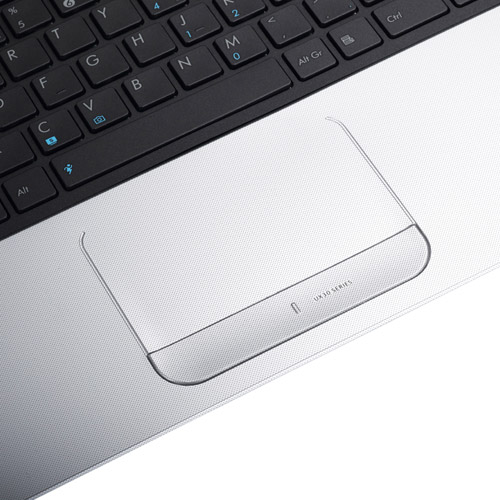
With an edge-to-edge glossy screen, dual-core chip and supermodel looks, the ultrathin Asus UX30-QX011C laptop is something of a tribute act to the Apple MacBook Air. Good looking, lightweight and a decent performer, the Asus UX30-QX011C wins points for its solid spec at a sub-£1,000 price. We can't understand why it runs Vista, however, and there are enough gripes with the hardware to tempts us to look elsewhere.
Single Review, online available, Medium, Date: 02/01/2010
Rating: Total score: 70% price: 80% features: 70% workmanship: 60%
Source: Techradar
Archive.org versionNot the fastest laptop, but good mobility and excellent quality and style. The Asus UX30 is the second Consumer Ultra-Low Voltage (CULV) laptop we've seen but, unlike the Advent Altro, this machine is aimed at the top end of the market. With its stunning design, usability and quality, the UX30 is easy to like. It's underpowered in comparison to rivals such as Apple's MacBook Air – although it's also cheaper – but if you're after something for the commute and place style over speed, it's worth a look.
Single Review, online available, Short, Date: 10/15/2009
Rating: Total score: 70%
Source: Pocket Lint
Archive.org versionDespite the fact most other CULV laptops are selling for considerably less than the Asus UX30’s £999 price tag, it’s difficult not to be impressed by this stylish machine. Few laptops can offer such a great mix of style and quality at this price, and the compact dimensions and light weight make it a great companion for the daily commute. Look elsewhere if value for money is high on your agenda, however, and the same goes for those of you seeking a portable powerhouse.
Single Review, online available, Medium, Date: 09/28/2009
Rating: Total score: 70%
Source: CNet
Archive.org versionThe Dell Adamo is one manufacturer's attempt to offer a Windows PC alternative to Apple's svelte MacBook Air. The Asus UX30 is another. This £1,000 thin-and-light laptop with an ultra-low-voltage processor apes Apple's machine to a surprising degree. There's plenty to like about the Asus UX30. It's better value than the Dell Adamo and has a better specification than the MSI X340. At £1,000, though, it's not that much cheaper than the MacBook Air and, while it's a fantastic-looking laptop, it's nowhere near as lust-worthy as Apple's offering.
Single Review, online available, Long, Date: 09/03/2009
Rating: Total score: 70%
Source: V3.co.uk
Archive.org versionThe Asus UX30 is one of the first laptops to reach these shores to use one of Intel's new Consumer Ultra Low Voltage (CULV) processors designed for 'thin and light' ultra-portables like the MacBook Air, but without the high price tag - in theory. Wonderfully slim and lovely to look at, the Asus UX30 is an impressive feat of engineering, but it would be more compelling if the battery life was better or the price a little lower.
Single Review, online available, Short, Date: 09/02/2009
Rating: Total score: 80%
Source: Computer Active
Archive.org versionWonderfully slim and lovely to look at, the Asus UX30 is an impressive feat of engineering, but it would be more compelling if the battery life was better or the price a little lower. Pros: Gorgeous slimline design; great screen and keyboard Cons: Price; middling battery life
Single Review, online available, Very Short, Date: 09/02/2009
Rating: Total score: 80%
Source: Channel Web
Archive.org versionThe Asus UX30 is one of the first laptops to reach these shores to use one of Intel's new Consumer Ultra Low Voltage (CULV) processors designed for 'thin and light' ultra-portables like the MacBook Air, but without the high price tag - in theory. Wonderfully slim and lovely to look at, the Asus UX30 is an impressive feat of engineering, but it would be more compelling if the battery life was better or the price a little lower.
Single Review, online available, Short, Date: 09/02/2009
Rating: Total score: 80%
Source: Computing
Archive.org versionThe Asus UX30 is one of the first laptops to reach these shores to use one of Intel's new Consumer Ultra Low Voltage (CULV) processors designed for 'thin and light' ultra-portables like the MacBook Air, but without the high price tag - in theory. Wonderfully slim and lovely to look at, the Asus UX30 is an impressive feat of engineering, but it would be more compelling if the battery life was better or the price a little lower.
Single Review, online available, Short, Date: 09/02/2009
Rating: Total score: 80%
Source: Mobile Computer
Archive.org versionWe’ve been lusting after the new breed of thin and light CULV laptops ever since we saw the gorgeous MSI X320 at this year’s CES and now models are starting to arrive in earnest. We’ll have a review of the Advent Altro for you next week, but first up is the ASUS UX30. CULV laptops are based on Intel’s Consumer Ultra Low Voltage (geddit?) processors and these offer energy efficiency approaching that of the Intel Atom, but better performance. The ASUS UX30 is an impressive first entry into the CULV laptop market, but it’s a bit too expensive for what’s on offer and the specification doesn’t quite tally with the premium price.
Single Review, online available, Medium, Date: 08/27/2009
Rating: Total score: 75%
Foreign Reviews
Source: Hispazone
 ES→EN Archive.org version
Single Review, online available, Long, Date: 07/21/2009
Rating: price: 80% performance: 80%
Source: Techno Zoom
 IT→EN Archive.org version
Single Review, online available, Short, Date: 04/30/2010
Rating: Total score: 70% price: 70% performance: 80% mobility: 75% workmanship: 70%
Source: Nonstop Mobil
 HU→EN Archive.org version
Comparison, online available, Medium, Date: 07/17/2009
Rating: Total score: 70% price: 70%
Source: Sohoa VN Express
 VN→EN Archive.org version
Single Review, online available, Very Short, Date: 09/28/2009
Rating: Total score: 60%
Source: Dinside
 NO→EN Archive.org version
Single Review, online available, Medium, Date: 10/07/2009
Rating: Total score: 67%
Comment
Intel Graphics Media Accelerator (GMA) 4500MHD: Onboard (shared Memory) GPU built in the GM45, GE45 and GS45 chipset (Montevina). Because of two more shaders and a higher core clock, much faster than the old GMA X3100. Still not advisable for gamers (DirectX 10 games not playable or only with very low settings). The integrated video processor is able to help decode HD videos (AVC/VC-2/MPEG2) , e.g., for a fluent Blu-Ray playback with slow CPUs.
Only some 3D games with very low demands are playable with these cards.
» Further information can be found in our Comparison of Mobile Graphics Cards and the corresponding Benchmark List.
Intel Core 2 Duo: This is the Core Duo and Core Solo successor with a longer pipeline and 5-20% more speed without more power consumption. As an addition to the Core Duo design there exists a fourth decoder, an amplified SSE-unit and an additional arithmetical logical unit (ALU).
The Core 2 Duo for laptops is identical to the desktop Core 2 Duo processors but the notebook-processors work with lower voltages (0.95 to 1188 Volt) and a lower Frontside bus clock (1066 vs 667 MHz). The performance of equally clocked notebooks is 20-25% lower than Desktop PCs because of the lower Frontside bus clock and the slower hard disks.
SU9400:
Power efficient low voltage processor based on the Penryn 3M core that features all Penryn functions like Virtualization and Trusted Execution.
» Further information can be found in our Comparison of Mobile Processsors.
13.30":
There are hardly any tablets in this display size range anymore. For subnotebooks, on the other hand, it is the standard format.
The advantage of subnotebooks is that the entire laptop can be small and therefore easily portable. The smaller display also has the advantage of requiring less power, which further improves battery life and thus mobility. The disadvantage is that reading texts is more strenuous on the eyes. High resolutions are more likely to be found in standard laptops.
» To find out how fine a display is, see our DPI List.Asus: ASUSTeK Computer Inc. is a major Taiwanese computer hardware manufacturer based in Taipei, founded in 1989. Under the Asus brand name, the company manufactures a wide range of products, including laptops, desktops, motherboards, graphics cards, monitors, smartphones and networking equipment, complete systems and PC components for end users.
Under the ROG (Republic of Gamers) brand name, ASUS manufactures gaming laptops known by gamers for their powerful specifications, dedicated graphics cards, high refresh rate displays and advanced cooling systems.
Beyond gaming, a wide range of notebooks are offered for different needs and budgets, from ultra-slim and lightweight ultrabooks to versatile 2-in-1 convertibles and budget-friendly options. In 2023, Asus had a 7% global market share of the PC market.
Customer satisfaction with ASUS notebooks concerns performance, the features, and the good price-performance ratio of ASUS notebooks. However, as with any brand, there are occasional reports of problems such as overheating, driver compatibility, or build quality issues.
72.46%: This rating is poor. More than three quarters of the models are rated better. That is rather not a purchase recommendation. Even if verbal ratings in this area do not sound that bad ("sufficient" or "satisfactory"), they are usually euphemisms that disguise a classification as a below-average laptop.
» Further information can be found in our Notebook Purchase Guide.