




South Korea’s Ecobee maglev is barely running
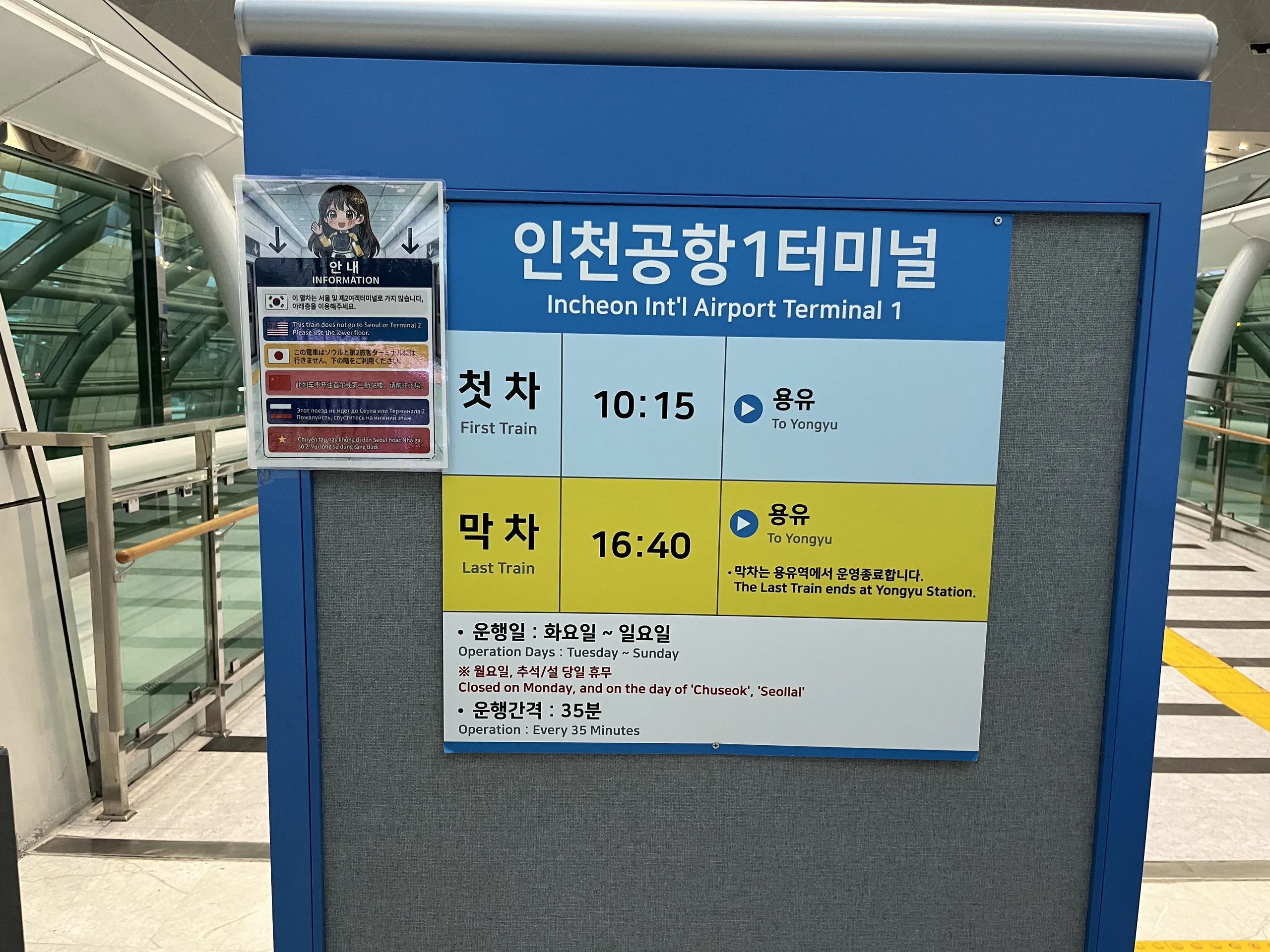
The Incheon Airport Maglev, also known as the Ecobee, is barely running. After a long period of uncertainty regarding its future—with service suspended for a surprisingly long time—the system is back in operation. However, the current service levels can only be described as laughable.
On Mondays, for instance, the Ecobee does not run at all. Even on its operating days, the service has been gutted to a bare minimum, as Notebookcheck.com was able to observe on-site. The first train does not depart until 10:15 AM, and the final train leaves the airport at 4:40 PM. In between, trains run every 35 minutes—or more precisely, a single trainset likely handles the entire route, as the schedule allows for it.
In the past, multiple trains operated on the line, and they would pass each other at stations. We have not yet been able to determine why the service was scaled back so drastically. Consequently, the system is no longer attractive to passengers. While it remains free of charge, few travelers heading to airport hotels are likely to wait 35 minutes, and it is equally impractical for airport staff. It almost seems as though the goal is to generate low ridership figures to justify a complete shutdown—a "skeleton" or "alibi" service.
This is a strategy often seen in Germany to justify the decommissioning of rail lines. We will have another opportunity to inspect the Ecobee in a few weeks and will hopefully see if the system is still being used at all. South Korea’s strategy stands in stark contrast to Japan’s first urban maglev. Despite being a one-off, the Linimo remains an integral part of the public transport network in Nagoya. Japan is particularly adept at producing and maintaining unusual transit systems, often choosing whatever fits best—sometimes literally, in cramped urban spaces—and is willing to pay a premium for it.
While South Korea has a similar technical capability, the maglev project by Hyundai-Rotem is reportedly no longer being pursued. No buyers were secured, despite temporary interest from Malaysia, and the plan to encircle the Incheon Airport region with an Ecobee ring has been abandoned.
The relatively new Terminal 2 is not accessible via the Ecobee, even though the western part of the airport offers potential through development areas that could benefit from a transit system. South Korea is now primarily focused on hydrogen research—ranging from subways that no longer require overhead lines (BuTX) to high-speed trains.
South Korea showed courage
South Korea actually did everything right when building the first operational pilot line for practical research. The country decided to build the system with double tracks from the start. Furthermore, the route includes several stations and is fully automated—a luxury setup for South Korea’s most important airport. While this might seem standard, such a configuration is hard to imagine in Germany.
Although hundreds of millions of euros are supposedly being funneled into urban maglevs there, politicians prematurely promised that a maglev would be cheaper than a tram. To keep this promise, they had to resort to shortcuts: single tracks, shortened trains, few stations, and long intervals are the means by which Germany is supposed to become a "maglev nation" again.
A maglev project in Nuremberg recently failed due to such a curious plan. Politicians wanted a cheap system and received a plan for one that was not practically useful—affordable, but useless. The situation was similar in Munich, and the first two attempts to establish the Transport System Bögl (TSB) in Berlin followed a similar path, even though concrete planning was lacking.
Initially, only enough funding was allocated for what was essentially a shuttle system on a single track. Later, a route was proposed running parallel to the S-Bahn from the exhibition grounds toward the airport. The TSB is actually a high-performance system: short intervals with moving blocks, high acceleration, fast cornering, steep climbing capabilities, and full automation are the hallmarks of this maglev. However, these strengths can only be realized if a proper route is built, which would likely cost several billion euros—a price range comparable to a U-Bahn or S-Bahn.
Berlin to receive a proper test track
Nevertheless, the Senate Department for Mobility confirmed to us a few weeks ago that the next Berlin maglev is intended to be a proper application route with double tracks. However, it is planned for the site of the former Berlin Tegel Airport, where high passenger potential is unlikely. Initial studies must be awaited, which can take time in Germany.
To date, a great deal of money has been invested in the TSB in Germany, but almost exclusively in the planning stages across various states and cities. The TSB has better prospects in China, despite competing with numerous domestic maglev systems. A contract for a test track has already been signed. It has been quiet since then, but that is not unusual for China; maglevs there are often opened without much public fanfare.
Source(s)
Own research
 Add as a preferred source on Google


