




New and compact imaging sensor gives robots 4D vision
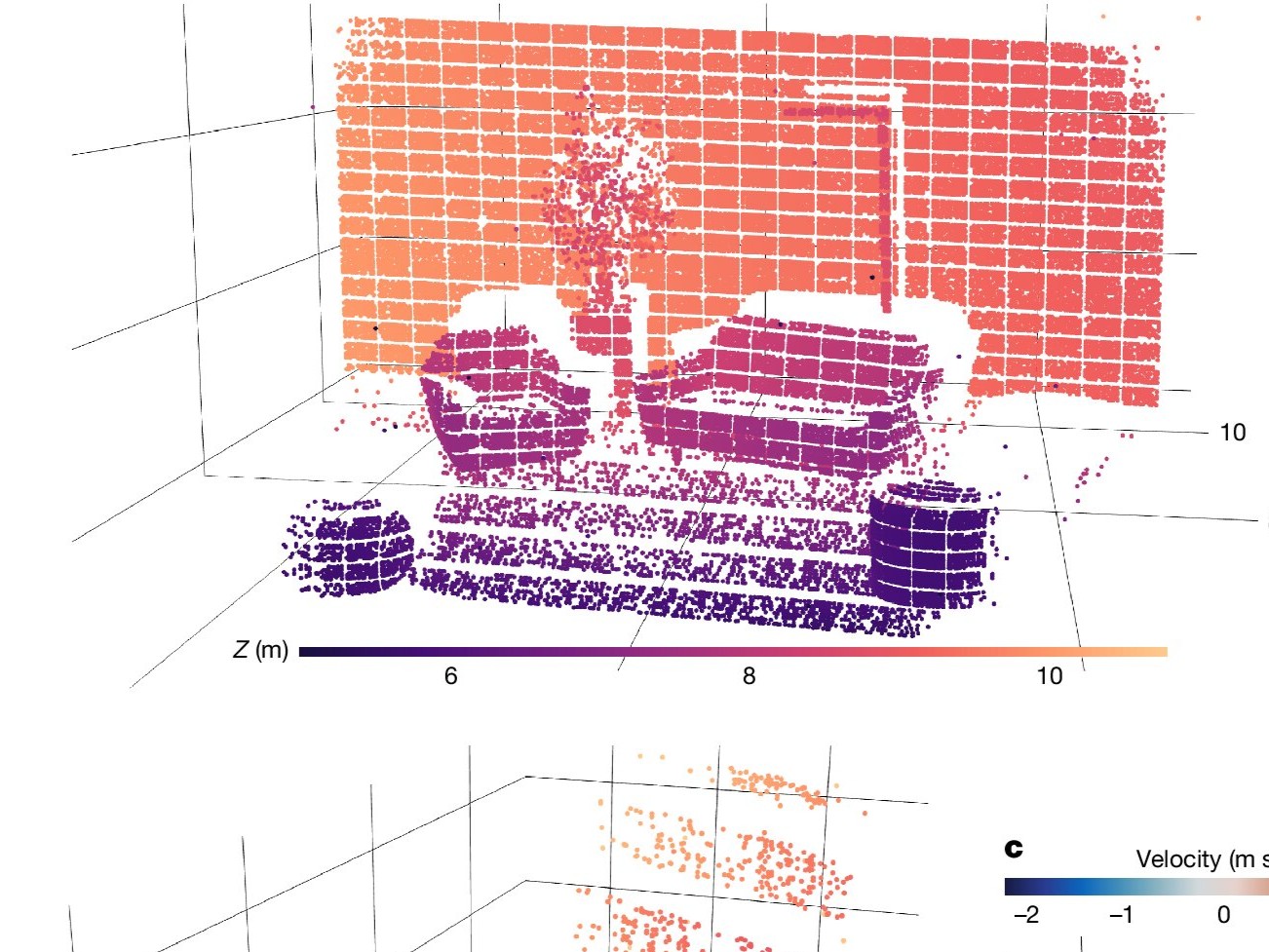
Current three-dimensional vision systems used in robots and drones are often bulky, expensive, and struggle to process fast-paced, unpredictable movements in the real world. To solve this, researchers have developed a highly advanced 4D imaging sensor consolidated onto a single silicon chip. This compact technology — detailed in the journal Nature — creates highly accurate digital maps of its surroundings while simultaneously tracking the exact speed of moving objects.
Unlike traditional sensors that rely on rapid pulses of light and require separate components for sending and receiving signals, the newly designed chip operates using a continuous laser beam. The laser light is routed through a physical grid of nearly 62,000 microscopic stationary pixels. Every pixel in this array acts as both a transmitter and a receiver, which keeps the overall device exceptionally compact. By analyzing tiny shifts in the frequency of the returning light waves, the system instantly calculates both how far away an object is and how fast it is moving.
The research team successfully tested the sensor across various scenarios, including mapping indoor rooms and instantly measuring the velocity of a spinning disk. In long-range outdoor tests, the chip successfully captured precise details, such as windows and balconies on a building located 65 meters away.
Because the design integrates all necessary electronic and optical components directly onto one chip, it is compact and scalable. Though it still needs improvement in its resolution and range, this 4D technology may one day improve the vision capabilities of autonomous machines, drones, and eventually everyday digital cameras and smartphones.
Source(s)
Image source: Nature (2026). DOI: 10.1038/s41586-026-10183-6
 Add as a preferred source on Google


