




Meta fixed the capture LED, but it still failed testing in Hamburg
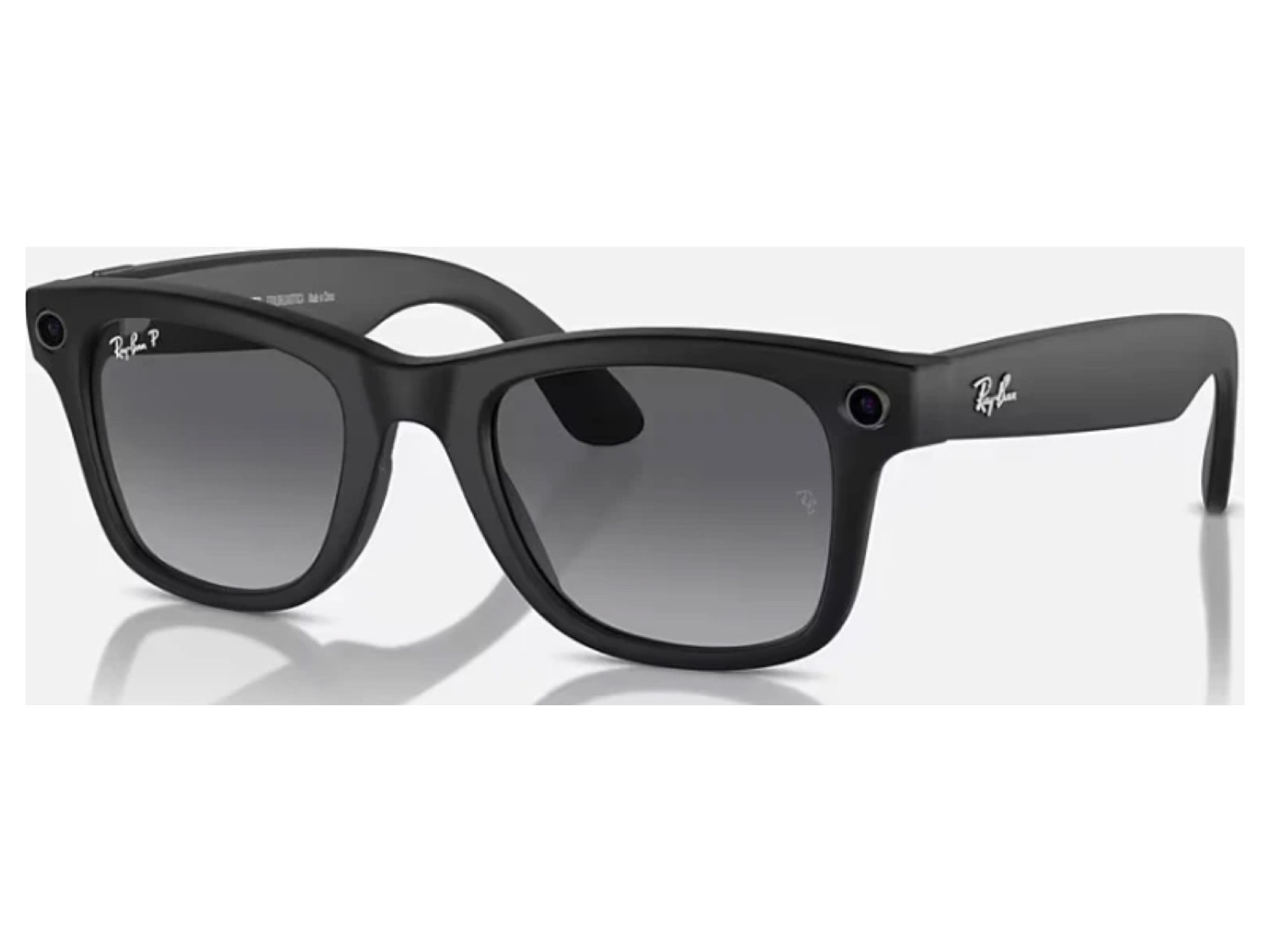
Meta Connect opens today, with the keynote at 1 a.m. Thursday German time. Glasses are on the agenda, and Meta is reportedly planning more than glasses. Six days after that, Meta joins a panel on regulation hosted by the French data protection authority CNIL. In between, prosecutors in Paris are investigating. In Hamburg, a final report on the small white light has been public since Sept. 10.
What firmware v128 changed
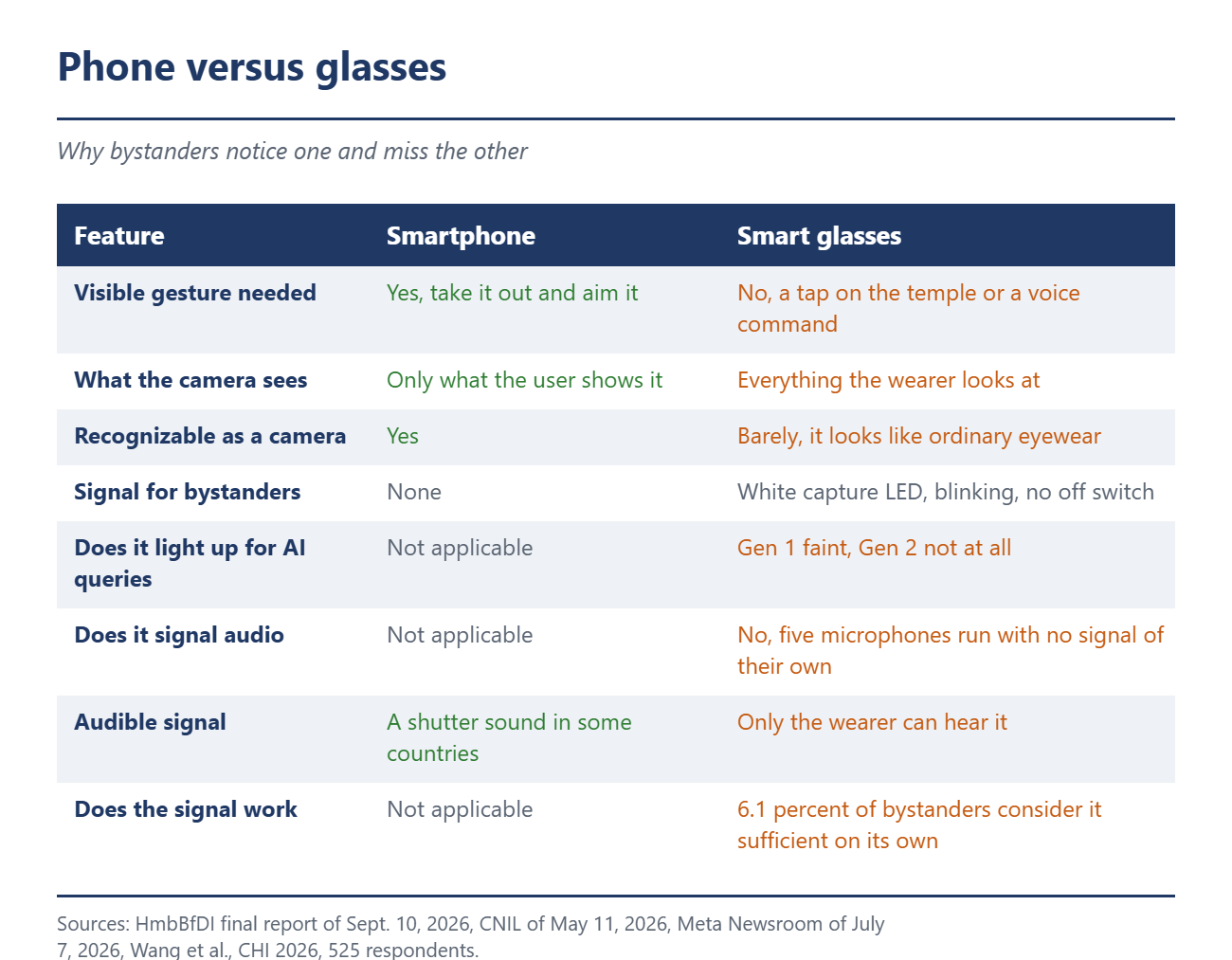
The capture LED on Meta’s Ray-Ban glasses blinks while a recording runs, and Meta says it has no off switch. For a long time it could be fooled anyway, because the glasses checked only at the start whether the light was covered. Cover it first and you were caught. Start the recording first and cover it afterwards, and the camera kept going. A small accessory market was built on that gap, stickers and clips.
That ended at the beginning of this month. The independent test lab IPVM published a test of firmware v128 on Sept. 2, on both generations and in daylight as well as at roughly 100 and 20 lux. Recording stopped within about five seconds in every run once the light was covered. The reason is a continuous check while the recording runs, instead of the single check at startup.
The review arrived eight days later
The Hamburg Commissioner for Data Protection and Freedom of Information (HmbBfDI) disassembled a Ray-Ban Meta Wayfarer in its lab and published a final report on Sept. 10. The authority examined the first generation, and it checked the second generation as well for how visible the light is. No firmware update can fix what the report says about visibility.
The LED light “is not easily visible in many environments, particularly outdoors and in direct sunlight,” the report says. It can serve as a signal only for people in close proximity who look almost directly at the glasses, because the beam angle is narrow. A study accepted at CHI 2026 put the same question to 525 people in China. Only 6.1 percent of bystanders considered such an indicator on its own to be enough.
The most serious finding is somewhere else. When someone asks Meta AI about their surroundings or about people in the field of view, the outward-facing LED behaves differently. On the first generation it “glows very dimly,” and on the second it “does not glow at all,” the report says. As a result, people in the frame often cannot recognize that they are being recorded. The second generation is, by the authority’s account, the world’s best-selling smart glasses.
Then there is what the light never shows. The glasses have five microphones, two on each temple and one on the bridge of the nose, and they are activated whenever a video is recorded. Audio data is “captured with high clarity from a distance of up to two meters,” the report says. A mere flashing of a white LED, it adds, does not sufficiently indicate that video and audio are being recorded.
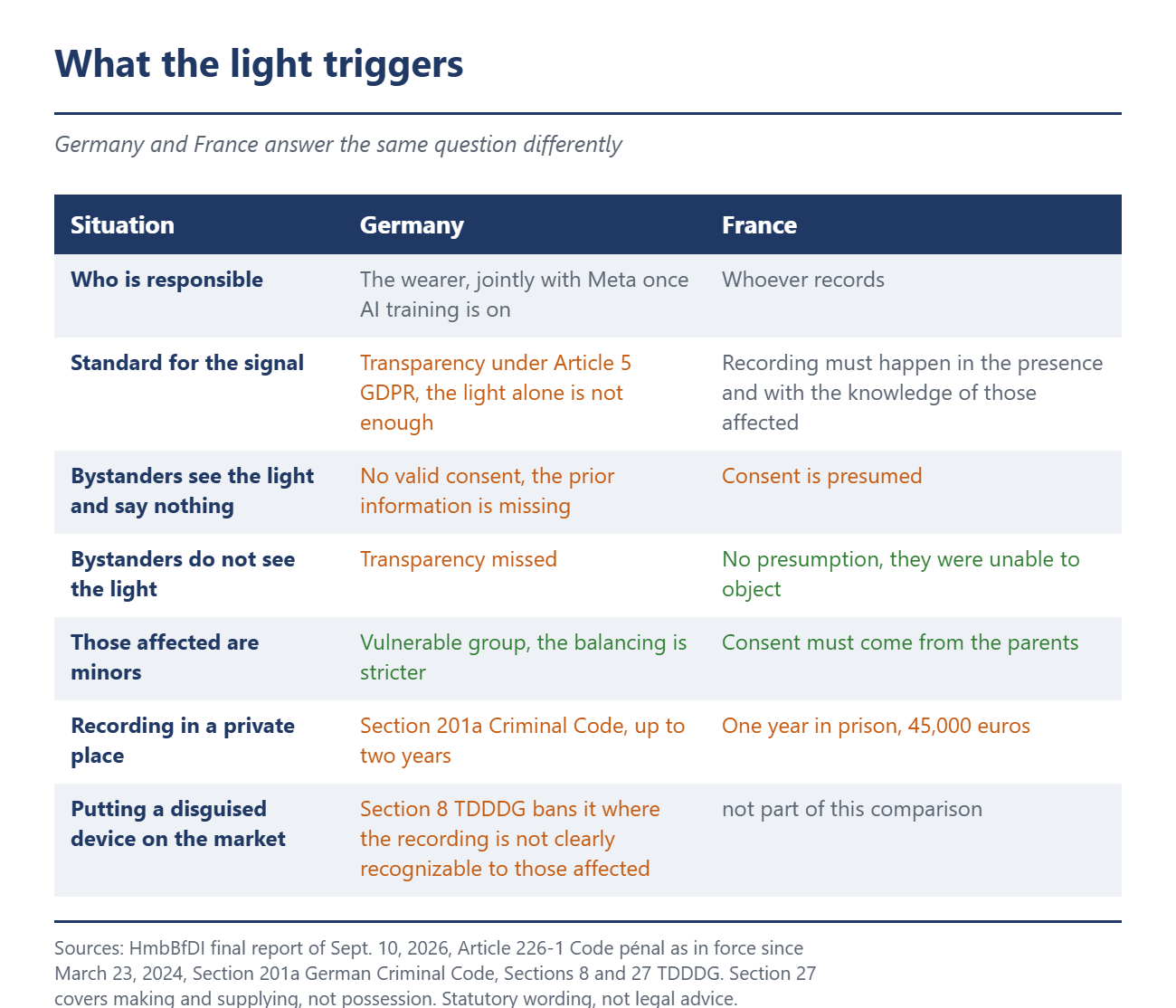
From this the authority draws a far-reaching conclusion. Recording people outside a close circle of friends and family will generally not be permissible, except in rare cases of legitimate interest, because informed consent cannot realistically be obtained for lack of transparency. The legal analysis covers the users of the glasses only, and Meta’s own processing is not evaluated. Where AI training is enabled, the report describes joint controllership with Meta under Article 26 of the GDPR. Separately, a criminal complaint has been filed over the sale, and it names the retailers. A complaint is not yet a case.
One paragraph in French law makes that light work against you
The French association e-Enfance put the point this way in September. Seeing a light does not mean consenting to the distribution of your image, and a person first has to notice it, understand what it means and be able to react.
Article 226-1 of the French Code pénal shows why those three conditions are worded so carefully. It carries one year in prison and a fine of 45,000 euros for deliberately violating the privacy of private life. One example named in the article is recording the image of a person in a private place without their consent. Then comes a paragraph that is rarely quoted. Where those acts were carried out in the presence and with the knowledge of the people concerned, and they did not object although they were able to, their consent is presumed.
A clearly visible light is one way to create that situation. Anyone who notices it and says nothing could later be told they consented. This is the wording of the statute and not legal advice, and a court decides the individual case. The article has two limits. The image provision applies only in a private place, and for minors the consent has to come from the parents. e-Enfance has received around 20 reports since the start of the year about women filmed without their knowledge. Most of them involve Meta glasses. Approached, filmed, humiliated, and the scene usually ends up on TikTok.
The Paris proceedings need some context. Prosecutors have opened at least one investigation into sexual harassment, according to Reuters, with no brand named. There is so far no source independent of that single agency report. The CNIL has received around 10 complaints, also with no brand named.
What you can change yourself
If you wear the glasses, the light is not enough as information. The Hamburg report asks for additional measures, a notice in text or pictogram form, or actively addressing the people around you. The CNIL advises switching off the recording functions when you do not need them, and removing the glasses wherever you would also switch off your phone. AI training is on by default, so you have to opt out. You can stop the storage of your voice recordings under Settings, Glasses, Glasses and privacy, Voice activity log. Recordings already stored do not disappear that way.
Meta delivered what could be delivered. The Hamburg report describes a gap that was already closed when the report appeared. Its assessment rests on distance, viewing angle and sunlight, on five silent microphones and on a feature where the light stays dark. Apple’s own glasses are said to arrive in 2027 with a privacy focus. Whether anyone notices the light is not something an update decides, and what a silence in response means will be decided by a court.
Source(s)
IPVM: test of firmware v128 against taping over the capture LED
Meta Newsroom: questions about the AI glasses, answered
Wang et al., CHI 2026: survey of 525 wearers and bystanders on camera glasses
e-Enfance: helpline 3018 warns about women filmed without their knowledge
Légifrance: Article 226-1 of the Code pénal, official text
CNIL: program of the Rencontres Informatique et Libertés on Sept. 29, 2026
Gesetze im Internet: Section 8 TDDDG on disguised recording devices
 Add as a preferred source on Google


No comments for this article
