




Leaked Project Helix documents reveal Microsoft's biggest backward compatibility push yet
Microsoft's long-term vision for Xbox could involve a lot more backward compatibility than initially anticipated. The Verge has stumbled upon an interesting document which outlines Microsoft's plans for Project Helix, Microsoft’s next Xbox console. According to the leaked documents, Helix is designed to support games spanning every Xbox generation, including the original Xbox, Xbox 360, Xbox One and Xbox Series S|X. Combined with Microsoft's previously announced "Xbox PC" strategy, the company appears to be building a single software ecosystem that unifies all Xbox generations.
The leak arrives only days after Microsoft officially launched Xbox backward compatibility on Windows, which supported four original Xbox titles: BLiNX: The Time Sweeper, Conker: Live & Reloaded, Crimson Skies: High Road to Revenge and Fuzion Frenzy. The games can be purchased through the Xbox app on Windows PCs and Windows-based handhelds such as the ROG Xbox Ally and ROG Xbox Ally X. Existing digital owners automatically receive PC access through Xbox Play Anywhere.
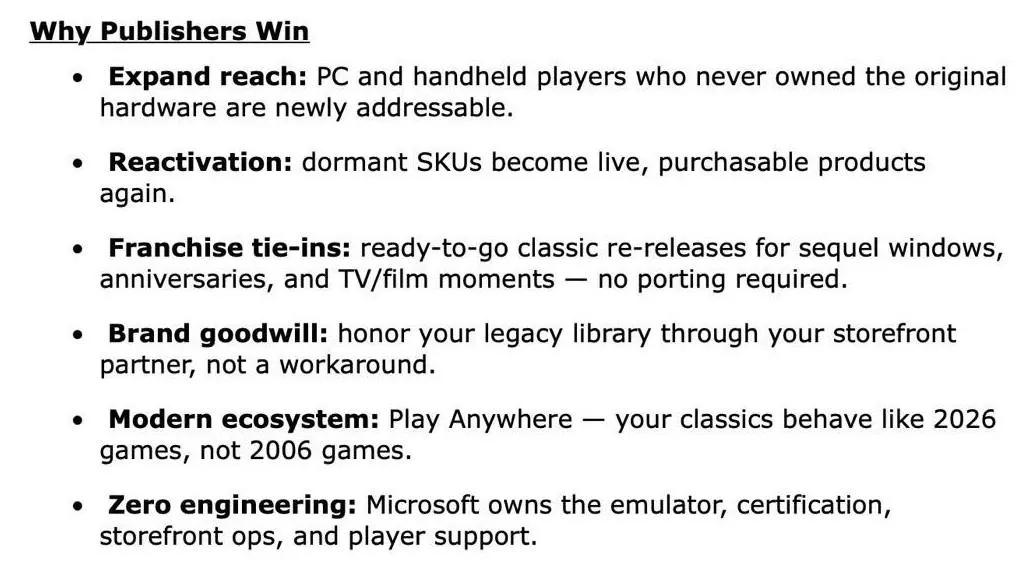
The Verge's leak shows Microsoft is reportedly asking publishers to opt into two preservation programs that would allow legacy Xbox titles to return without requiring developers to create remasters or new ports. Microsoft will handle engineering, certification and technical support, while publishers retain full control over pricing, licensing, branding and Game Pass participation.
The initiative is framed as a commercial opportunity alongside a preservation effort. One slide describes the ability to "reactivate dormant SKUs," allowing publishers to sell older games again with little to no technical investment. Another highlights the ability to expand franchises across PC, handhelds and future Xbox hardware without rebuilding games from scratch. Whether that does anything to slow the industry's seemingly endless appetite for remakes and remasters remains another question entirely.
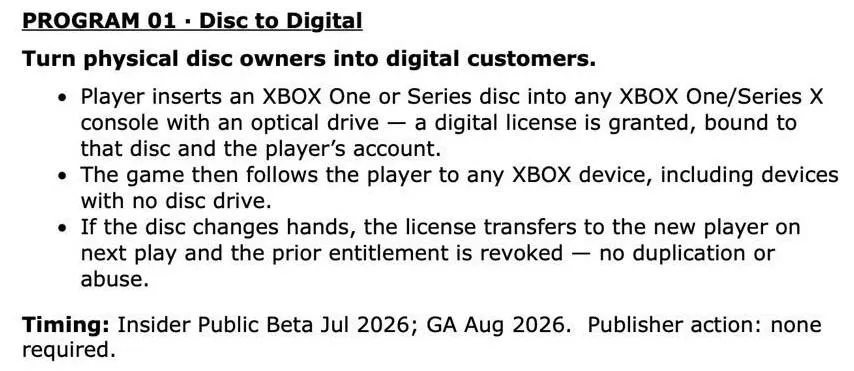
The leak also corroborates an earlier roadmap shared by eXtas1s. Under Microsoft’s “Disc to Digital” program, inserting a supported Xbox One or Xbox Series disc into a console with an optical drive would grant a digital entitlement tied to both the user’s account and that specific disc. The game could then follow the player to other Xbox devices, including hardware without a disc drive. If the physical copy is sold or traded, the license would transfer to the new owner the next time the disc is used, while the previous owner’s access would be revoked. Microsoft’s slide lists an Insider Public Beta in July 2026 and a wider launch in August 2026, with no publisher action required.
Digital Foundry's John Linneman recently claimed that earlier plans pointed toward continued support for physical media, potentially through either an integrated optical drive or an optional external disc drive. Sony's decision to abandon physical disks completely, and the ensuing backlash that followed, will almost certainly influence how Microsoft tackles this rather delicate situation. Additional speculation from Moore's Law Is Dead suggests Microsoft's newly launched PC compatibility layer may ultimately evolve into a unified solution capable of supporting software from every Xbox generation. While MLID's conclusions are largely based on analysis rather than leaked documentation, they sit in line with the direction outlined by The Verge's report.
That said, it will ultimately come down to publishers and their willingness to support older, often abandoned titles. It also opens another can of worms with rights issues involving licensed music, vehicles, sports leagues and other third-party intellectual property. Nevertheless, the prospect of playing 25-odd years of titles on a single piece of hardware is a promising one, as it addresses one of the key pain points with consoles: wonky backward compatibility— something PC owners don’t have to worry about.
Source(s)
The Verge (paywalled)
 Add as a preferred source on Google


