




First Ethernet cables were painted Safari Yellow to avoid electrocution in style

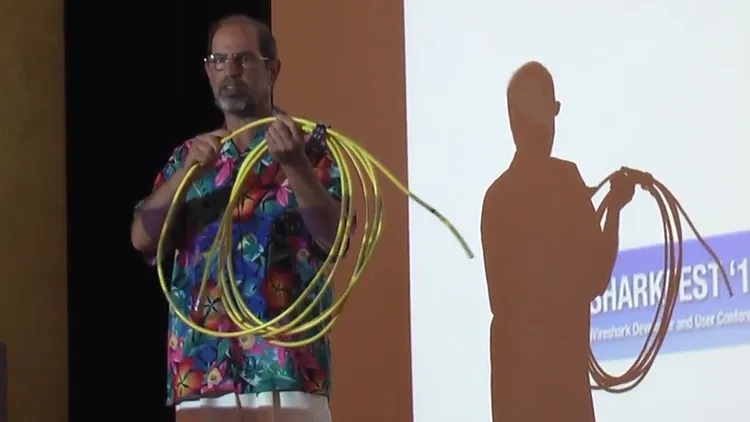
Ethernet cables today come in every color a spool manufacturer feels like printing, but the very first ones’ hue was concocted as both a design choice and a safety measure. According to Rich Seifert, one of the engineers behind the original Ethernet specification, the cabling that shipped in the early 1980s was uniformly yellow for several good reasons.
Seifert has said the color partly reflected his own taste in car and furniture paint, as he specifically chose a shade close to a 1968 Corvette’s hue that is sometimes called "Safari yellow" among classic car fans. A more practical reason had to do with how Ethernet was physically installed at the time. Unlike the thin, flexible cabling used today, early Ethernet ran over thick coaxial cable that had to be connected using a so-called vampire tap.
The cables in the original Ethernet standard from the early 1980s that was based on DEC/Intel/Xerox's inventions were called 10BASE5, or "thicknet," and the yellow jacket color was actually specified in the standard so installers could easily identify it.
The connector literally bit through the cable's outer shielding to make contact with the conductor inside. That installation method made any potential mistake a lot more dangerous than with today’s crimping. Technicians were often working with bundles of cable strung through ceilings, and drilling into the wrong one always carried the risk they could puncture a power line instead. Making the Ethernet network cable as visually distinct as possible, in the “wild yellow” of the specific 1968 Corvette, served the dual purpose of preventing exactly that kind of accident.
At the time, a single Ethernet controller required a pair of large circuit boards costing around $3,000 and consuming 60 watts alone, or more than the power draw of a whole single-board computer like the CanaKit Raspberry Pi 5 Starter Kit Pro available on Amazon for less than $260.
The familiar blue or gray twisted-pair cables came later, once coaxial Ethernet with a vampire tap was gradually phased out. For a few years, though, the flashy yellow cable wasn't just a design whim of its creator but there to stop someone from actually drilling into the wrong wire and electrocuting themselves.

Source(s)
PC Gamer, Image: Matthew Millman via Helsinki.fi
 Add as a preferred source on Google


