




Eustella free tier review: Three chats, four images — and the quota was gone

I've been following the European chatbot alternative Eustella since its beta release. I previously tested its capabilities in this article and came away with a positive impression, particularly because of its integration of open-weight models.
Recently, Eustella officially left beta behind and launched with a new pricing model. Paid plans start at €5.99 per month, but anyone who wants to try Eustella can do so through the free tier. The question is: just how restrictive is that free plan?
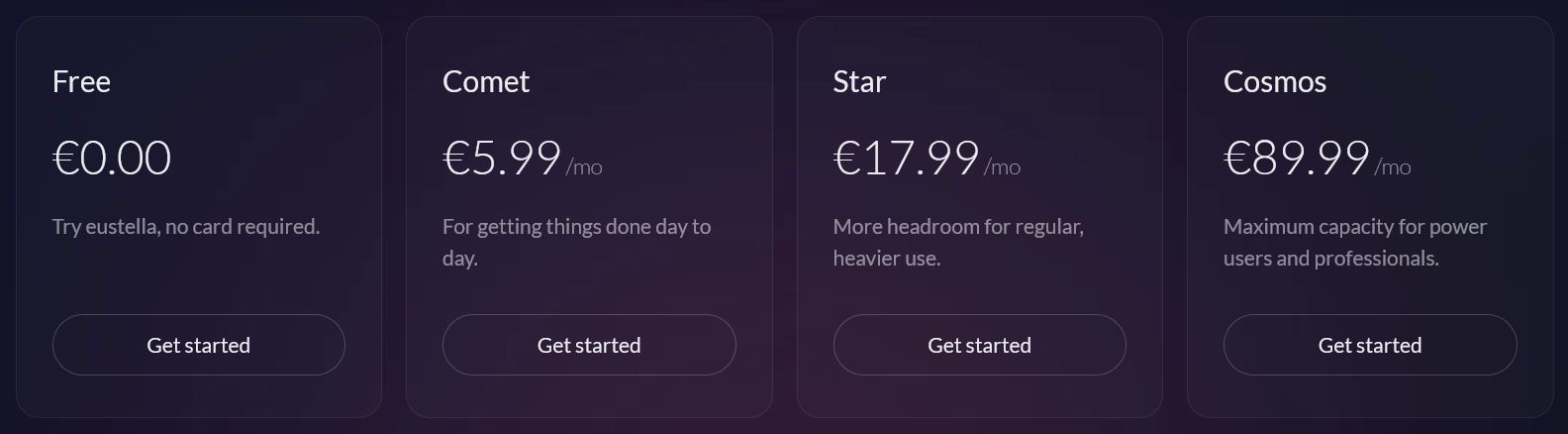
How the free-tier limit works
After taking a break from using Eustella for about three and a half weeks, I logged back into my account and started asking questions again to see how quickly I would hit the limit. During the conversation, it became clear that usage is measured within a weekly time window. In the worst-case scenario, that means if I use up my quota on the very first day, I have to wait another six days before I can use Eustella's free tier again.
Compared to other AI chatbots, that's a much stricter approach and—depending on the actual limits—could make Eustella's free tier almost impractical to use.
Real-world test: How quickly the quota disappears
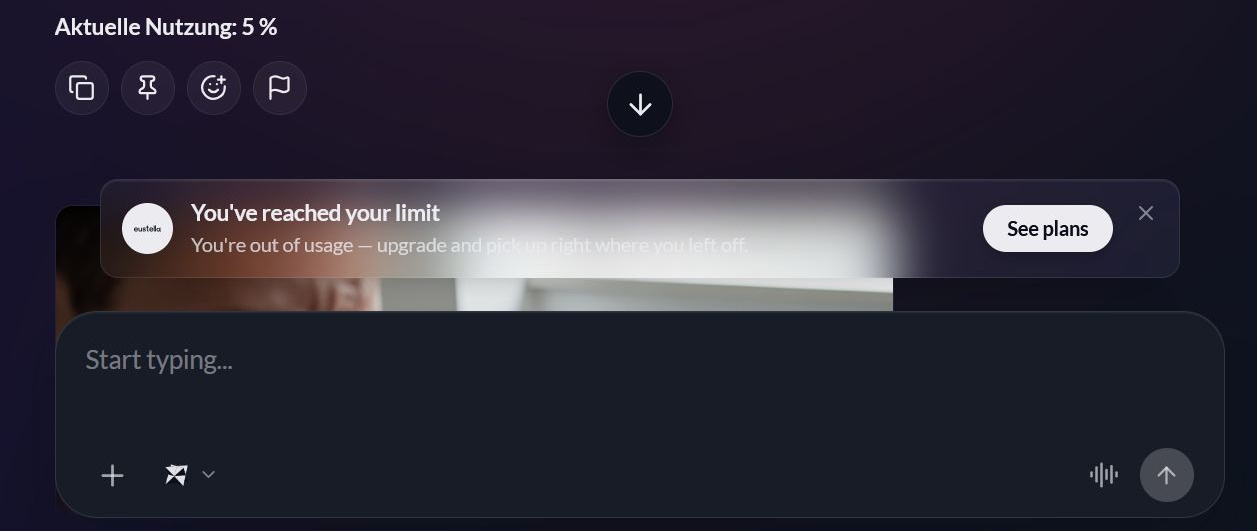
Apparently, the chatbot has access to my current usage statistics, so I instructed Eustella to include my quota usage as a percentage after every response to help me keep track. I also asked how usage is calculated, but the answer wasn't particularly helpful (text chats & research < coding & documents < image generation).
After my first three text prompts, my reported usage was still just 5 percent. I didn't think much of it. Then I decided to push it further by generating an article image. The reported usage remained at 5 percent. "Wow," I thought, "the quota must be fairly generous." It seemed likely that usage was being tracked internally in small increments.
I wasn't happy with the first image, so I generated another one. After the fourth image, my reported usage was still supposedly 5 percent—but suddenly my quota had been exhausted, and I was told to wait another six days before I could continue using the service.
New features: Office files instead of just chat
Since the beta, Eustella has added new features. It can now generate documents, including Microsoft Office formats such as DOCX, XLSX, and PPTX—something that wasn't available during the beta.
Unfortunately, I wasn't able to test those features because my weekly quota had already been used up by that point.
Conclusion: Fine for testing, too limited for everyday use
After just three text prompts and four generated images, my weekly Eustella free-tier quota was exhausted without any additional warning, leaving me with a six-day wait before I could continue.
Unlike ChatGPT, which switches users to less powerful models when limits are reached—or at least allows them to continue the next day—Eustella's free tier feels far too restrictive for regular use. In its current form, it really seems designed only for a brief trial rather than day-to-day use.
That said, Eustella doesn't make money from free users the way many larger providers do, which often use free users' chat histories and customer data for model training and other purposes. Eustella, by contrast, does not use customer data for training.
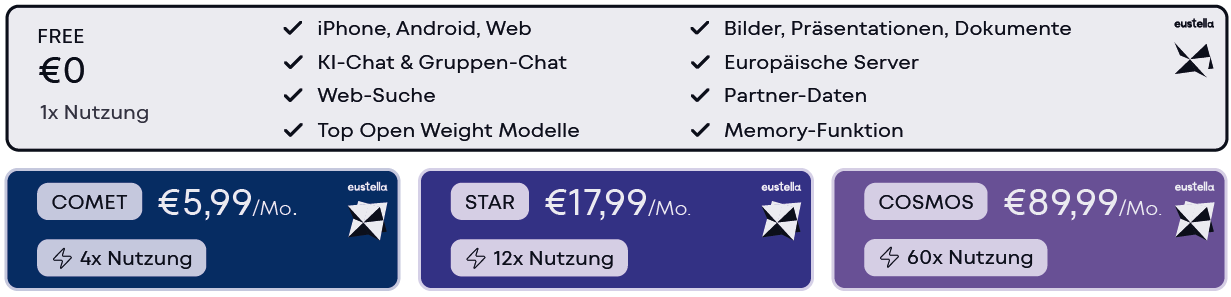
Still, this also raises the question of how usable Eustella is in its lowest-priced paid tier. The original press release described the Comet subscription as offering "4x usage." If that meant four times the free-tier allowance, it would still be rather disappointing. Hopefully, the actual limits are considerably more generous.
The developers appear to have revised that wording in the meantime. Comet is now presented as the baseline with "1x usage," while the more expensive subscription tiers are described as providing proportionally higher usage limits, as shown in the screenshot above.
 Add as a preferred source on Google


