



AMD's Jack Huynh claims GPU frequency world record with a 4.837 GHz Radeon RX 9060 XT
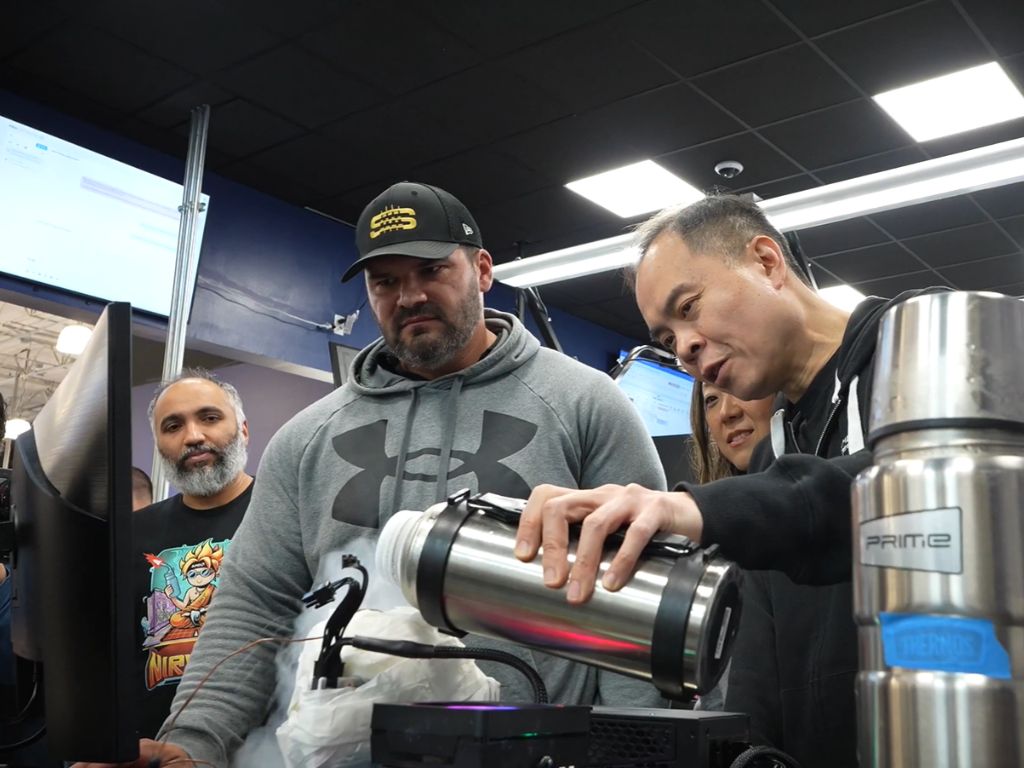
Jack Huynh, AMD's senior vice president and general manager of its Computing and Graphics Group, has claimed a new GPU frequency world record after pushing a Radeon RX 9060 XT to 4,837 MHz with liquid nitrogen. Working alongside AMD overclocker Bill "Sampson" Alverson, Huynh made the run on November 15 at Micro Center's new store in Austin, Texas, two days after its grand opening. The result beats the previous record of 4,789 MHz, which Alverson set with South Korean overclocker SoonHo in June, by 48 MHz.
An overclocking session at Micro Center's new Austin store
Huynh shared the result nine days later, taking to X on November 24 to celebrate:
"A NEW @microcenter in Austin. An INCREDIBLE community. And a GPU WORLD RECORD.
I had an absolute blast celebrating with Austin's gamers, PC builders, and creators. From meeting fans and snapping photos to building PCs and sharing our passion for all things tech.
And then came an even BIGGER moment… I joined forces with Bill Alverson and our @AMD overclocking team. Armed with liquid nitrogen and pushing frequencies to the absolute limit, we set our sights on something BIG: breaking the GPU FREQUENCY WORLD RECORD! And we did it! 4.837 GHz!"
AMD lists the RX 9060 XT's boost clock at up to 3,130 MHz, so the 4,837 MHz reading sits about 54.5% above the official specification. To get there, the team replaced the card's stock cooler with a pot mounted directly on the GPU die and kept it filled with liquid nitrogen.
What the GPU-Z screenshot shows
A GPU-Z capture published with the record's entry in SkatterBencher's OC World Record Museum shows the core running at 1.434 V, with both the GPU and hotspot sensors reading −49°C. The June 4,789 MHz capture shows an identical reading, which suggests a sensor floor rather than the true die temperature under liquid nitrogen. The screenshot also shows 0% GPU load and a board power draw of just 62 W, so the record is a peak clock reading taken without a rendering workload, not a benchmark result.
How the RX 9060 XT climbed the record table
Before AMD's mid-range card entered the picture, the discrete GPU record was Splave's 4,020 MHz on a GeForce RTX 4090 from July 2023, while the overall mark was SkatterBencher's own 4,250 MHz on an Intel Arrow Lake integrated GPU from May 2025. AMD's February video with Splave and Alverson claimed 4,769 MHz, but the museum logs that session at 4,043 MHz, the figure on the GPU-Z readout visible in the footage. By the museum's count, the RX 9060 XT only took the overall record on June 2, when Alverson reached 4,643 MHz, before he and SoonHo pushed it to 4,789 MHz a day later.
The record still awaits verification
Huynh says the team captured the whole attempt on camera, including the moment the record fell. Even so, the museum lists the result as unverified, as it does every RX 9060 XT entry so far, and the new entry does not yet cite a source. HWBOT, the main database for competitive overclocking, takes the maximum clock from GPU-Z's sensor tab, but its rules also require a running render in the screenshot, which the published capture lacks. Neither Huynh nor the museum has said how long the card sustained 4,837 MHz, a figure that now sits just 163 MHz short of the 5 GHz barrier.
Source(s)
 Add as a preferred source on Google


