




The hidden costs of the AI boom

Anyone who watches the news or reads a newspaper from time to time knows: The current artificial intelligence boom is the cause of many negative developments. A prime example is the sharply rising cost of graphics cards (GPUs) and other specialized IT components, which makes powerful PCs, notebooks, or smartphones almost unaffordable for many home users.
Much more severe, however, is the extreme resource hunger of AI data centers. To meet the electricity demand, IT giants can no longer rely solely on renewable energy: Increasingly, gas power plants are being built right alongside the data centers (examples include Microsoft or Elon Musk's X.ai). If that is still not enough, they secure nuclear power: By building their own reactors (e.g., Amazon) or by signing decades-long contracts with existing nuclear power plants, keeping them online much longer, even though they should have been replaced by other energy sources long ago (this is the approach taken by Meta, the parent company of Facebook and Co., among others).
It goes without saying that these practices have long-term, negative impacts on the environment. But even in the short term, private individuals feel the effects through increased prices for electricity and other energy sources. For example, Google's recent announcement that it intends to build its first data center in Austria, sparked discussions about whether this project would have a direct impact on electricity prices across the entire country. After all, estimates suggest the data center could consume about 5 to 6 percent of Austria's electricity—almost twice as much as the city of Graz.


But enough about the impacts on (environmental) costs; let's move on to a much more mundane downside. While artificial intelligence is considered in certain circles to be almost a democratization of knowledge, such ideas must be viewed with great caution. Of course, an LLM (Large Language Model) gives the user access to the model's entire wealth of knowledge, which today is usually unimaginably vast. On the other hand, one first needs access to the AI itself. This is often simply not available in poorer households, areas, or cultures, as at least an internet connection and a suitable device are prerequisites for interaction.
The fact that not everyone can use AI might not seem particularly serious at first glance, given that we couldn't use it until a few years ago either. At the same time, however, it must be noted that the world has changed in the meantime. Companies and self-employed individuals without AI deployment lose competitiveness due to lower productivity; pupils and students without access to AI tutors and learning aids fall behind their more privileged peers; AI skills are increasingly required in the job market, and so on and so forth. Even on a small scale, the difference between people who can afford access to paid (Pro) versions of LLMs and those who have to rely on free models is already often noticeable today.
Another problem is that those who are not accustomed to using AI have significantly more difficulty recognizing deepfakes and AI-generated content. This exposes them to disinformation and propaganda far more than others. Admittedly, it is also becoming increasingly tricky for experienced individuals, as AI-generated images and videos look better and more realistic all the time.

A final disadvantage, before we get completely depressed, is the fact that artificial intelligence diminishes our problem-solving skills and confirms our biases. Anyone who relies too heavily on the all-knowing conversational partner who has a solution for every problem will sooner or later lose the drive to find a suitable way out themselves. It's not the loss of drive that is the biggest shame, but rather the loss of practice and thus the ability to solve problems. Furthermore, artificial intelligence is not neutral—it was trained on human, biased data. The AI adopts these prejudices and possibly even amplifies them.
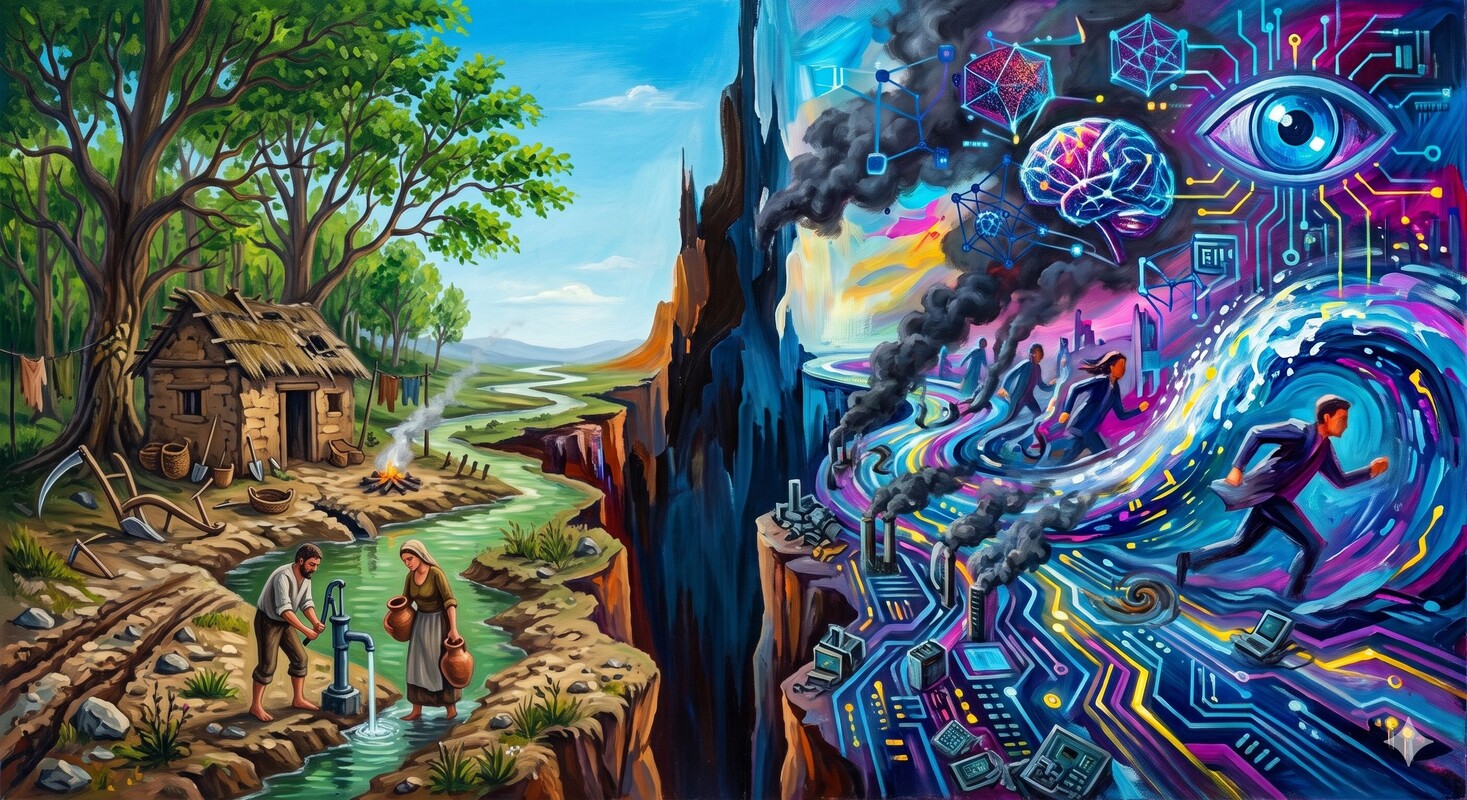
What do we learn from all this? Today, there is no way around artificial intelligence, because anyone who does not ride the AI wave simply cannot keep up in many disciplines anymore. At the same time, for many reasons, it would actually be best to do without AI entirely. As is so often the case in life, it will therefore have to be a middle ground - neither one thing nor the other.
Sources
own research; Google Blog, ORF, Der Standard
 Add as a preferred source on Google


