




Finding the balance: AI and sustainability

The enormous power and water consumption makes artificial intelligence one of the most resource-intensive applications of our time. Also Notebookcheck recently reported on problems of the AI boom. It is only logical, then, that many people vehemently oppose the use of AI. However, you cannot or do not always want to forgo the support of digital assistants, whether due to professional requirements or simply because you have come to appreciate the help.
In this case, the question of a compromise is likely to arise: How can artificial intelligence and sustainability be combined, ideally along with improved data protection?

Many Providers?
As is so often the case, the search starts on the internet. Anyone searching Google for green or sustainable AI will find an abundance of results. The first actually interesting result is the frequently recommended AI search from the sustainable search engine Ecosia. It is absolutely free, runs on 100% renewable energy, and uses particularly efficient, i.e., small, models.
What this means in practice, unfortunately, became apparent quite quickly during testing. While simple queries were answered quite reliably, the model quickly reached its limits with more complex prompts. Especially with somewhat deeper research tasks, the AI no longer reliably delivered the right result or failed to understand the question. It's a pity, as the idea behind Ecosia is highly commendable, but for an AI developed for web search, such behavior is naturally a no-go.
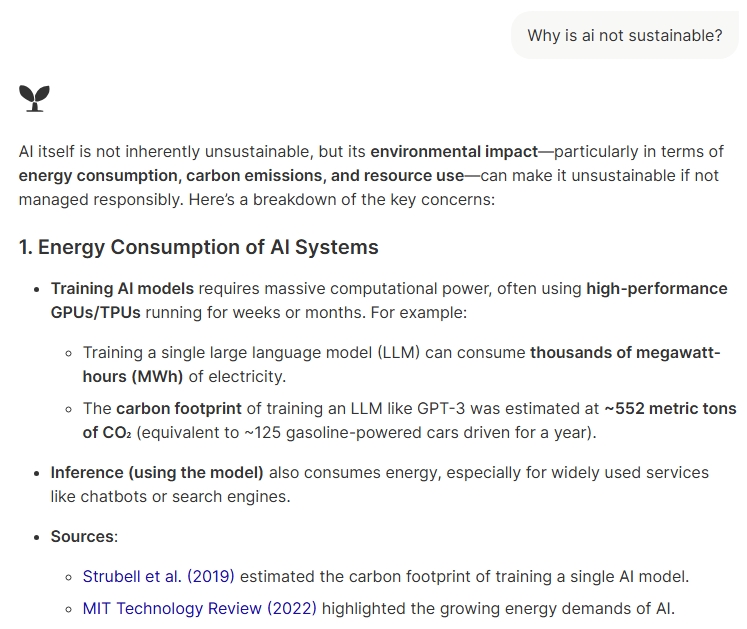
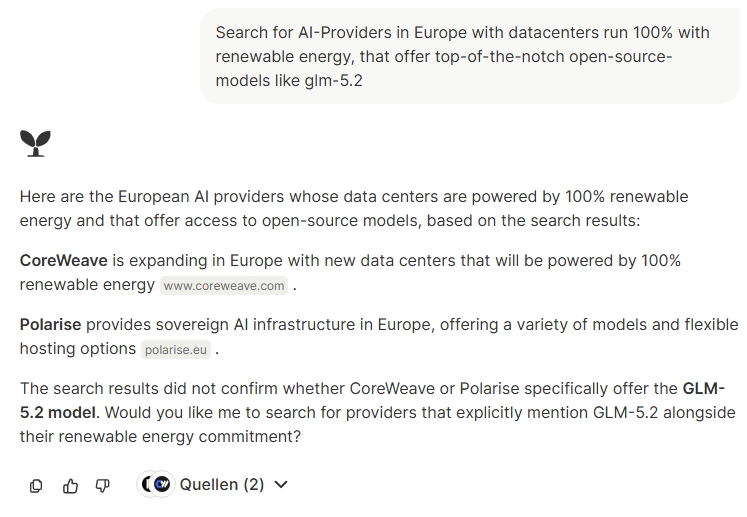
So, onward with our search for potential providers. Reading various blogs, forums, and company websites quickly reveals that there are plenty of providers wanting to jump on the "sustainable" AI bandwagon. As an example, I would like to discuss two "types" of platforms here.
Promises a lot, but explains little
On the one hand, there are those providers, who advertise sustainability, but do not provide much information on how this is to be achieved. Viro, for example, is worth mentioning here. On their website, they state that they support sustainable forms of energy with their revenue. Furthermore, they claim to transparently show how much power was consumed during the chat with the AI. Further down, you read that they have financed around 14,000 kWh of renewable energy so far.
While that is a large number, it is a negligible amount of energy in the context of data centers. In Austria, a country with relatively high electricity prices, the energy cost for 14,000 kWh of green power is roughly 2,000 to 3,000 euros. This is not a major investment for a company that promotes itself as sustainable. Moreover, it is paradoxical that Viro uses the AI models ChatGPT, Gemini, or Claude of all things - those from the not-exactly-sustainable IT giants.
The only positive thing to note is that Viro is generally free of charge. It is financed through advertising, or alternatively offers a subscription for $1.
Truly transparent providers
On the other hand, there are providers who disclose more information about their green promises. GreenPT hosts all its AI models on European infrastructure powered entirely by 100 percent renewable electricity and is fully GDPR-compliant. The data centers are also primarily air-cooled, which significantly reduces water consumption. Additionally, the provider uses open-source models, independent of well-known data hoarders like Google and the like. However, this comes at the cost of a monthly subscription, which sets you back between 4.50 and 17.50 euros per month.
A quick search reveals that GreenPT relies on Scaleway's servers. For users with technical know-how, an even more direct route is available here: Those who do not make enough queries to justify a monthly subscription can use Scaleway's API (Application Programming Interface) directly. Here, you only pay for actual usage. Extremely powerful models like glm-5.2 are also available here, leaving nothing to be desired in terms of intelligence (at least within the realm of what is currently possible). Using a router like Requesty offers similar advantages, provided that servers with a high proportion of green electricity are specifically selected here.
Conclusion
There are many options that promise sustainability. However, how resource-efficient they actually are, varies widely, depending on your personal preferences and willingness to pay.
Source
own research
 Add as a preferred source on Google


