




Monocab: Self-balancing monorail now runs on new tracks as a campus shuttle
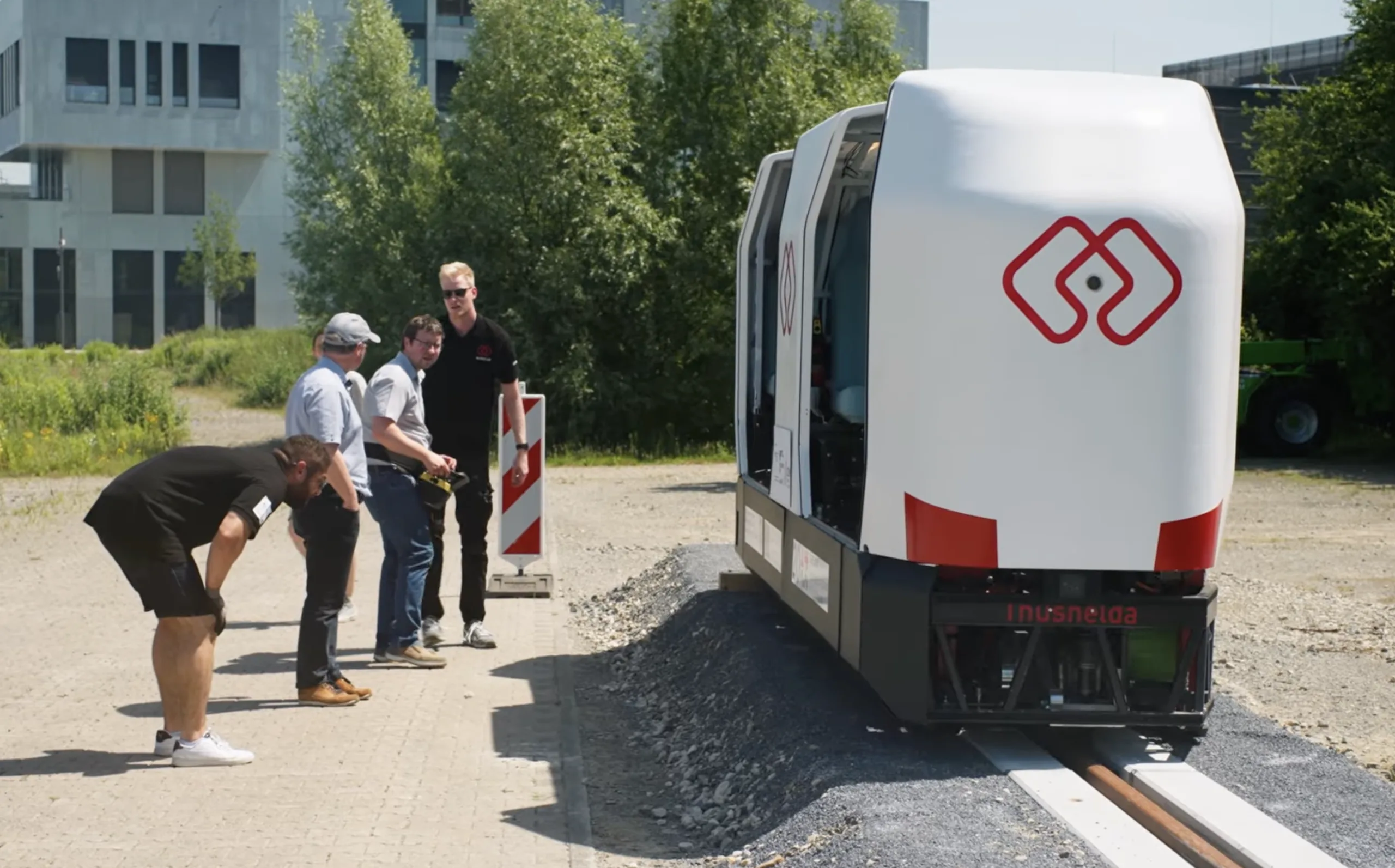
The campus rail system is now operational. The research team behind the Monocab design has opened its first test route, which is only a few meters long. The campus system is a variation of the Monocab concept, which was originally intended to operate on disused rail lines, with one rail used for travel in each direction.
The campus system instead involves building a new track on which the Monocab balances. This allows the infrastructure to be placed more freely while maintaining a small footprint. It also initially avoids the work required to modify existing rail infrastructure so that vehicles can turn around and transfer to the opposite rail for the return journey. That capability has not yet been demonstrated.
The campus route could simply form a loop, or the vehicle could travel back and forth. Switches could later be developed and demonstrated to provide greater operational flexibility. However, a working paper by Jürgen Brunsing of TU Darmstadt identifies switches as a significant challenge.
The campus rail project is intended to explore these issues. Fraunhofer IOSB-INA is also involved in the research and has provided further details. The project has received $5.12 million in funding, and one of its goals by the end of November 2026 is to demonstrate "MonoCab-specific track and rail switching."
According to the project website, the Monocab system has currently reached TRL 5: "Test setup in an operational environment." The current system builds on research conducted between 2021 and 2023 that demonstrated the concept's basic feasibility, although only with a vehicle traveling on one rail without transferring to another. The next step would be TRL 6: "Prototype in an operational environment," for which the campus rail system would likely be suitable. The vehicle, named Thusnelda, is currently operating on a 20-meter track for initial testing at the Innovation Campus Lemgo of the Ostwestfalen-Lippe University of Applied Sciences and Arts (TH OWL). A 300-meter route is scheduled for completion by the end of the year. Construction is expected to begin in the fall, with the route also set to include curves and gradients.
Unclear roadmap
However, the team behind the Monocab system is pursuing several lines of research, and the campus rail system is only one option. Monocab still aims to reach TRL 9 on a disused line in Extertal in 2028, meaning a "qualified system with evidence of successful operation."
It may only reach TRL 8, however, defined as a "qualified system with evidence of operational functionality," since the website also lists that target for 2028. Alternatively, TRL 8 may not be completed until 2029, with work toward TRL 9 beginning in 2030. A Monocab roadmap published in early 2025 lists yet another set of dates. According to that roadmap, Monocab is also expected to operate at the International Garden Exhibition (IGA), which begins in April 2027.
Monocab also plans to present its concept at InnoTrans 2026 in Berlin. It remains to be seen whether the roadmap can be met and whether switches and track changes will have been demonstrated by then. Another open question is whether the vehicles will be shown turning around, as their asymmetrical design means they would normally require a turning loop or turntable for bidirectional operation on disused rail lines. This is due to the clearance required when two vehicles pass within the loading gauge of a conventional railroad. Monocab aims to use as much of that space as possible but can only do so on one side.
Source(s)
 Add as a preferred source on Google


