




Heat wave: Eurostar Celestia trains get "Sahara option"
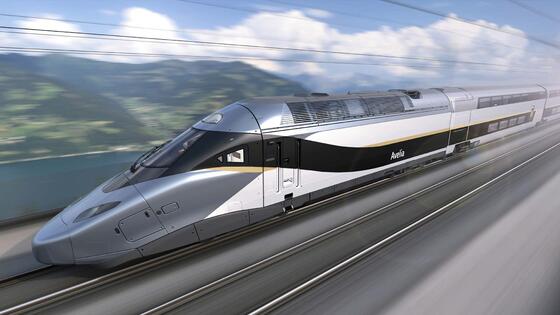
Some Eurostar trains are more than 30 years old and will probably have to remain in service into the 2030s, since rolling stock cannot simply be swapped out at will. New trains have already been ordered, however: the Eurostar Celestia. When they arrive in the early 2030s, they will likely have to last into the 2060s and probably closer to the 2070s. Given increasingly severe heat waves, there is a high risk that the previously planned air conditioning systems rated for up to 45°C will not be enough.
Eurostar has therefore opted for the "Sahara option" before production begins. The Celestia trainsets will receive a significantly more powerful air conditioning system, as The Telegraph reports. Accordingly, the Eurostar Celestia, the Eurostar version of the Alstom Avelia Horizon, was originally designed to ensure that its air conditioning would only need to operate up to 45°C. But the recent heat wave in France prompted the rail company to rethink its plans, even though it primarily operates trains in northern Europe.
Eurostar benefits from the fact that the Avelia Horizon is already being designed for Sahara temperatures anyway. The train is also expected to run in the Kingdom of Morocco soon. ONCF, the Office national des chemins de fer du Maroc, has ordered 18 trainsets. They are intended to support the expansion of the existing high-speed rail network there and, of course, cope with the temperatures typical of the region. On Saturday, July 18, for example, temperatures of 44°C are expected there in the shade.
Eurostar can therefore rely on Alstom's expertise, which the company has to develop anyway for the ONCF version of the Avelia Horizon. Hopefully, that will also be enough for further temperature increases in the coming years.
In recent years, rail companies have had to invest more heavily in better air conditioning systems. This has been particularly noticeable at Deutsche Bahn. In 2010, Süddeutsche Zeitung reported, for example, that ICE air conditioning systems only worked in the range of 32 to 35°C. At the time, there were frequent failures in such weather conditions. However, even then, there were suspicions that Deutsche Bahn had cut costs on maintenance.
The temperature range has also been expanded, however. The ICE 4, for example, is specified for temperatures of up to 45°C.
Source(s)
Eurostar
 Add as a preferred source on Google


