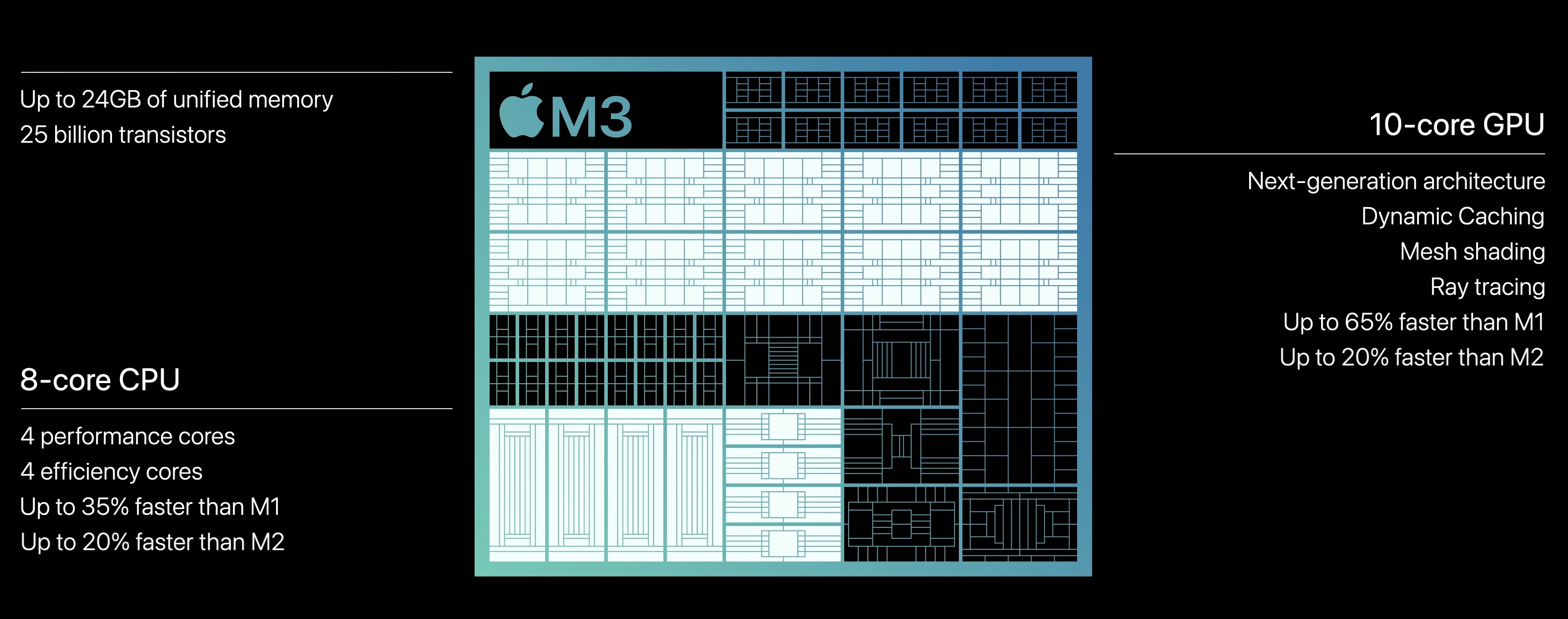
The Apple M3 is a system on a chip (SoC) from Apple for notebooks that was introduced in late 2023. It integrates a new 8-core CPU with 4 performance cores with up to 4.06 GHz and 4 efficiency cores running at up to 2.75 GHz. Apple claims that the CPU is up to 20% faster than in the old Apple M2 (3.5 GHz).
Due to the higher clock speeds and architecture improvements, the processor performance is also significantly better than the M2 in benchmarks (see e.g. Geekbench below) and can keep up with the fastest CPUs in short single-core tests (like the Raptor Lake i9-13950HX).
The M3 also integrates a new graphics adapter with dynamic caching, mesh shading and ray tracing acceleration called Apple M3 10-Core GPU. According to Apple, it is 20% faster than the GPU in the M2. The chip integrates again 10 GPU cores, but the cheaper variant only offers 8 cores (e.g. in the entry iMac). Later in early 2025 Apple also introduced a 9-core variant in the new iPad Air models. Furthermore, the GPU only supports 2 displays (an additional 6K60 display to the internal one).
Both GPU and CPU can access the unified memory on the package together. It is still available in 8, 16 and 24 GB variants and offers the same 100 GB/s maximum bandwidth (unlike the Pro models that feature a reduced memory bandwidth).
The integrated 16-core Neural Engine has also been revised and now offers 18 TOPS peak performance (versus 15.8 TOPS in the M2 but 35 TOPS in the new A17 Pro). The video engine now supports AV1 decoding in hardware. H.264, HEVC and ProRes (RAW) can still be decoded and encoded.
Unfortunately, the integrated wireless network module only supports Wi-Fi 6E (no Wi-Fi 7) and due to the support of only a single external monitor, the chip also has to make do with no Thunderbolt 4 (Thunderbolt 3 / USB 4 support only for up to 40 Gbit/s).
The chip is manufactured on the current 3nm TSMC process (N3B most likely) and contains 25 billion transistors (+25% vs. Apple M2). The 3nm process should also contribute to the excellent efficiency of the chip. Under load, the M3 CPU consumes approximately 20 Watt.
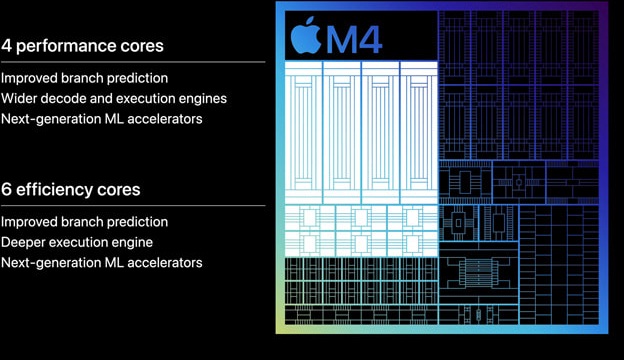
The 10-core Apple M4 is an impressively fast ARM architecture processor (SoC) sporting 4 performance and 6 efficient CPU cores along with a 16-core neural engine and a 10-core GPU with hardware RT support and other modern features. On-package 7500 MT/s LPDDR5x RAM, USB 4 support and Thunderbolt 4 support are onboard as well, as are Wi-Fi 6E and Bluetooth 5.3.
The M4 debuted in May 2024 as part of an iPad launch event; its 4 performance cores run at up to 4.4 GHz, representing a healthy improvement over the M3 (10-core GPU) and its 4.06 GHz top clock speed. Besides, this new chip also has 6 efficient cores at its disposal that run at up to 2.9 GHz. The M3 had to make do with 4 performance cores and 4 efficient cores, for reference.
Architecture and Features
The new CPU cores run at faster clock speeds than what the M3 was capable of while also featuring some minor architectural improvements. A heavily customized version of ARM's v9.4-A microarchitecture is reportedly employed here. The M4 comes with on-package LPDDR5x-7500 RAM (120 GB/s) whereas the M3 was limited to 6400 MT/s. The updated NPU delivers up to 38 TOPS of performance for AI workloads.
Performance
In 2024 iPad Pros, the 3 nm chip is 10% to 20% faster than the M3 (10 GPU cores) in both multi-thread and single-thread short-term workloads. It also delivers about 10% higher multi-thread performance than the 9-core M4. This puts the 10-core part on an equal footing with the Ryzen 7 7745HX, Core i7-13705H and other higher-end x86 processors released in 2023 and 2024.
iPad Pros come with no active cooling solution however Mac minis and MacBook Pros do have one and the latest iMacs probably do as well. As our Fall 2024 Mac mini review shows, the M4's short-term performance doesn't benefit much from the presence of a fan, however its sustained performance benefits tremendously.
Graphics
The M4 GPU (10 cores) has hardware support for ray tracing as well as mesh shading and other modern technologies. It supports external displays with resolutions as high as 8K.
The graphics adapter runs at higher clock speeds than what the (otherwise identical) 10-core GPU built into the 9-core M4 can muster. As our Mac mini 2024 review confirmed, its performance is good enough to run many 2023 and 2024 games at 1080p on low or medium quality settings.
Much like it is with CPU performance, M4-powered iPad Pros will be much slower in long-term GPU-intensive workloads than iMacs, Mac minis and MacBook Pros due to the lack of proper cooling.
Power consumption
This specific M4 chip is found in 2024 iPad Pros, 2024 iMacs, 2024 Mac minis and 2024 MacBook Pros. Within the thin metal cases of the iPads - no active cooling - the chip's sustained power consumption hovers in the 4 W - 5 W area, with short-term peaks of up to 14 W possible. However, Mac minis and MacBook Pros do have an active cooling solution (and the new iMacs probably do, too) meaning the power consumption figures are several times higher. In our Fall 2024 Mac mini review, the SoC consumed 30 W to 40 W when under high loads.
The M4 is built with a "second generation" 3 nm TSMC process which is still cutting-edge as of late 2024.
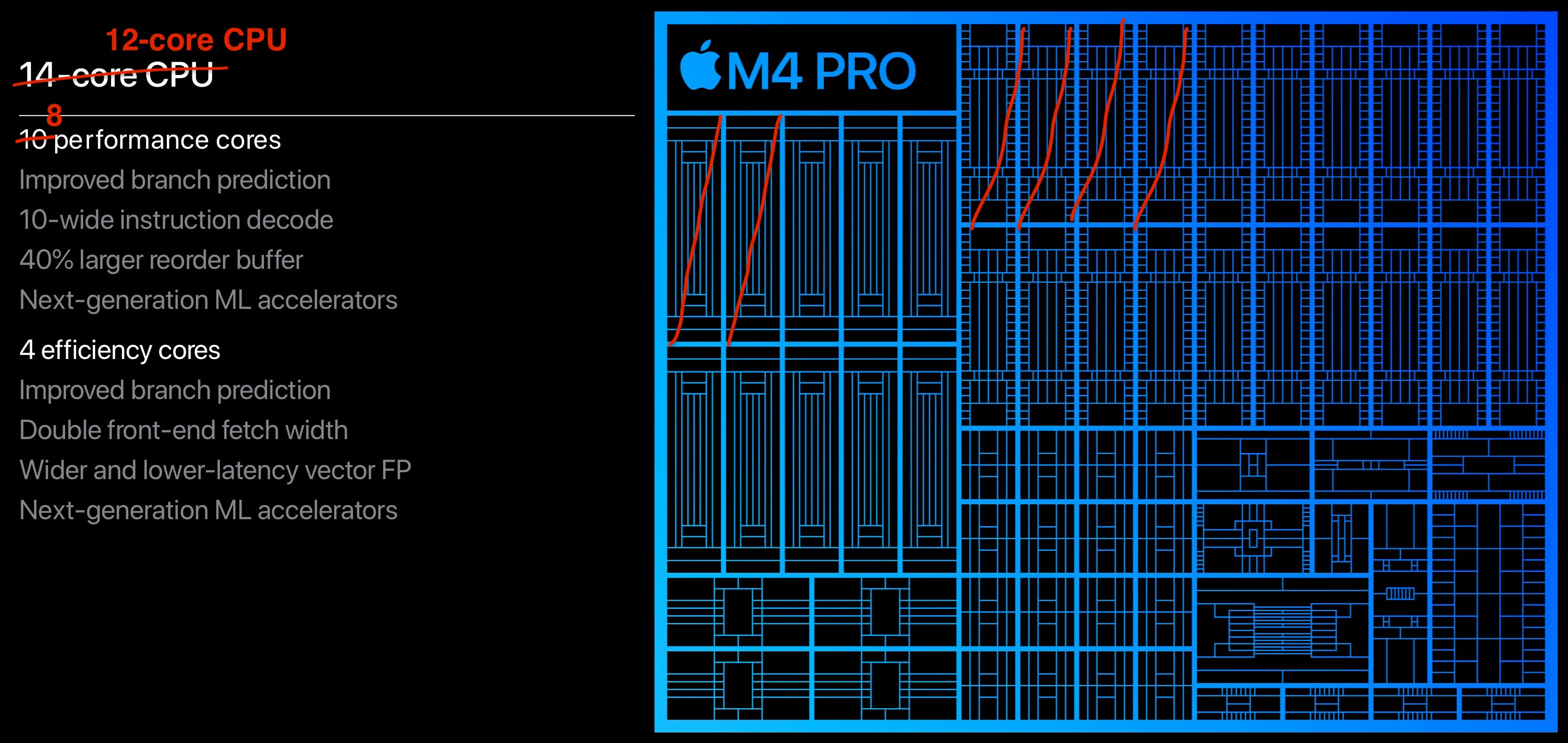
The Apple M4 Pro 12-Core CPU is a high-end SoC for laptops and mini PCs that was introduced in September 2024. It has 8 of the 10 powerful CPU cores running at up to 4.5 GHz and 4 efficient cores running at up to 2.6 GHz. The integrated 16-core GPU and at least 24 GB of fast LPDDR5x memory at 273 GB/s (depending on configuration) are included, as well as USB 4 and Thunderbolt 5 support.
The integrated neural engine with 16 cores (up to 38 TOPS) can be found in the entire M4 chip family. In addition, all M4 processors are assumed to be based on the ARM v9.4-A architecture to some degree.
The CPU performance when using all cores is similar to a AMD Ryzen AI 9 HX 370 (Cinebench R23 slightly faster on average). The modern Core Ultra 9 288V can be clearly outperformed. In terms of single-core performance, the M4 Pro scores very well and is on a par with the fastest Intel chips, such as the Core i9-14900HX. Interestingly enough, the M4 and the faster M4 Pro variant with 14 cores were 4-5% faster than the slimmed-down entry-level M4 Pro in Cinebench (Geekbench at the same level).
The power consumption during Cinebench 2024 Multi is around 40 Watt at the beginning (according to powermetrics) and then goes down to around 32 Watt (sustained). Combined with the GPU (Cinebench + Valley) the SoC can hit 47,5 Watt peak at the beginning, but then reduces its power draw to 31 Watt combined (22 W CPU + 9 W GPU).
The 3 nm TSMC process of the 2nd generation, with which the M4 Pro is manufactured, offers good energy efficiency.
Average Benchmarks Apple M4 Pro (12 cores) → 148%n=16
- Range of benchmark values for this graphics card - Average benchmark values for this graphics card * Smaller numbers mean a higher performance 1 This benchmark is not used for the average calculation
v1.35
log 04. 00:32:32
#0 ran 0s before starting gpusingle class +0s ... 0s
#1 checking url part for id 15110 +0s ... 0s
#2 checking url part for id 17538 +0s ... 0s
#3 checking url part for id 18557 +0s ... 0s
#4 redirected to Ajax server, took 1764804752s time from redirect:0 +0s ... 0s
#5 did not recreate cache, as it is less than 5 days old! Created at Tue, 02 Dec 2025 08:12:07 +0100 +0s ... 0s
#6 composed specs +0.01s ... 0.01s
#7 did output specs +0s ... 0.01s
#8 getting avg benchmarks for device 15110 +0.001s ... 0.011s
#9 got single benchmarks 15110 +0.007s ... 0.018s
#10 getting avg benchmarks for device 17538 +0.001s ... 0.018s
#11 got single benchmarks 17538 +0.006s ... 0.024s
#12 getting avg benchmarks for device 18557 +0.001s ... 0.025s
#13 got single benchmarks 18557 +0.004s ... 0.029s
#14 got avg benchmarks for devices +0s ... 0.029s
#15 min, max, avg, median took s +0.027s ... 0.056s






 - Average benchmark values for this graphics card


