




Apple M1 Max vs Apple M4 Pro (14 cores) vs Apple M1
Apple M1 Max
► remove from comparison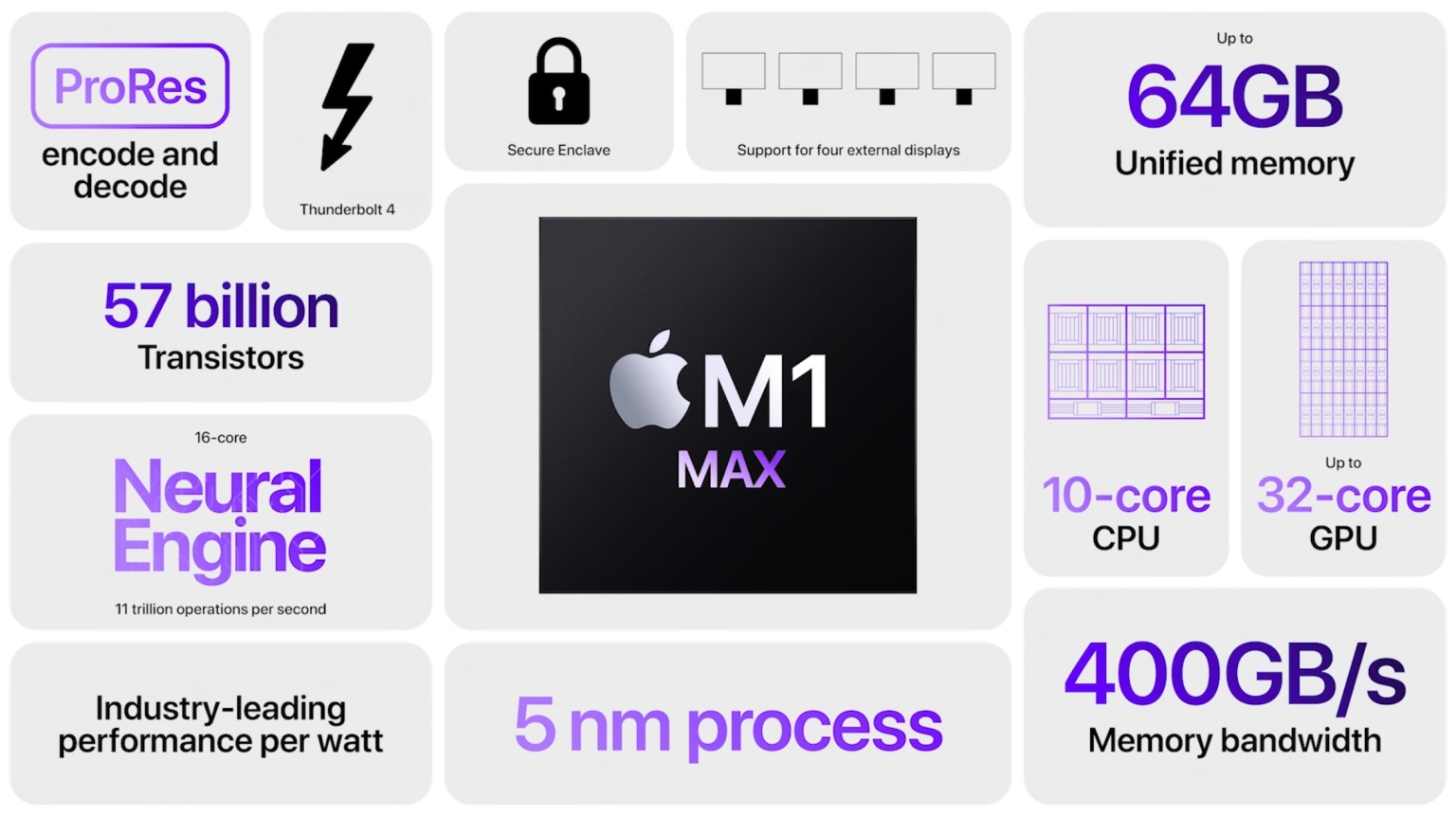
The Apple M1 Max is a System on a Chip (SoC) from Apple that is found in the late 2021 MacBook Pro 14 and 16-inch models. It offers all 10 cores available in the chip divided in eight performance cores (P-cores with 600 - 3220 MHz) and two power-efficiency cores (E-cores with 600 - 2064 MHz). There is no Turbo Boost for single cores or short burst periods. The cores are similar to the cores in the Apple M1.
The big cores (codename Firestorm) offer 192 KB instruction cache, 128 KB data cache, and 24 MB shared L2 cache (up from 12 MB in the M1). The four efficiency cores (codename Icestorm) are a lot smaller and offer only 128 KB instruction cache, 64 KB data cache, and 4 MB shared cache. CPU and GPU can both use the 48 MB SLC (System Level Cache). The efficiency cores (E cluster) clock with 600 - 2064 MHz, the performance cores (P cluster) with 600 - 3228 MHz.
The unified memory (32 or 64 GB LPDDR5-6400) next to the chip is connected by a 512 bit memory controller (200 GB/s bandwidth) and can be used by the GPU and CPU. This is the main difference to the M1 Pro and the CPU performance is quite similar.
The biggest difference to the M1 Pro is the bigger integrated GPU with 24 or 32 cores (up from 16).
Furthermore, the SoC integrates a fast 16 core neural engine, a secure enclave (e.g., for encryption), a unified memory architecture, Thunderbolt 4 controller, an ISP, and media de- and encoders (including two ProRes engines).
The M1 Pro is manufactured in 5 nm at TSMC and integrates 57 billion transistors. The peak power consumption of the chip was advertised around 30W for CPU intensive tasks.
Apple M4 Pro (14 cores)
► remove from comparison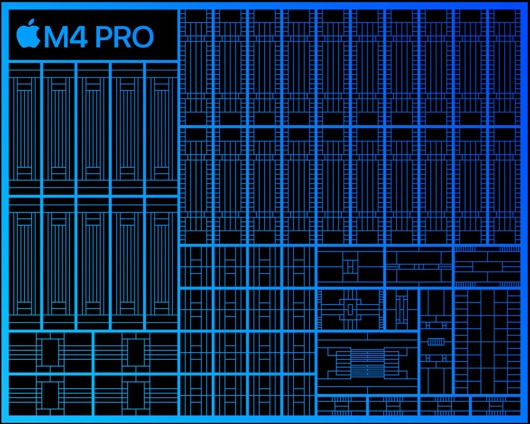
The 14-core Apple M4 Pro is a powerful ARM architecture processor (SoC) for laptops and mini-PCs that debuted in Sep 2024. It features 10 performance CPU cores running at up to 4.5 GHz along with 4 efficient cores running at up to 2.6 GHz. The 20-core M4 GPU and at least 24 GB of fast 273 GB/s LPDDR5x on-package memory depending on the configuration are included as well, as is USB 4 and Thunderbolt 5 support.
The built-in 16 core neural engine (up to 38 TOPS) is found across the whole M4 chip family. Furthermore, all M4 processors are thought to be based on the ARM v9.4-A architecture to a certain degree.
Performance
In our testing, the M4 Pro delivered multi-thread benchmark scores very close to those of the 16-core M3 Max as well as the Intel Core i9-12950HX. Some small generation-to-generation improvement is obviously present but it's the new integrated graphics adapters that are the real stars of the show.
Graphics
The 20-core M4 GPU has hardware support for ray tracing as well as mesh shading and other modern technologies. It supports external displays with resolutions as high as "8K" and it can HW-decode a few popular video codecs such as h.264, h.265 and AV1.
Its gaming performance is at least as good as that of the GTX 1660 Ti Laptop. Please keep in mind that very few games have been compiled specifically for Apple silicon Macs meaning most titles have to be run via emulation layers. Some of them are displayed with visual artefacts as a result, or don't start at all.
- The Witcher 3 1080p Ultra = 53 fps (close to the GTX 1660 Ti Laptop)
- Baldur's Gate 3 1440p Ultra = 42 fps (close to the GeForce RTX 4050 Laptop)
- Cyberpunk 2077 2.1 Phantom Liberty 1080p Ultra = 40 fps (close to the GTX 1660 Ti Laptop)
Power consumption
When under heavy CPU and GPU load, the SoC briefly consumes around 80 W before settling at around 70 W later. With no load at all, it makes do with 2 W to 7 W. A single P-core of the chip eats around 6 W when under heavy load.
The 2nd generation 3 nm TSMC process the M4 Pro is built with delivers good power efficiency, as of late 2024.
Apple M1
► remove from comparison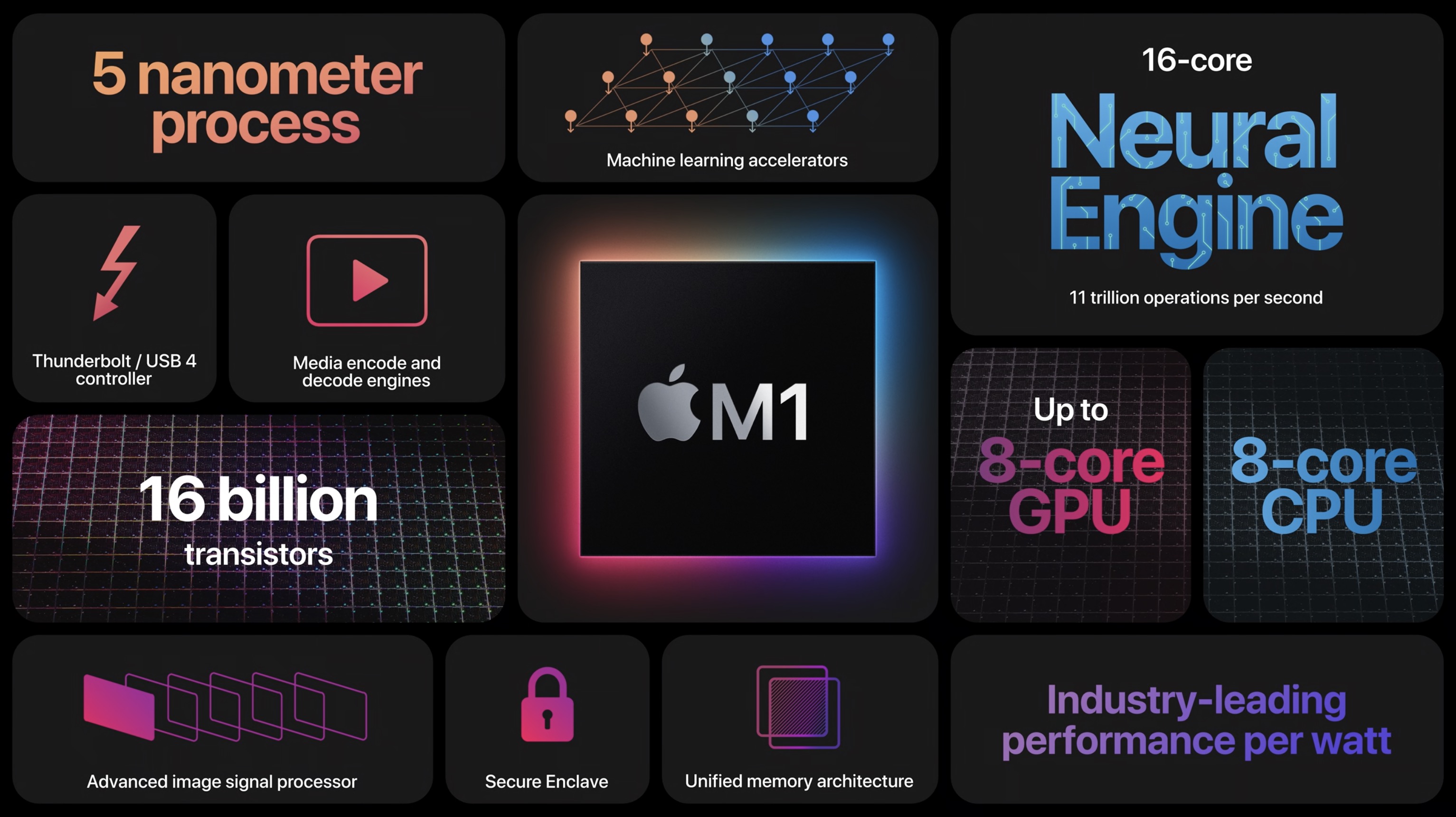
The Apple M1 is a System on a Chip (SoC) from Apple that is found in the late 2020 MacBook Air, MacBook Pro 13, and Mac Mini. It offers 8 cores divided in four performance cores and four power-efficiency cores. The big cores offer 192 KB instruction cache, 128 KB data cache, and 12 MB shared L2 cache. According to Apple the performance of these cores should be better than anything on the market (in late 2020). The four efficiency cores are a lot smaller and offer only 128 KB instruction cache, 64 KB data cache, and 4 MB shared cache. The efficiency cores (E cluster) clock with 600 - 2064 MHz, the performance cores (P cluster) with 600 - 3204 MHz.
The M1 is available in two TDP variants, a passive cooled 10 Watt variant for the MacBook Air and an active cooled faster variant for the MacBook Pro 13 and Mac Mini. Those should offer a better-sustained performance according to Apple.
The integrated graphics card in the M1 offers 8 cores (7 cores in the entry MacBook Air) and a peak performance of 2.6 teraflops. Apple claims that it is faster than any other iGPU at the time of announcement.
Furthermore, the SoC integrates a fast 16 core neural engine with a peak performance of 11 TOPS (for AI hardware acceleration), a secure enclave (e.g., for encryption), a unified memory architecture, Thunderbolt / USB 4 controller, an ISP, and media de- and encoders.
The Apple M1 includes 16 billion transistors (up from the 10 billion of the A12Z Bionic and therefore double the amount of a Tiger Lake-U chip like the i7-1185G7) and is manufactured in 5nm at TSMC.
| Model | Apple M1 Max | Apple M4 Pro (14 cores) | Apple M1 | ||||||||||||||||||||||||||||||||||||||||||||||||||||||||||||
| Series | Apple M1 | Apple M4 | Apple M1 | ||||||||||||||||||||||||||||||||||||||||||||||||||||||||||||
| Series: M1 |
|
|
| ||||||||||||||||||||||||||||||||||||||||||||||||||||||||||||
| Clock | 2060 - 3220 MHz | 2592 - 4512 MHz | 2064 - 3220 MHz | ||||||||||||||||||||||||||||||||||||||||||||||||||||||||||||
| L1 Cache | 2.9 MB | 2 MB | |||||||||||||||||||||||||||||||||||||||||||||||||||||||||||||
| L2 Cache | 28 MB | 4 MB | 16 MB | ||||||||||||||||||||||||||||||||||||||||||||||||||||||||||||
| L3 Cache | 48 MB | 8 MB | |||||||||||||||||||||||||||||||||||||||||||||||||||||||||||||
| Cores / Threads | 10 / 10 | 14 / 14 10 x 4.5 GHz Apple M4 P-Core 4 x 2.6 GHz Apple M4 E-Core | 8 / 8 | ||||||||||||||||||||||||||||||||||||||||||||||||||||||||||||
| Transistors | 57000 Million | 16000 Million | |||||||||||||||||||||||||||||||||||||||||||||||||||||||||||||
| Technology | 5 nm | 3 nm | 5 nm | ||||||||||||||||||||||||||||||||||||||||||||||||||||||||||||
| Features | ARMv8 Instruction Set | Unified Memory LPDDR5X-8533 (273 GB/s), 16-Core Neural Engine, Media Engine (Encoding / Decoding: H.264, HEVC, ProRes, ProRes RAW, AV1 Decoding only) | ARMv8 Instruction Set | ||||||||||||||||||||||||||||||||||||||||||||||||||||||||||||
| iGPU | Apple M1 Max 32-Core GPU | Apple M4 Pro 20-Core GPU | Apple M1 8-Core GPU | ||||||||||||||||||||||||||||||||||||||||||||||||||||||||||||
| Chip AI | 11 TOPS INT8 | 11 TOPS INT8 | |||||||||||||||||||||||||||||||||||||||||||||||||||||||||||||
| Architecture | ARM | ARM | ARM | ||||||||||||||||||||||||||||||||||||||||||||||||||||||||||||
| Announced | |||||||||||||||||||||||||||||||||||||||||||||||||||||||||||||||
| TDP | 40 Watt | ||||||||||||||||||||||||||||||||||||||||||||||||||||||||||||||
| TDP Turbo PL2 | 46 Watt | ||||||||||||||||||||||||||||||||||||||||||||||||||||||||||||||
| NPU / AI | 38 TOPS INT8 | ||||||||||||||||||||||||||||||||||||||||||||||||||||||||||||||
| Manufacturer | www.apple.com |
Benchmarks

Average Benchmarks Apple M1 Max → 100% n=9
Average Benchmarks Apple M4 Pro (14 cores) → 166% n=9
Average Benchmarks Apple M1 → 82% n=9
 - Average benchmark values for this graphics card
* Smaller numbers mean a higher performance
1 This benchmark is not used for the average calculation

- Magnetischer Blickschutzfilter für Apple MacBook Pro 16 Zoll (2021-2024, M4, M3, M2, M1 Pro/Max), Sichtschutzfilte Abnehmbar Anti Glare Blaulicht Laptop Blickschutzfolie Mac Privacy Sichtschutz
- ARVOK Laptoptasche Schutzhülle für Neu 16-Zoll MacBook Pro M4 / M3 / M2 / M1 Pro/Max (2024-2019), Wasserdicht Laptophülle Notebook Hülle Tasche Laptop Sleeve Case für HP, Dell, Lenovo, Asus, Acer
- tomtoc Slim Laptop Tasche Hülle für Neu 14-Zoll MacBook Pro M5/M4/M3/M2/M1 Pro/Max A3434 A3112 A3401 A3185 A2992 A2918 A2779 A2442 2025-2021, Wasserabweisend Laptoptasche Passt 13,8" Surface Laptop 7
- UGREEN Nexode USB C Ladegerät 65W GaN Netzteil 3-Port PD Charger 60W PPS kompatibel mit MacBook Pro/Air, iPhone 17 Pro Max/16/15, iPads, Galaxy S24 Ultra/S23/S22(Schwarz)
- BlueSwan Hülle kompatibel für MacBook Pro 14 Zoll 2026 M5 M4 M3 M2 M1 A3434 A3112 A3185 A3401 A2992 A2918 A2779 A2442 Pro/Max 2025-2021, Fallfeste TPU-Rahmen+Matte Anti-Fingerprint Schutzhülle,Schwarz


 Add as a preferred