




Exclusive: Snapdragon 4 Gen 6 data sheet reveals a new Adreno GPU and TSMC 4 nm process
A confidential Qualcomm data sheet obtained by NotebookCheck details the SM4875, codenamed Poros, an unreleased Snapdragon chip that appears to succeed the Snapdragon 4 Gen 5 (SM4850, codenamed Aldabra) launched earlier this year. The document is dated March 2026 and carries Qualcomm's internal trade secret markings.
CPU and GPU
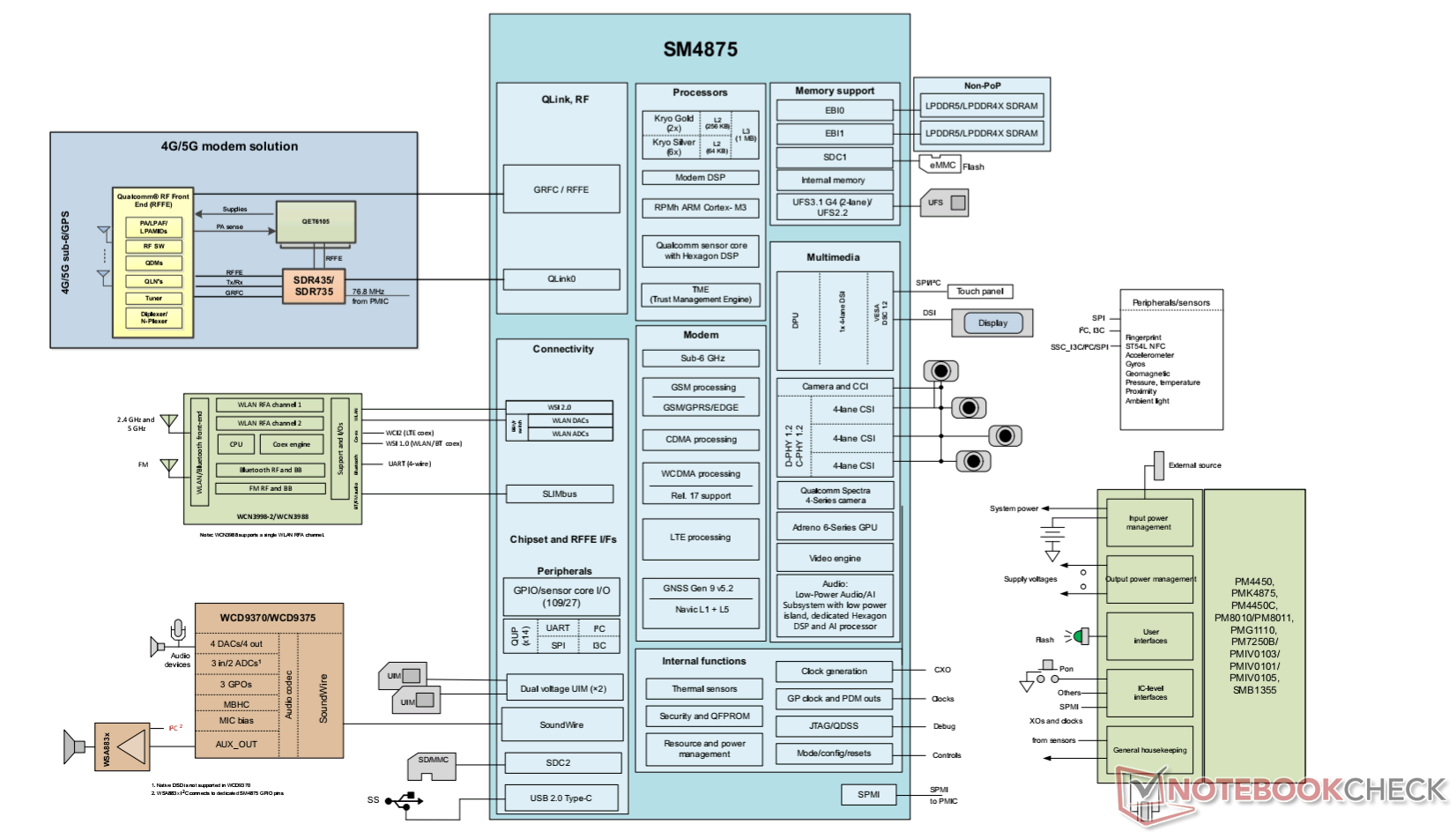
The SM4875 keeps the same Kryo CPU configuration as its predecessor: two Kryo Gold (Cortex-A78-based) performance cores with 256 KB of L2 apiece, plus six Kryo Silver (Cortex-A55-based) efficiency cores with 64 KB of L2 each, all sharing a 1 MB L3 cache. Like the Snapdragon 4 Gen 5, it's built on TSMC's 4 nm process. Everything around the CPU gets an upgrade, though. The GPU moves from the Adreno 4-series to the Adreno 6-series, which promises another leap in performance over the 4 Gen 5's already impressive 77% generation-over-generation gain. Memory support expands from LPDDR4X-only to dual-channel LPDDR5 at 3,200 MHz, with LPDDR4X retained as a lower-cost option for OEMs.
Connectivity
Connectivity is OEM-configurable rather than fixed. The SM4875 data sheet lists four WLAN companion chip options spanning two generations: the WCN3998-2 (Wi-Fi 5, 2×2 MU-MIMO, Bluetooth 5.2) and WCN3988 (Wi-Fi 5, 1×1, Bluetooth 5.1) connect over SLIMbus, the same interface used by the SM4850. The newer WCN6750 (Wi-Fi 6, 2×2, Bluetooth 5.2) and WCN6450 (Wi-Fi 6, 1×1, Bluetooth 6.0) instead connect over a new single-lane PCIe Gen 3 interface, which appears to exist specifically to support these two modules rather than storage or general expansion. Bluetooth 6.0 is available only via the WCN6450 path, rather than as a chip-wide upgrade. None of the four options support Wi-Fi 7, so despite the added PCIe lane, the SM4875 doesn't fully close the gap with the Snapdragon 6 Gen 5, which does support Wi-Fi 7. Still, it's a massive upgrade over the Snapdragon 4 Gen 5's Wi-Fi 5-only support.
Security and package size
Security hardware also gets a refresh, with hardware-based ECC image authentication, Widevine L1 support, and an updated Trust Management Engine for root-of-trust duties. The chip ships in a larger PSP917 package (11.1 × 12.0 mm) compared with the SM4850's PSP808, reflecting the added I/O for PCIe and the higher GPIO count.
Launch window
Qualcomm has not announced the SM4875 publicly, and its pricing and launch window remain unknown, though we can expect the chip sometime next year. As with any leak sourced from a pre-release engineering document, the final retail silicon could see changes to its features or specifications before launch.
Source(s)
Own
 Add as a preferred source on Google


