




Downgrades or upgrades: New Snapdragon 6 Gen 5 and 4 Gen 5 trade LPDDR5, USB 3.1 for Wi-Fi 7, 4K video, 77% GPU boost
Qualcomm has officially expanded its mid-range and entry-level portfolios with the debut of the Snapdragon 6 Gen 5 (replacing the 6 Gen 4) and Snapdragon 4 Gen 5 (replacing the 4 Gen 2) - two chips we’ll start seeing in budget Android phones very soon.
Both chipsets are built on TSMC’s (relatively) efficient 4nm process, promising better thermals and battery life than their predecessors. While the "Gen 5" name suggests an upgrade, a closer look at the spec sheet reveals a surprising strategy of "give and take," where raw performance gains are balanced by the removal of certain premium features found in the Gen 4 series.
Snapdragon 6 Gen 5: Less lag for budget Android phones; big connectivity cuts compared to 6 Gen 4
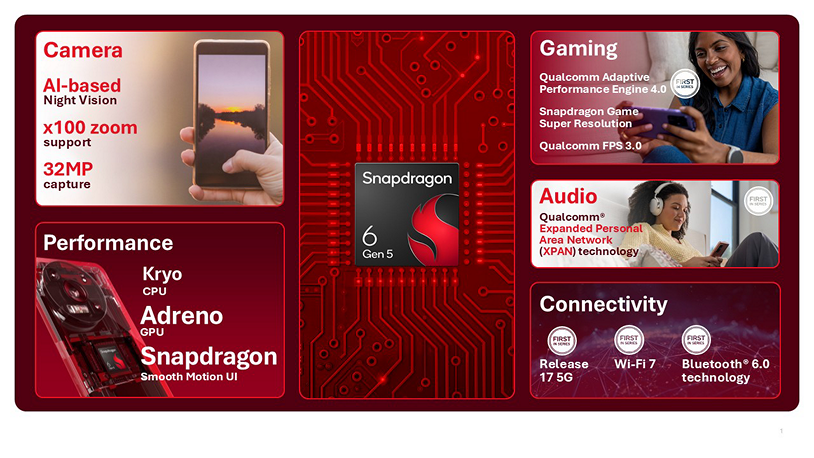
The Snapdragon 6 Gen 5 is positioned as the new performance leader for the 6-series. Thanks to its "Snapdragon Smooth Motion UI," Qualcomm claims a 20% boost in app launch speeds and an 18% reduction in stutter compared to the Snapdragon 6 Gen 4. For gamers and power users, the chip retains support for LPDDR5 RAM (3,200MHz effective clock speed) and UFS 3.1 storage.
Now, to the controversial bit… The Snapdragon 6 Gen 5 is the first chip in the budget class to support Wi-Fi 7 and Bluetooth 6.0. However, Qualcomm has removed mmWave 5G support and the L2 GPS band. Furthermore, the USB interface has been downgraded to USB 2.0, a significant step back from the USB 3.2 Gen 1 capabilities of its predecessor. Ouch!
Snapdragon 4 Gen 5: Massive GPU gains and game-changing upgrade to 4K video; slower RAM
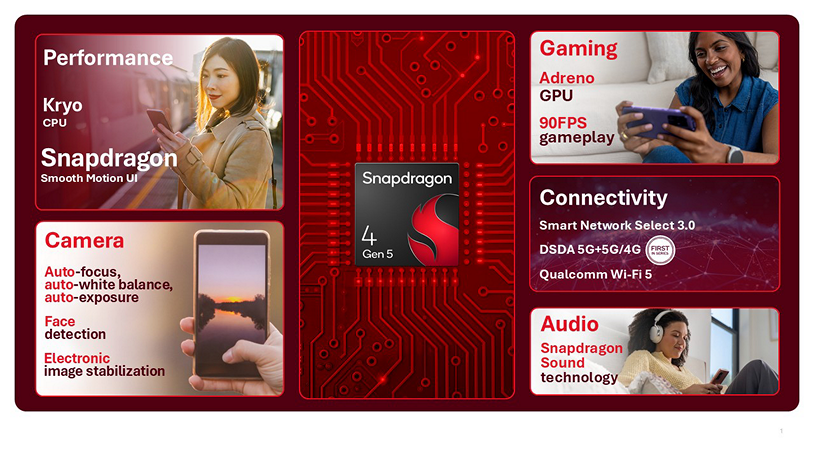
The Snapdragon 4 Gen 5 steals the spotlight in terms of raw improvement. Its Adreno GPU sees a massive 77% performance leap, claims Qualcomm, making it the first 4-series chip capable of 90fps gaming. Camera/video enthusiasts will also appreciate the (huge) upgrade to 4K UHD video recording (from 1080p on the Snapdragon 4 Gen 2).
However, here comes the "but". The trade-off here is found in the memory speeds. While the Snapdragon 4 Gen supported LPDDR5, the new Gen 5 is restricted to LPDDR4X (2,133MHz effective speed). On the bright side, it introduces Dual SIM Dual Active (DSDA) 5G support, allowing for simultaneous high-speed connections on two networks.
The upgrade-downgrade balance: Why is Qualcomm downgrading budget SoC specs; does it matter?
Why the downgrades? Well, Qualcomm appears to (attempt to) strike a balance between "premium" flagship features and cost-effectiveness.
By cutting less-used hardware (like mmWave and high-speed USB controllers) to prioritize massive GPU gains, AI camera enhancements, and modern connectivity standards like Wi-Fi 7, perhaps budget phones can become more appealing to the masses. But that’s just an educated guess.
Either way, the first budget Android phones featuring these chips from brands like Honor, Oppo, Realme, and Redmi are expected to hit the market in the summer of 2026.
Source(s)
 Add as a preferred source on Google


