


Black Friday: How to check deals from ChatGPT and Gemini
Black Friday falls on November 27 this year, followed by Cyber Monday on November 30. More shoppers than ever plan to let AI help them find the best deal. In a YouGov survey in Germany, 51% of people planning to shop on Black Friday said they would use a chatbot for it, up from 23% a year earlier. ChatGPT was the most popular choice at 56%, followed by Gemini at 41%. Two in three trust these tools to find the best deal, and about a third want to use them to check whether a discount is real. Only 8% would let the AI do the buying on its own.
What the chatbots can do for shoppers
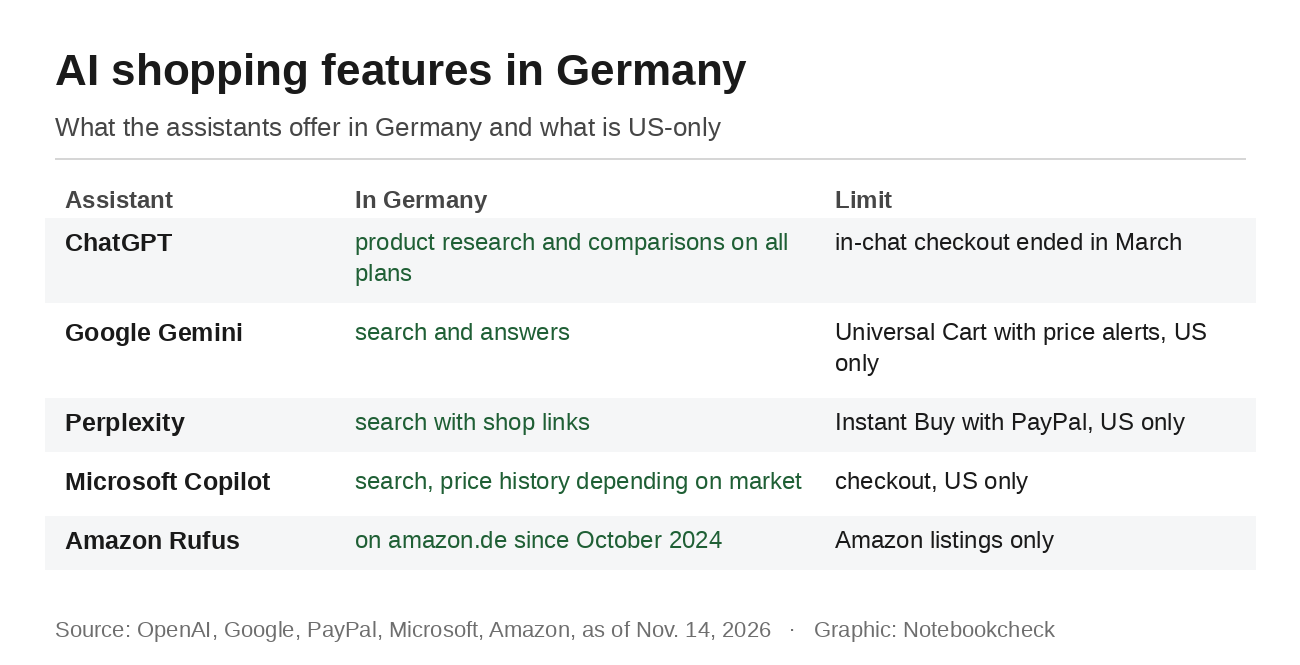
Where you live makes a big difference. According to OpenAI, ChatGPT offers product research and comparisons on every plan, including the free one. Payment happens on the retailer's site, though, because OpenAI ended in-chat checkout in March. Google's Universal Cart with price alerts and Google Pay checkout is so far limited to the U.S., as are Perplexity's Instant Buy with PayPal and checkout in Microsoft Copilot. Amazon's Rufus assistant has been available in Germany since October 2024. None of the major chatbots currently lets shoppers in the EU buy directly in the chat.
Android Police tested the free versions of ChatGPT and Gemini as deal hunters. For four devices with a combined list price of $1,450, ChatGPT found $322 in savings and Gemini found $156. Both quoted wrong prices. Gemini recommended a Pixel Watch 4 for $465 even though another retailer had it for $299, and it relied on an outdated deal. ChatGPT cited a Walmart deal at $585 that cost $635 from a third-party seller. Some links only led to a search page.
When the chatbot recommends a fake shop
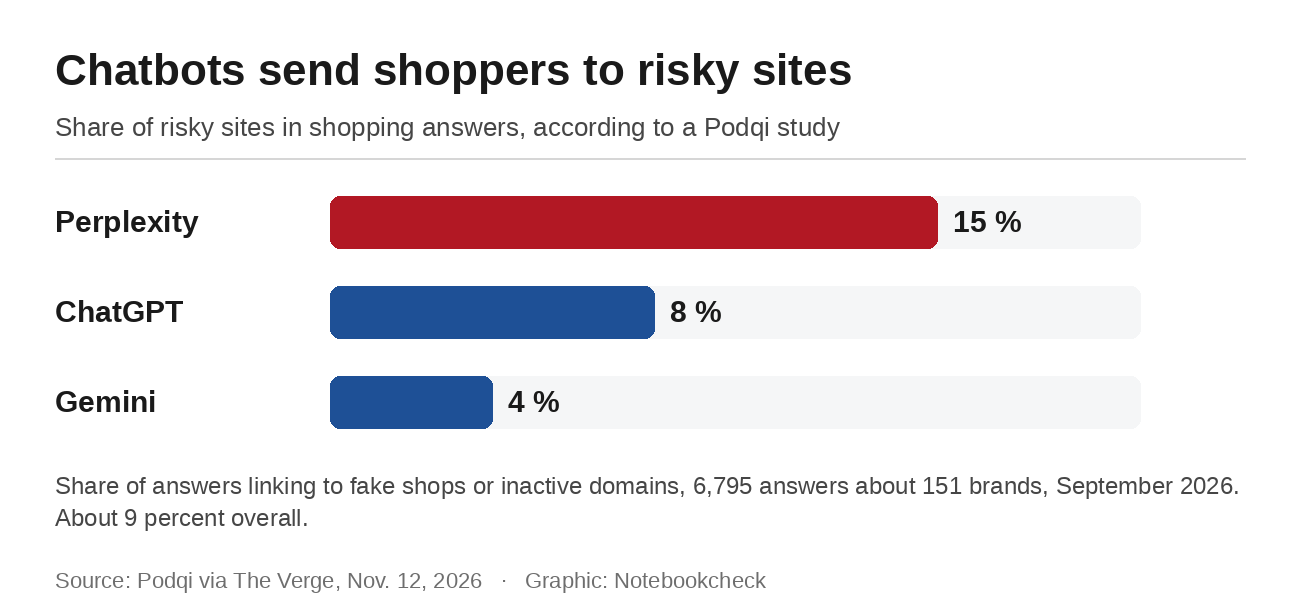
A wrong price is annoying, but a wrong store is worse. In September, brand protection firm Podqi asked ChatGPT, Gemini and Perplexity shopping questions about 151 brands and analyzed 6,795 answers. According to The Verge, about 9% of the answers pointed to risky sites. The rate was 15% for Perplexity, 8% for ChatGPT and 4% for Gemini. Of the 718 flagged domains, 351 were fake shops and the rest were inactive. More than half of the risky links were presented as buying recommendations, and only 9% came with a warning. Questions about shops in other countries and about small brands were hit hardest. Podqi measured how often users were sent to such sites, not whether anyone was defrauded. OpenAI said it would improve its safeguards, Google pointed to the source links it displays, and Perplexity acknowledged it is not perfect.
A network NordVPN uncovered in early November shows what these shops look like. According to the company's announcement, more than 10,000 domains impersonate 166 fashion and luxury brands in 26 countries, all built from a single cloned template. Adidas topped the list with 52 domains, followed by Ralph Lauren with 30 and Dr. Martens with 29. In NordVPN's test, Perplexity recommended two of these shops as trustworthy, one of them as the official Dr. Martens store for Ireland. NordVPN says ChatGPT and Gemini also cited sites from the network. In September we reported on 119,000 fake shops that impersonated brands including FRITZ! and Dreame.
How to check a deal and a store yourself
Check a store before you place an order with a site a chatbot suggested. In Germany, the consumer centers' Fakeshop-Finder rates a web address within seconds using a traffic-light system, and according to the state of North Rhine-Westphalia it has already identified 100,000 fake shops. Typical warning signs listed by the consumer centers include unusual domain endings such as .de.com, a missing legal notice, trust seals that do not link to a certificate, and prepayment as the only payment method left at the last step of checkout. For branded goods, check the manufacturer's official site, which often lists its authorized retailers.
In Germany and the rest of the EU, the law helps with prices. A store that advertises a discount has to state the lowest price it charged in the previous 30 days, as set out in Section 11 of Germany's Price Indication Ordinance. Price comparison sites also show price histories going back months, and Amazon now displays one as well. Never take a price from a chatbot at face value. Open the store yourself and compare the price in the cart with what the chatbot told you.
If you still ask a chatbot, ask a precise question. Request links to the manufacturer's official stores or to well-known retailers, and ask for the date a price was valid. An answer without a source, or one that points to a shop you have never heard of, is a reason to check for yourself before entering any details. In the Podqi study, ChatGPT added a warning on its own in 24% of the risky cases, the others far less often. Searches for shops abroad and for small brands had the highest error rates, so that is where a second check pays off most.
AI agents that click through websites on their own call for extra caution. In July, researchers from Seoul National University and the University of Illinois showed that a manipulated product review can trick such an agent into clicking "Buy now" instead of "Read more," The Hacker News reported. For deal hunting, AI works best as a research assistant, but make the choice and click Buy yourself.
Source(s)
YouGov: Black Friday 2026, half of German shoppers plan to use AI (German)
OpenAI: Product discovery in ChatGPT
PayPal: Instant Buy with Perplexity
Android Police: ChatGPT and Gemini tested as deal hunters
The Verge: Podqi study on risky shopping links in chatbots
NordVPN: Fake shop network with more than 10,000 stores
Verbraucherzentrale: Fakeshop-Finder (German)
Verbraucherzentrale: Eight signs of a fake shop (German)
State of North Rhine-Westphalia: Fakeshop-Finder identifies its 100,000th fake shop (German)
German law: Section 11 of the Price Indication Ordinance (German)
The Hacker News: Data injection attack tricks AI shopping agents
 Add as a preferred source on Google


