




Toshiba Satellite R830-11C
Specifications
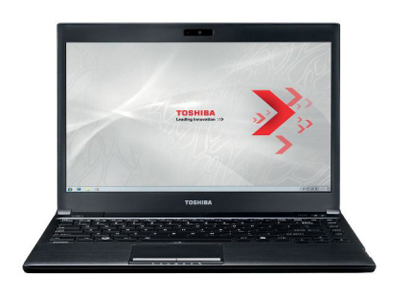
Toshiba Satellite R830-11C (Satellite R830 Series)
Processor
Intel Core i5-2410M 2c/4t 2 x 2.3 - 2.9 GHz, Sandy Bridge
Graphics adapter
Intel HD Graphics 3000, 8.15.10.2291
Memory
4 GB
, DDR3-10600, 1333 MHz, max. 8 GB, 2 banks
Display
13.30 inch 16:9, 1366 x 768 pixel, LED backlighting, glossy: no
Mainboard
Intel HM55 Express Chipset
Storage
Toshiba THNSFC128GBSJ, 128 GB
, Solid State Drive
Soundcard
Realtek ALC269
Connections
2 USB 2.0, 1 USB 3.0 / 3.1 Gen1, 1 VGA, 1 HDMI, 1 Kensington Lock, 1 eSata, Audio Connections: 2x audio (headphones, microphone), Card Reader: 6-in-1 card reader (MMC, SD Memory Card, SDHC, miniSD, microSD, SDXC)
Networking
Intel 82579V Gigabit Network Connection (10/1000MBit/s), Atheros AR9002WB-1NG Wireless Network Adapter (b/g/n = Wi-Fi 4/), Bluetooth 3.0 + HS
Optical drive
MATSHITA DVD-RAM UJ8A2AS
Size
height x width x depth (in mm): 18.3 x 316 x 227 ( = 0.72 x 12.44 x 8.94 in)
Battery
66 Wh Lithium-Ion, 6-cell battery, 10.8 Volt
Operating System
Microsoft Windows 7 Home Premium 64 Bit
Camera
Webcam: VGA WebCam mit Gesichtserkennung
Additional features
Toshiba Bluetooth Stack, Toshiba Bluetooth Monitor, Toshiba Disc Creator, Toshiba user handbook, Supervisor password program, Toshiba Assist, Chicony Camera Assistant Software, Toshiba facial recognition software, Toshiba Value Added Package, 24 Months Warranty
Weight
1.48 kg ( = 52.21 oz / 3.26 pounds), Power Supply: 230 g ( = 8.11 oz / 0.51 pounds)
Price
999 Euro
Price comparison
Average Score:
Average of 2 scores (from 4 reviews)
Average of 2 scores (from 4 reviews)
price: - %, performance: 76%, features: 69%, display: 74% mobility: 91%, workmanship: 88%, ergonomy: 84%, emissions: 79%
Reviews for the Toshiba Satellite R830-11C
Review Toshiba Satellite R830-11C Notebook | Notebookcheck
Business Subnotebook. Toshiba has released the Satellite R830, a 13.3-inch subnotebook that could be of particular interest to business customers. The small, light laptop stands out with its stylish appearance, good battery life and built-in solid state drive.
Business Subnotebook. Toshiba has released the Satellite R830, a 13.3-inch subnotebook that could be of particular interest to business customers. The small, light laptop stands out with its stylish appearance, good battery life and built-in solid state drive.
Toshiba Satellite Z830 review: First Look
Source: It Pro Archive.org version
The Toshiba Satellite Z830 is the most promising Ultrabook design we've seen so far, if only because it doesn't slavishly ape the MacBook Air. Much depends on pricing and battery life though which we won't be able to judge until final production models arrive in the UK later this year.
Single Review, online available, Very Short, Date: 09/05/2011
Source: It Pro
Archive.org versionThe Toshiba Satellite Z830 is the most promising Ultrabook design we've seen so far, if only because it doesn't slavishly ape the MacBook Air. Much depends on pricing and battery life though which we won't be able to judge until final production models arrive in the UK later this year.
Single Review, online available, Very Short, Date: 09/05/2011
First look at Toshiba's Portégé Z830 Ultrabook
Source: Reg Hardware Archive.org version
Indeed, Toshiba seems deliberately tried not to go down the Apple 'design above all' route. Yes, the Z830 is not as pretty as the Air or Acer's Aspier S3, but it has three full-size USB ports, Gigabit Ethernet and HDMI - the latter arguably more useful than the Air's DisplayPort connector.
Single Review, online available, Very Short, Date: 09/04/2011
Source: Reg Hardware
Archive.org versionIndeed, Toshiba seems deliberately tried not to go down the Apple 'design above all' route. Yes, the Z830 is not as pretty as the Air or Acer's Aspier S3, but it has three full-size USB ports, Gigabit Ethernet and HDMI - the latter arguably more useful than the Air's DisplayPort connector.
Single Review, online available, Very Short, Date: 09/04/2011
Toshiba Portege Z830 first look
Source: Trusted Reviews Archive.org version
All told, though, we're deeply impressed by the Toshiba Portege Z830. It really is remarkably thin and light, and attractive too. But it's the fact that Toshiba has achieved this without compromising on almost any front. It may not quite be class leading in any one area - particularly the screen - but for usability, connectivity, performance and battery life combined there are few competitors that can hold a candle to it. All that remains to be seen now is whether Toshiba can get the pricing right here in the UK.
Single Review, online available, Short, Date: 09/02/2011
Source: Trusted Reviews
Archive.org versionAll told, though, we're deeply impressed by the Toshiba Portege Z830. It really is remarkably thin and light, and attractive too. But it's the fact that Toshiba has achieved this without compromising on almost any front. It may not quite be class leading in any one area - particularly the screen - but for usability, connectivity, performance and battery life combined there are few competitors that can hold a candle to it. All that remains to be seen now is whether Toshiba can get the pricing right here in the UK.
Single Review, online available, Short, Date: 09/02/2011
Foreign Reviews
Test Toshiba Satellite R830-11C Notebook
Source: Notebookcheck DE→EN Archive.org version
Single Review, online available, Long, Date: 07/25/2011
Rating: Total score: 84% performance: 76% display: 74% mobility: 91% workmanship: 88% ergonomy: 84% emissions: 79%
Source: Notebookcheck
DE→EN Archive.org versionSingle Review, online available, Long, Date: 07/25/2011
Rating: Total score: 84% performance: 76% display: 74% mobility: 91% workmanship: 88% ergonomy: 84% emissions: 79%
Comment
Intel HD Graphics 3000: Integrated graphics card in the Intel Sandy Bridge processors (Core ix-2xxx). The HD 3000 is the faster (internally GT2 called) version with 12 Execution Units (EUs).
Only some 3D games with very low demands are playable with these cards.
» Further information can be found in our Comparison of Mobile Graphics Cards and the corresponding Benchmark List.
2410M:
Dual-core processor based on the Sandy Bridge architecture with an integrated graphics card and dual-channel DDR3 memory controller. The CPU is clocked at 2.3 GHz (Turbo Boost 2.6-2.9 GHz) and the GPU at 650 (1200 MHz Turbo).
» Further information can be found in our Comparison of Mobile Processsors.
 Add as a preferred source on Google


