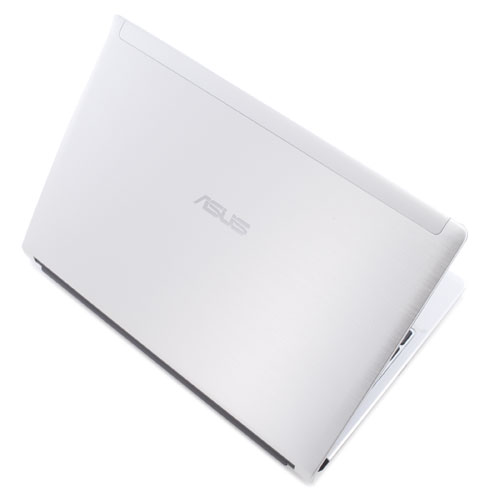
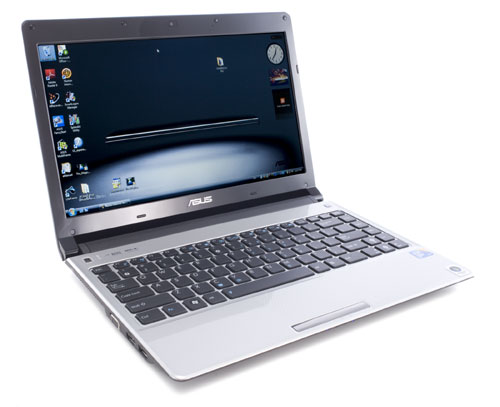
Asus UL30A-A1
Specifications
Price comparison
Average of 12 scores (from 17 reviews)
Reviews for the Asus UL30A-A1
Source: Trusted Reviews
 Archive.org version
It won't win any beauty pageants, but the Asus UL30A has it where it counts: value and battery life. A great keyboard, solid feature set and generous two-year warranty only further strengthen its credentials.
Single Review, online available, Medium, Date: 06/21/2010
Rating: Total score: 90% price: 100% performance: 80% features: 70% mobility: 100%
Source: PC Authority
Archive.org versionWe've seen some impressive battery scores this month, but the Asus UL30A sweeps all before it. In our heavy-use test it endured 4hrs 14mins away from the mains, and in light use it lasted an incredible 10hrs 23mins. In exchange for that sort of longevity you expect a few trade-offs, but when you pick up the UL30A it doesn't feel like a compromise.
Single Review, online available, Very Short, Date: 06/08/2010
Rating: price: 83% performance: 83% features: 67% mobility: 100%
Source: T3
Archive.org versionAll-in-all the Asus UL30A is a fantastically portable machine. The 745 minute battery life is almost unprecedented, and means you’ll be able to carry out your business without worrying about carrying around the charger with you. Concessions have been made to performance, but for day-to-day tasks it's fine, ultimately this doesn’t detract from the excellent business usability the machine provides.
Single Review, online available, Short, Date: 03/16/2010
Rating: Total score: 80%
Source: Inside HW
Archive.org versionA usual working day ends with a laptop being put to the test battery. The next day begins by reading the test results. Well, it usually happens, but not this time. Test in which a laptop is in the minimum load lasted more than 14 hours. Of course we thought that it was an error, but when we repeated the test and get the same result, we realized that before us we have a laptop with the exceptional autonomy. To remind you, this test should match the reading or writing of texts and emails, with reduced screen brightness.
Single Review, online available, Medium, Date: 01/16/2010
Rating: mobility: 95%
Source: Techradar
Archive.org versionOne of the most portable laptops we have ever seen, but performance suffers. Asus' ultraportable UL range offers affordable and portable computing. The Asus UL30A is the smaller of the two machines that comprise the series and offers a lightweight solution and unprecedented battery life that will keep you productive on the move for over twelve and a half hours. This is the ideal laptop for the business person or regular traveller who wants to work on the go. It's small, light and offers a truly amazing battery life.
Single Review, online available, Medium, Date: 11/10/2009
Rating: Total score: 70%
Source: Liliputing
Archive.org versionThe Asus UL30A is an interesting machine. It’s not the most powerful laptop you can find for $700 to $800. But it’s strength isn’t its power, so much as the combination of price, performance, and portability. It’s a lot like a netbook that way. It just happens to be bigger, more powerful, and more expensive than most netbooks.
Single Review, online available, Long, Date: 10/28/2009
Rating: price: 70% performance: 60% mobility: 70%
Source: CNet
Archive.org versionWhether CULV thin-and-light laptops will ever fully find a spot between the Netbook world and the full-featured laptop world, they are most definitely a category that's growing every day. Dropping an optical drive and throwing a low-voltage processor alongside a long-lasting battery is the trend of 2009, although the low-voltage laptops we've seen so far have often sacrificed either build quality, performance, or value-for-dollar. If you're in the market for an affordable thin-and-light, the Asus UL30A-A1 provides great value and a solid Core 2 Duo CULV processor in an attractive package.
Single Review, online available, Long, Date: 09/30/2009
Rating: Total score: 80%
Source: PC Mag
Archive.org versionThe consumer ultra-low voltage (CULV) processor revolution is about to quiet all the buzz netbooks have created in the laptop category. CULV processors favor battery life and don't necessarily come with optical drives—just like netbooks. I've seen a bunch of CULV-based laptops already, starting with the MSI X340 (021US) and Acer Timeline AS3810T. But so far, the ASUS UL30A-A1 is my favorite.The ASUS UL30A-A1 is an amazing ultra-thin laptop that gives 10 hours of battery life for less than what everyone else is charging.
Single Review, online available, Long, Date: 09/24/2009
Rating: Total score: 90%
Source: PC World
Archive.org versionTake everything we liked about the Asus Eee PC 1005HA (a well-designed, seashell-shaped netbook) and marry that with the CULV-laden Acer Timeline 3810T. The result: Asus's stab at a good, low-cost ultraportable computer--the UL30A. (OK, low cost is relative. Our review unit sells for $800 as of 9/16/2009.) Slick looks, a CULV processor and a huge keyboard make Asus' new ultraportable a laptop worth a second (and maybe even a third) look.
Single Review, online available, Medium, Date: 09/18/2009
Rating: Total score: 60%
Source: Computer Shopper
Archive.org versionNot since the HP Pavilion dv2-1030us have we seen an under-$800 fully functional ultraportable, so the $799 Asus UL30A-A1 is a welcome addition to the category. The 13-inch 3.7-pound Asus UL30A-A1 is a low-cost, highly portable notebook with good looks and decent performance. We define an “ultraportable” as a notebook weighing less than four pounds, and typically, they have 12.1-inch screens, but since this one makes that weight requirement, it falls into ultraportable territory, with the extra inch of screen real estate as a bonus. With marathon-level battery life, this is one of the most portable notebooks we’ve seen. Its performance lags, but its $799 price puts it ahead of the pricey ultraportable pack.
Single Review, online available, Long, Date: 09/01/2009
Rating: price: 80% performance: 80% mobility: 95%
Foreign Reviews
Source: Netzwelt
 DE→EN Archive.org version
Single Review, online available, Medium, Date: 02/10/2010
Rating: performance: 70% features: 70%
Source: PC Welt
DE→EN Archive.org versionSingle Review, online available, Medium, Date: 01/05/2010
Rating: Total score: 72% price: 80% performance: 50% features: 73% mobility: 100% ergonomy: 65%
Source: T-Online
DE→EN Archive.org versionSingle Review, online available, Medium, Date: 01/05/2010
Rating: Total score: 72% price: 80% performance: 50% features: 73% mobility: 100% ergonomy: 65%
Source: Mobile News - 1/10
Single Review, , Length Unknown, Date: 01/01/2010
Rating: Total score: 90%
Source: Kiến Thức Laptop
 VN→EN Archive.org version
Single Review, online available, Short, Date: 10/05/2009
Rating: Total score: 70%
Source: Komputer for alle
 DA→EN Archive.org version
Single Review, online available, Very Short, Date: 01/15/2010
Rating: Total score: 90%
Source: Komputer for alle
DA→EN Archive.org versionSingle Review, online available, Very Short, Date: 12/21/2009
Rating: Total score: 90%
Comment
Intel Graphics Media Accelerator (GMA) 4500MHD: Onboard (shared Memory) GPU built in the GM45, GE45 and GS45 chipset (Montevina). Because of two more shaders and a higher core clock, much faster than the old GMA X3100. Still not advisable for gamers (DirectX 10 games not playable or only with very low settings). The integrated video processor is able to help decode HD videos (AVC/VC-2/MPEG2) , e.g., for a fluent Blu-Ray playback with slow CPUs.
Only some 3D games with very low demands are playable with these cards.
» Further information can be found in our Comparison of Mobile Graphics Cards and the corresponding Benchmark List.
Intel Core 2 Duo: This is the Core Duo and Core Solo successor with a longer pipeline and 5-20% more speed without more power consumption. As an addition to the Core Duo design there exists a fourth decoder, an amplified SSE-unit and an additional arithmetical logical unit (ALU).
The Core 2 Duo for laptops is identical to the desktop Core 2 Duo processors but the notebook-processors work with lower voltages (0.95 to 1188 Volt) and a lower Frontside bus clock (1066 vs 667 MHz). The performance of equally clocked notebooks is 20-25% lower than Desktop PCs because of the lower Frontside bus clock and the slower hard disks.
SU7300: Slow clocked dual core processor with a low TDP of 10 Watt.» Further information can be found in our Comparison of Mobile Processsors.
 Add as a preferred source on Google