




This tiny M.2 module turns your everyday laptop into a penetration testing tool
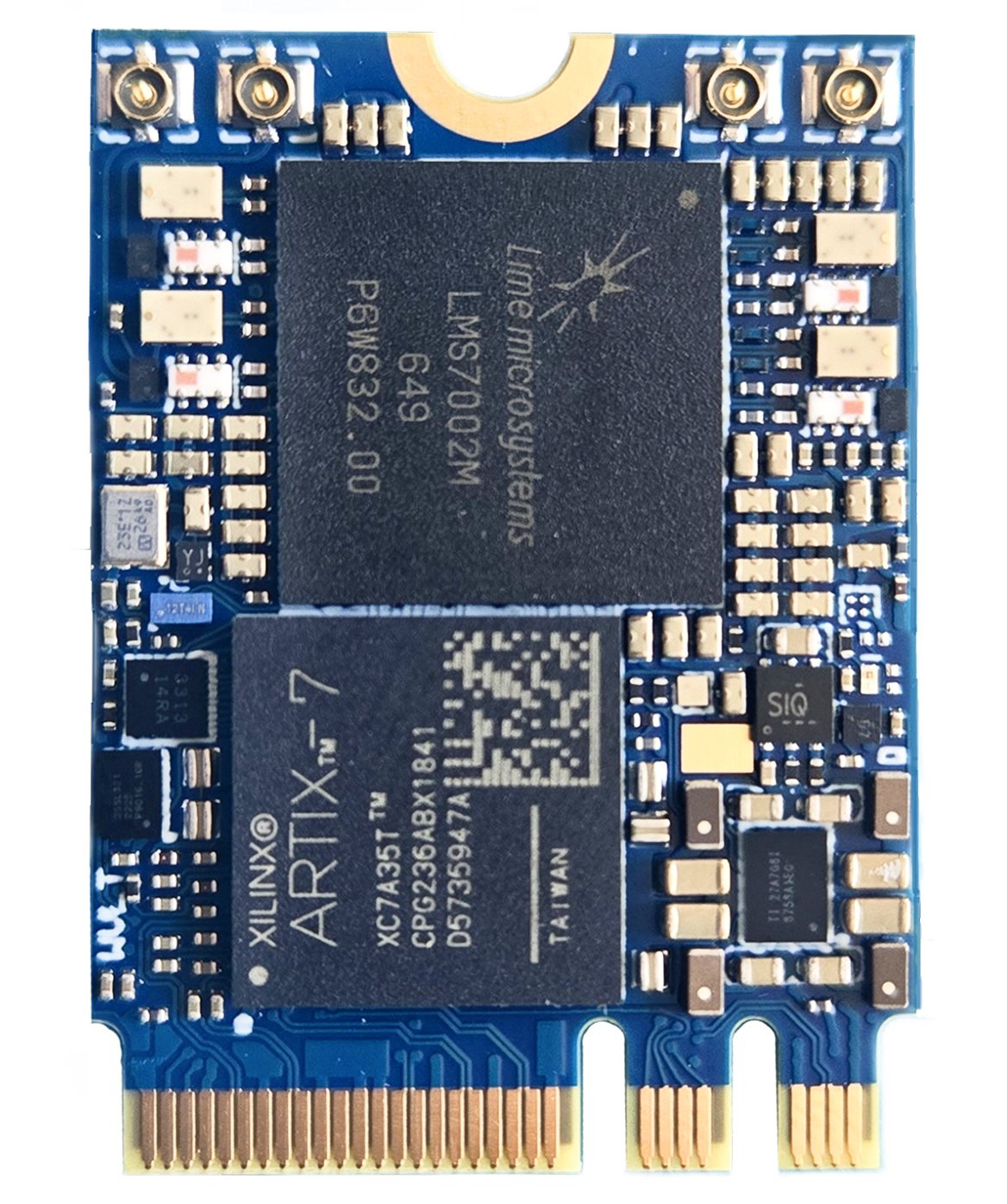
The xSDR is currently offered via Crowd Supply, where it has already reached its funding goal ahead of its March 2026 deadline. This new module also follows the company’s earlier uSDR platform, but now supports 2×2 MIMO and extended bandwidth in the same 30 mm × 22 mm footprint.
At its core, the xSDR is based on the Lime Microsystems LMS7002M RF transceiver, paired with an AMD Artix-7 XC7A50T FPGA. This combination covers a 30 MHz to 3.8 GHz tuning range. The SDR supports sample rates from 0.1 MSPS up to 122.88 MSPS in SISO mode and over 80 MSPS in MIMO mode, with channel bandwidths ranging from 0.5 MHz to 90 MHz. Four MHF4 antenna connectors provide access to the two RX and two TX channels.
The module also exposes a 12+2-pin 1.8V GPIO header via the reserved pins of the M.2 A+E key interface, which can control external RF front-ends, toggle antenna relays, or enable JTAG for custom gateware debugging. Furthermore, one of these GPIOs can be specifically configured as a 1PPS (Pulse Per Second) input, accepting precision timing signals from a GPS Disciplined Oscillator (GPSDO) to synchronize multiple boards for phase-coherent, multi-channel arrays perfectly.
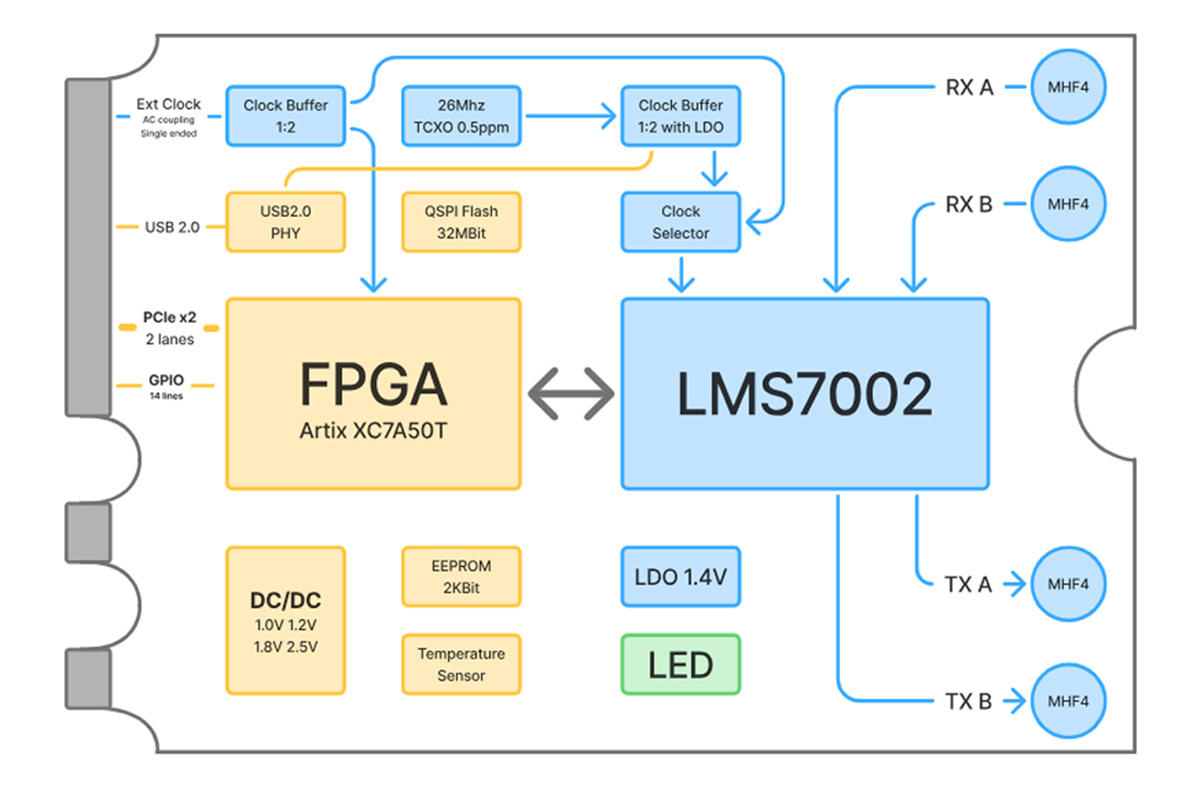
On the software side, the xSDR supports tools like GNU Radio, srsRAN, and SoapySDR. It also works with wsdr.io, a browser-based platform with WebUSB support for configuring and controlling radio functions directly from a web interface without complex driver setups.
Wavelet Lab markets this module for cellular experimentation (LTE and 5G), embedded RF analysis, custom wireless data links, and research applications. However, it can also be used for penetration testing using software such as Universal Radio Hacker. With the right settings, the xSDR can mimic, intercept, or decode a wide range of wireless protocols.
Despite its wide bandwidth and 2×2 MIMO support, the module can be constrained by USB 2.0 throughput in certain configurations. Since it supports both USB 2.0 and PCIe 2.0 ×2 via the M.2 interface, installing it in a slot that supports only USB may limit its full performance. At $549, the xSDR is clearly aimed at professionals, researchers, and advanced hobbyists rather than entry-level users.
Manufacturing of the xSDR will be handled by Wavelet Lab, with final fulfillment managed by Mouser Electronics through the Crowd Supply distribution network. As with most hardware crowdfunding campaigns, potential risks include tariff fluctuations, component availability constraints, firmware-related issues, and possible certification or compliance delays, any of which could impact final delivery timelines.
Source(s)
Crowd Supply spotted by CNX-software
 Add as a preferred source on Google


