




One of India’s original budget smartphone heavyweights may be gearing up for a comeback

Karbonn, one of the more recognisable names from the early days of India's Android smartphone market, could be preparing a comeback. A device called the Karbonn ZenZ Pro (definitely not a play on Gen-Z) has appeared on Geekbench, and it could be the company's first new Android smartphone in years. Its last offering launched sometime in 2020, with the company subsequently shifting its focus to the feature phone market.
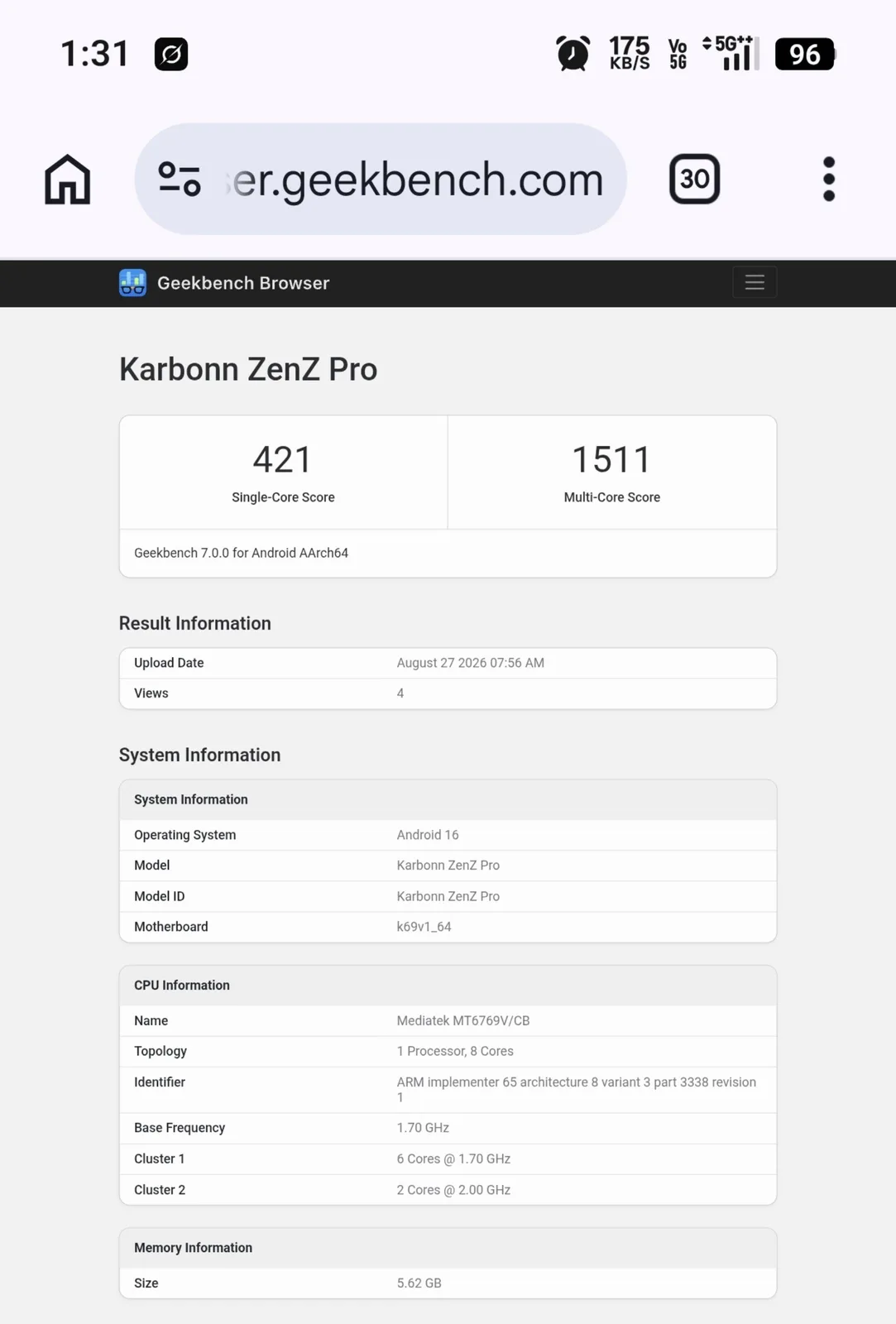
The benchmark listing, spotted by Abhishek Yadav, identifies the device as the Karbonn_UTL_ZenZ_Pro. It runs Android 16 and comes with 6 GB of RAM. The motherboard information points to the MT6769V/C platform, which corresponds to the MediaTek Helio G70 SoC. The ageing 12 nm chipset last powered phones in 2020, so it is genuinely surprising where Karbonn managed to dig one up from.
It combines two Cortex-A75 performance cores clocked at up to 2.0 GHz with six Cortex-A55 efficiency cores at 1.7 GHz, alongside a Mali-G52 MC2 GPU. The ZenZ Pro managed 421 points in Geekbench 7’s single-core test and 1,511 points in multi-core.
That said, Geekbench listings are fairly easy to fake, especially for older platforms like the Helio G70. Someone could easily have played around with the build.prop file on a dusty old smartphone and run Geekbench on it, resulting in what looks like a ‘new’ Karbonn smartphone.Therefore, the listing alone does not establish that the ZenZ Pro will see the light of day. However, the combination of a heretofore unseen name, Android 16 and Karbonn's UTL branding makes the putative launch somewhat plausible.
Karbonn would not be alone in eyeing a return to India's budget smartphone segment. Fire-Boltt has already entered the space through its Boltt smartphone brand, while Mivi is also preparing to launch its first handset. Both companies are best known for affordable wearables and audio products, and their smartphone push suggests there is renewed interest among Indian consumer-electronics brands in the sub-₹15,000 ($158) market. With established players such as Redmi and Realme increasingly moving away from the ultra-budget end of the market, it was only a matter of time before someone stepped in to fill the void.
Source(s)
 Add as a preferred source on Google


