




Bolt Graphics' unconventional Zeus GPU clears first hardware tests, but commercial launch slips to 2028
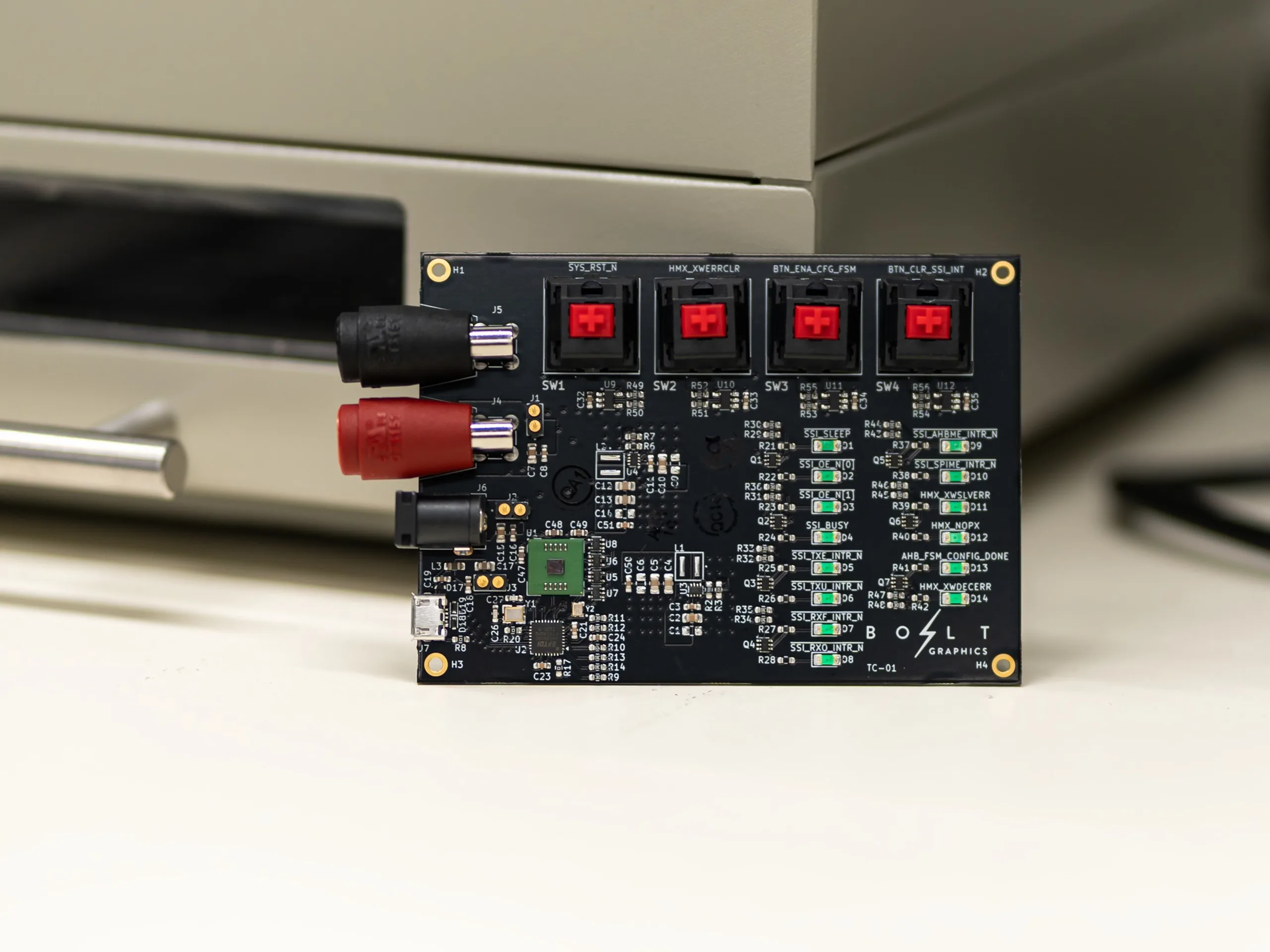
Last year, Bolt Graphics unveiled its ambitious Zeus GPU with some rather lofty performance claims. The company previously showcased its Thunder GPU in 2024 before turning its attention to Zeus. The latter promised up to 10 times the path-tracing performance of an Nvidia GeForce RTX 5090, along with some unconventional hardware features such as expandable memory and integrated 400 GbE networking. Now, Bolt Graphics has achieved an important milestone that brings the pipe dream GPU one step closer to reality.
In a press release, Bolt Graphics confirmed it had successfully brought up its first Zeus test chip. Fabricated on TSMC’s 12 nm process, the prototype measures just 6 mm² and consumes approximately 1.4 W of power. The company says its engineers powered on the A0 silicon and completed initial bring-up within 24 hours, with no functional issues detected. The chip was also tested across temperatures ranging from -40°C to 85°C.
Interestingly, Bolt Graphics says the prototype consumes considerably less power than the FPGA-based platform previously used to validate its architecture, which required 35 W. The company also claims the silicon exceeded its internal performance and efficiency estimates. However, the figures should not be interpreted as a direct comparison with production GPUs, particularly since Bolt Graphics hasn’t provided independently verifiable performance benchmarks.
Zeus reimagines how we look at graphics cards. Its proposed configurations include a 120 W entry-level model with 32 GB of LPDDR5X memory, expandable through DDR5 SO-DIMMs. Higher-end server configurations can accommodate up to 2.25 TB of memory using DDR5 RDIMMs. Integrated networking, dedicated path-tracing hardware and a focus on professional rendering make it more suited to scientific simulations and content creation. For now, gaming is an afterthought.
The latest test chip positions itself as dedicated hardware for electromagnetic simulations. Bolt Graphics claims this approach can accelerate calculations involving Maxwell’s equations, potentially letting engineers simulate complete products rather than individual components. The company eventually wants to extend the approach to computational fluid dynamics and molecular dynamics.
However, Zeus still has some way to go before it can challenge established GPU manufacturers. The 6 mm² prototype is primarily intended to validate the underlying architecture, and its successful bring-up does not establish whether a full-sized Zeus GPU can deliver the previously advertised performance figures.
Bolt Graphics has also revised its production timeline. While it previously expected Zeus to enter production in Q4 2027, the company now plans to provide developer access in Q1 2027, followed by initial hardware availability for Early Access Program customers towards the end of the year. Volume production of Zeus PCIe cards and servers is now scheduled for 2028.
Finally, Bolt Graphics has established a new office in Taipei to strengthen coordination with its manufacturing partners. Unlike the test chip, commercial Zeus GPUs are expected to use TSMC’s more advanced N5P process node. Whether the eventual hardware can live up to the company’s ambitious performance claims remains to be seen.
Source(s)
 Add as a preferred source on Google


No comments for this article
