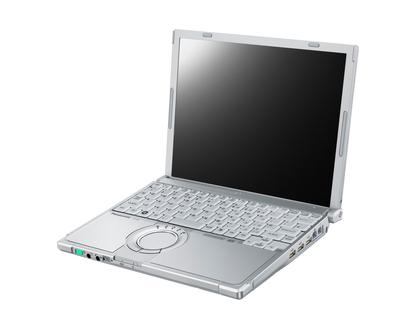
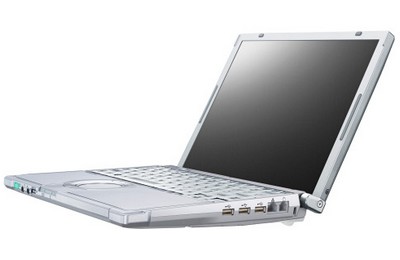
Panasonic Toughbook CF-T8
Specifications
Price comparison
Average of 1 scores (from 1 reviews)
Reviews for the Panasonic Toughbook CF-T8
Source: Techradar
 Archive.org version
Panasonic's latest isn't exactly going to take the world by storm, but for a minority of users - who either make spreadsheets on the sides of volcanoes or suffer from acute butter fingers - it's going to be essential. And they've done a good job of packing it with the right features - our only major concerns being the lack of graphical athleticism, and the price.
3.5 von 5, Mobilität sehr gut, Display gut, Leistung mäßig, Preis schlecht
Single Review, online available, Medium, Date: 11/10/2008
Rating: Total score: 70% price: 40% performance: 60% display: 80% mobility: 90%
Comment
Intel Graphics Media Accelerator (GMA) 4500MHD: Onboard (shared Memory) GPU built in the GM45, GE45 and GS45 chipset (Montevina). Because of two more shaders and a higher core clock, much faster than the old GMA X3100. Still not advisable for gamers (DirectX 10 games not playable or only with very low settings). The integrated video processor is able to help decode HD videos (AVC/VC-2/MPEG2) , e.g., for a fluent Blu-Ray playback with slow CPUs.
Only some 3D games with very low demands are playable with these cards.
» Further information can be found in our Comparison of Mobile Graphics Cards and the corresponding Benchmark List.
Intel Core 2 Duo: This is the Core Duo and Core Solo successor with a longer pipeline and 5-20% more speed without more power consumption. As an addition to the Core Duo design there exists a fourth decoder, an amplified SSE-unit and an additional arithmetical logical unit (ALU).
The Core 2 Duo for laptops is identical to the desktop Core 2 Duo processors but the notebook-processors work with lower voltages (0.95 to 1188 Volt) and a lower Frontside bus clock (1066 vs 667 MHz). The performance of equally clocked notebooks is 20-25% lower than Desktop PCs because of the lower Frontside bus clock and the slower hard disks.
SU9300: Power efficient low voltage processor based on the Penryn 3M core that features all Penryn functions like Virtualization and Trusted Execution.» Further information can be found in our Comparison of Mobile Processsors.
 Add as a preferred source on Google