




Acer Aspire 9805WKHi
Specifications
Price comparison
Average of 1 scores (from 1 reviews)
Reviews for the Acer Aspire 9805WKHi
Source: PC Mag
 Archive.org version
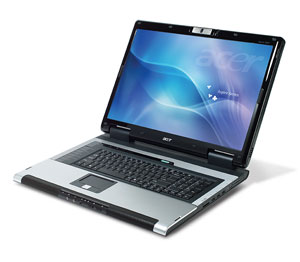
There was a time when 17-inch widescreen laptops were considered downright huge, but thanks to lower LCD costs and Dell's launch of its 20-inch widescreen notebook, the XPS M2010, monstrous laptops are starting to take over my test area. The Acer Aspire 9805WKHi, with a 20-inch widescreen, weighs a shoulder-straining 17.1-pounds, so it isn't for everyone. It's abundantly clear that Acer didn't put as much thought into the Aspire's design as Dell did into the XPS M2010. Apparently, the company just found the largest screen available—a gorgeous 20.1 inch CrystalBrite display—and slapped it onto a laptop base secured with some hinges. Unlike the M2010's LCD, which lets you adjust heights and positions, the Aspire gives you only one comfortable viewing position.
eher kurz gehaltener Test; online abrufbar
3 von 5
Single Review, online available, Short, Date: 08/02/2006
Rating: Total score: 60%
Comment
NVIDIA GeForce Go 7600: The NVIDIA GeForce Go 7600 is a middle class video card of the 7000 series and suited for games of the year 2006. The performance is very similar to ATI X1600 / X1700. Compared to the desktop 7600 it is clearly slower.
Only some 3D games with very low demands are playable with these cards.
» Further information can be found in our Comparison of Mobile Graphics Cards and the corresponding Benchmark List.
Intel Core Duo: Double Core processor with a very good relation of performance to current consumption. The 2 MB L2 Cache are used together by the double. The maximum capacity of 31 watts is only 4 watts more than with the Pentium M (predecessor). Both cores are lowered automatically and independently of each other by speed steps down to 1 GHz. In addition it now supports also SSE3 instructions. At least it is just as fast as a equivalent Pentium M. With applications, which were designed for multi-processors, the performance can be nearly twice as fast as with the Pentium M (e.g. CineBench around 86% fast)
T2600: Second fastest Core Duo based on the Yonah core. Does not support 64 Bit operating systems.» Further information can be found in our Comparison of Mobile Processsors.
 Add as a preferred source on Google


