




Apple M1 vs Apple A13 Bionic
Apple M1
► remove from comparison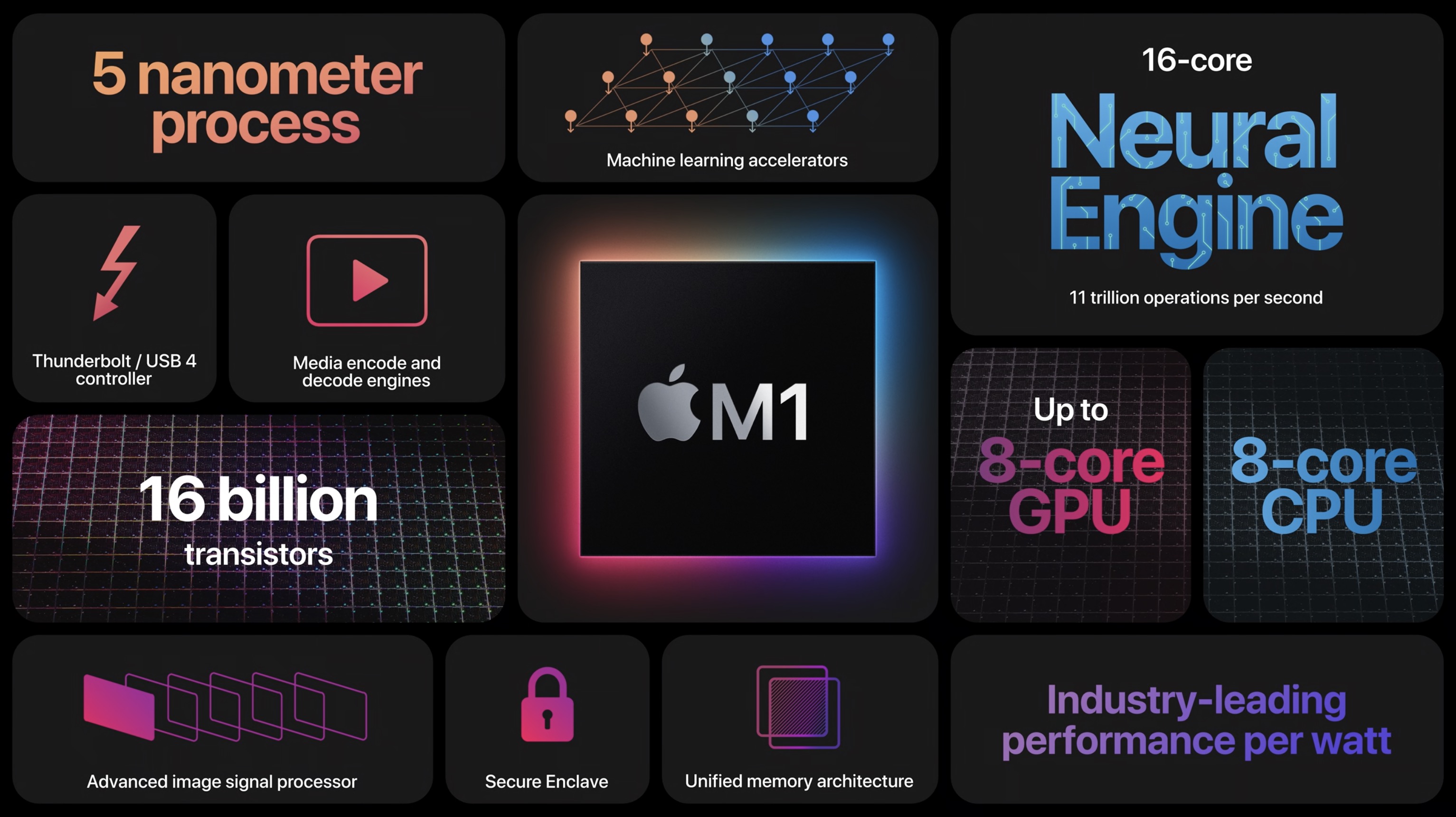
The Apple M1 is a System on a Chip (SoC) from Apple that is found in the late 2020 MacBook Air, MacBook Pro 13, and Mac Mini. It offers 8 cores divided in four performance cores and four power-efficiency cores. The big cores offer 192 KB instruction cache, 128 KB data cache, and 12 MB shared L2 cache. According to Apple the performance of these cores should be better than anything on the market (in late 2020). The four efficiency cores are a lot smaller and offer only 128 KB instruction cache, 64 KB data cache, and 4 MB shared cache. The efficiency cores (E cluster) clock with 600 - 2064 MHz, the performance cores (P cluster) with 600 - 3204 MHz.
The M1 is available in two TDP variants, a passive cooled 10 Watt variant for the MacBook Air and an active cooled faster variant for the MacBook Pro 13 and Mac Mini. Those should offer a better-sustained performance according to Apple.
The integrated graphics card in the M1 offers 8 cores (7 cores in the entry MacBook Air) and a peak performance of 2.6 teraflops. Apple claims that it is faster than any other iGPU at the time of announcement.
Furthermore, the SoC integrates a fast 16 core neural engine with a peak performance of 11 TOPS (for AI hardware acceleration), a secure enclave (e.g., for encryption), a unified memory architecture, Thunderbolt / USB 4 controller, an ISP, and media de- and encoders.
The Apple M1 includes 16 billion transistors (up from the 10 billion of the A12Z Bionic and therefore double the amount of a Tiger Lake-U chip like the i7-1185G7) and is manufactured in 5nm at TSMC.
Apple A13 Bionic
► remove from comparison
The Apple A13 Bionic is a System on a Chip (SoC) from Apple that is found in the iPhone 11 series. It was announced late 2019 and offers 6 cores divided in 2 performance cores and four power efficiency cores. Compared to the previous A12 Bionic, the A13 should offer a 20% improved CPU performance at 40% lower power (according to Apple).
With 8.5 billion transistors, the A13 Bionic is a big chip especially compared to the Snapdragon 835 (3 Billion) or a Skylake desktop quad-core Soc (1.75 Billion).
| Model | Apple M1 | Apple A13 Bionic | ||||||||||||||||
| Series | Apple M1 | Apple Apple A-Series | ||||||||||||||||
| Series: M1 |
| |||||||||||||||||
| Clock | 2064 - 3220 MHz | <=2660 MHz | ||||||||||||||||
| L1 Cache | 2 MB | 832 KB | ||||||||||||||||
| L2 Cache | 16 MB | 12 MB | ||||||||||||||||
| L3 Cache | 8 MB | |||||||||||||||||
| Cores / Threads | 8 / 8 | 6 / 6 | ||||||||||||||||
| Transistors | 16000 Million | 6900 Million | ||||||||||||||||
| Technology | 5 nm | 7 nm | ||||||||||||||||
| Features | ARMv8 Instruction Set | ARMv8 Instruction Set | ||||||||||||||||
| iGPU | Apple M1 8-Core GPU | Apple A13 Bionic GPU | ||||||||||||||||
| Chip AI | 11 TOPS INT8 | |||||||||||||||||
| Architecture | ARM | ARM | ||||||||||||||||
| Announced | ||||||||||||||||||
| Codename | Lightning and Thunder | |||||||||||||||||
| NPU / AI | 6 TOPS INT8 |

Benchmarks
Average Benchmarks Apple M1 → 100% n=17
Average Benchmarks Apple A13 Bionic → 69% n=17
 - Average benchmark values for this graphics card
* Smaller numbers mean a higher performance
1 This benchmark is not used for the average calculation


