


AMD Zen 6 laptop CPU leak reveals unusual core configurations and reduced cache

AMD's upcoming Zen 6-based Medusa Point laptop processors have made another appearance on Geekbench, this time revealing two previously unseen configurations. Unlike earlier leaks involving ten-core models, the latest entries feature six-core and eight-core engineering samples, suggesting AMD is preparing several variants of its next-generation mobile processors.
First spotted by VideoCardz, both processors were tested on unidentified Lenovo platforms running Windows 11 Pro. Geekbench identifies them as Medusa Point 2/3, distinguishing them from the previously spotted ten-core Medusa Point 1.
The six-core engineering sample features 12 threads arranged in an unusual 1+5 configuration. It comes with 6 MB of L2 cache and just 4 MB of shared L3 cache. Meanwhile, the eight-core variant has 16 threads arranged in a 2+6 configuration, alongside 8 MB each of L2 and L3 cache.
Interestingly, both processors share the same CPU family and model identifiers, suggesting they could be different configurations of the same underlying silicon. However, Geekbench does not reveal how the cores are divided between Zen 6 and Zen 6c, so their exact architectures remain uncertain.
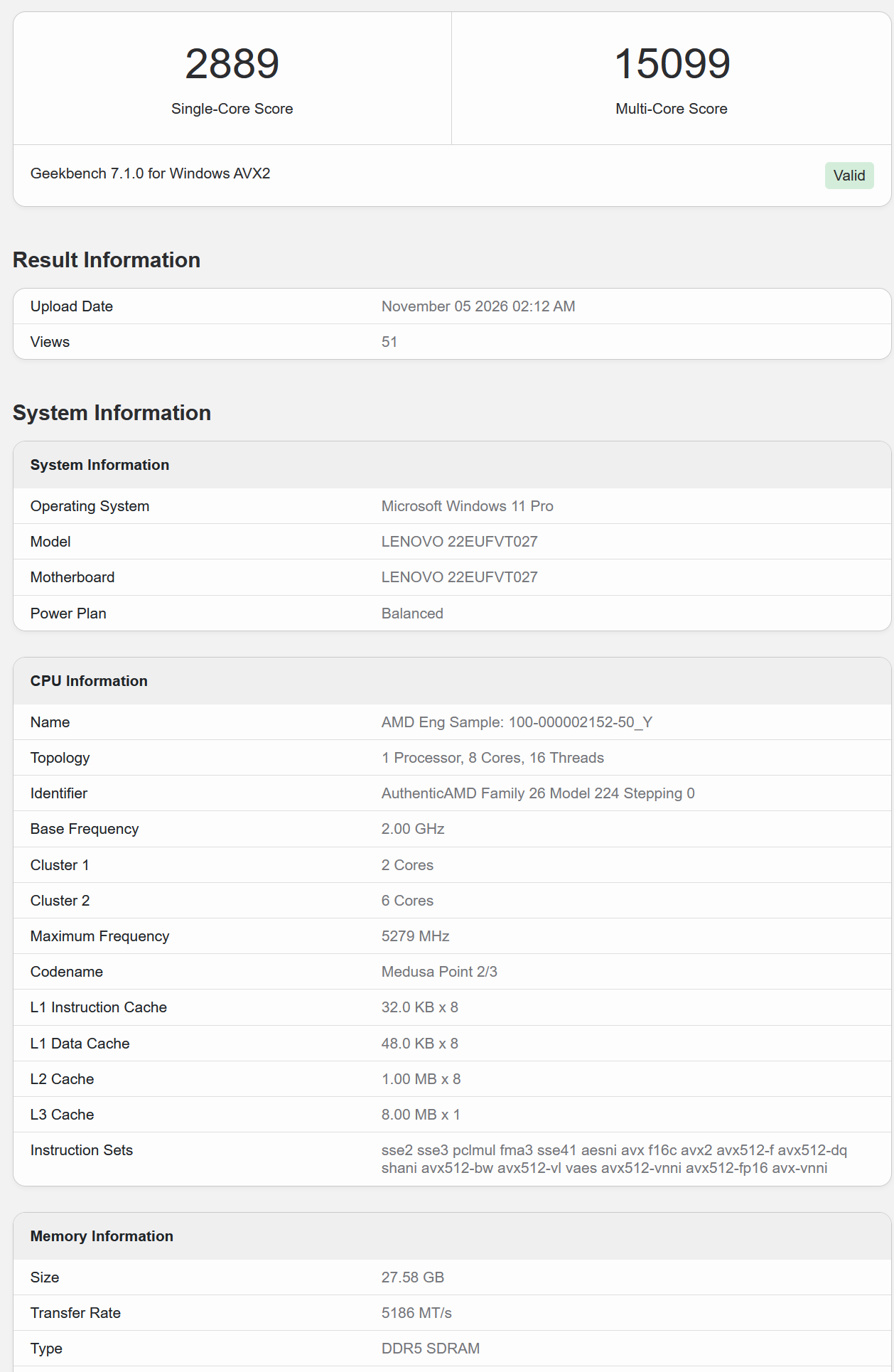
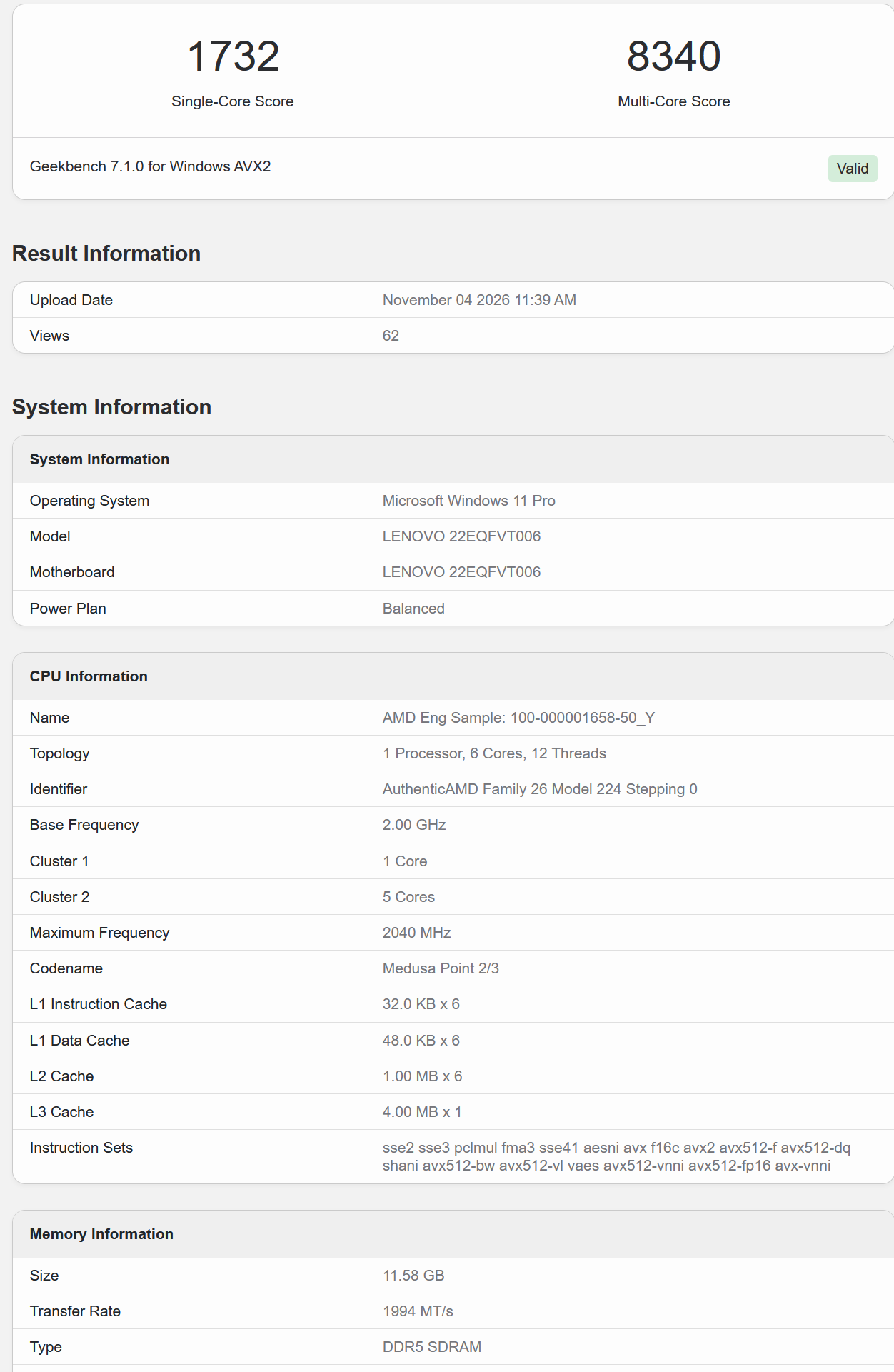
Performance-wise, the six-core processor scored 1,732 points in Geekbench 7's single-core test and 8,340 in multi-core. Its eight-core counterpart performed considerably better, achieving 2,889 and 15,099 points, respectively. For comparison, the recently spotted ten-core Medusa Point sample managed 3,100 and 18,313 points in the same benchmark. These numbers do not represent the final performance of Zen 6 or Medusa Point in general because the hardware is clearly not opearting at peak capacity.
AMD previously outlined its next-generation CPU roadmap at its Financial Analyst Day, confirming that Zen 6 would arrive in 2026 on a TSMC 2 nm-class process. Its Zen 6-based Medusa laptop processors, including the expected Medusa Point and Medusa Halo families, are anticipated to follow in 2027, with the Zen 5-based Gorgon refresh filling the gap. AMD also acknowledged Zen 7, promising a new Matrix Engine but revealing little else.
Meanwhile, Moore's Law Is Dead has claimed Zen 6 desktop processors could achieve boost clocks exceeding 6.5 GHz, potentially thanks to TSMC's N2X process. The leaker has also suggested Zen 7 could feature four different CPU core types, expanded 3D V-Cache and TSMC's A16 manufacturing process. However, these claims remain unverified, and the rumored desktop clock speeds cannot be extrapolated to AMD's upcoming laptop processors.
We previously covered a ten-core Medusa Point engineering sample, which demonstrated promising performance gains over its Zen 5 predecessor. The latest discoveries provide additional insight into AMD's plans for the broader Zen 6 laptop lineup, although final specifications, product names, and launch dates remain unconfirmed.
Source(s)
via Videocardz
 Add as a preferred source on Google


