 Deutsch
 Español
 Français
 Italiano
 Nederlands
 Polski
 Português
 Русский
 Türkçe
 Svenska
 Chinese
 Magyar
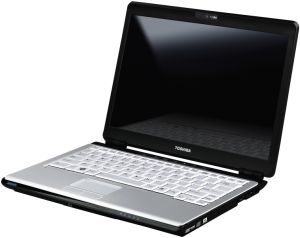
Toshiba Satellite Pro U300
Specifications
Pricecompare
Average of 1 scores (from 3 reviews)
Reviews for the Toshiba Satellite Pro U300
Source: Inside HW
 Archive.org version
Generally, right word that describes this notebook best is average. Nowadays average doesn’t go by very well. None of these faults are too big but there are many of them, much more than we expected. Toshiba Satellite U300-153 with price tag somewhere around 700€ ranks up as cheaper in its class. That is withal its biggest selling point because of reduced offer of 13.3’’ screen notebooks on the market. We consider that you can spend your money wiser if, from any reasons, notebook of these dimensions isn’t necessary.
Preis mäßig
Single Review, online available, Medium, Date: 07/02/2008
Rating: price: 60%
Source: Pocket Lint
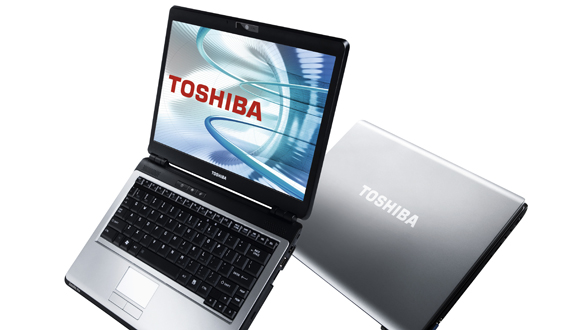
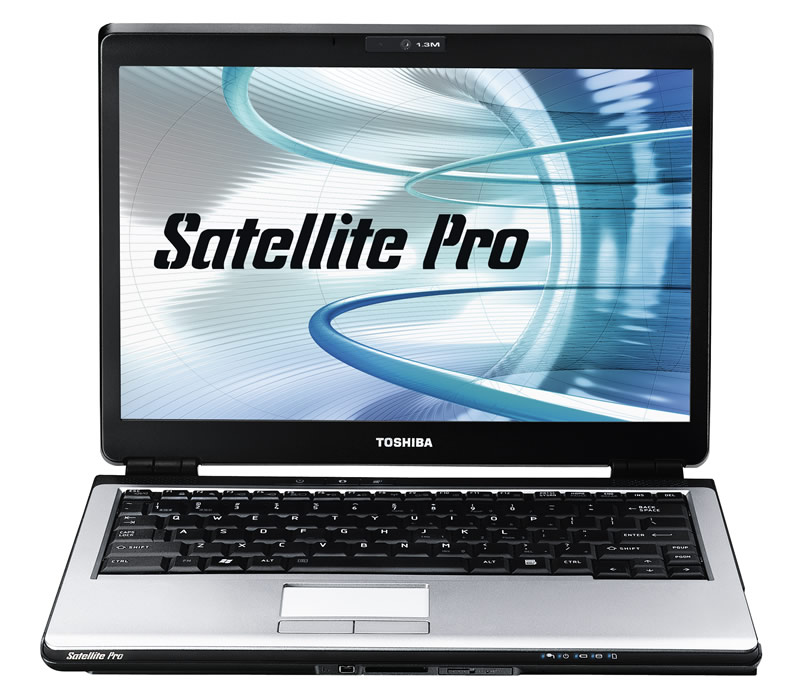
Archive.org versionToshiba tends to split its business in two quite distinctive trends, you have the full multimedia statements, such as its Qosmio line, and then there is the rather subdued and safe business machine. While the Toshiba Satellite Pro U300 falls into the second camp it's not an unattractive notebook. Finished in black and grey plastic, this isn't the most stylish of notebooks but it certainly proved robust for use on the move. It's a slim machine considering there is a DVD rewriter built-in and the size means it great for the commute, as it will easily slip in to any standard carry case. With an overall weight of 2.1kg, it's reasonably portable and coupled with a battery life well in excess of 3 hours, we were more than satisfied with its portability. The Toshiba Satellite Pro U300 may not be a notebook to grab the headlines like some other 13.3-inch machines but we found it a powerful and versatile machine that certainly offers great value for money.
8 von 10, Leistung gut, Mobilität gut
Single Review, online available, Short, Date: 04/07/2008
Rating: Total score: 80% performance: 80% mobility: 80%
Foreign Reviews
Source: c't - 4/08

Comparison, , Medium, Date: 01/31/2008
Rating: performance: 70% features: 80% display: 40% mobility: 70% ergonomy: 80%
Comment
Intel Graphics Media Accelerator (GMA) X3100: Intel Graphics Media Accelerator (GMA) X3100 is an integrated (onboard) graphic chip on a Mobile Intel 965GM chipset. It is the successor of GMA 950 and features a fully programmable pipeline (supports Aero Glass fully and DirectX 10 with newest drivers). The peformance of the X3100 is clearly better than the GMA 950, still demanding modern games won't run fluently.
These graphics cards are not suited for Windows 3D games. Office and Internet surfing however is possible.
» Further information can be found in our Comparison of Mobile Graphics Cards and the corresponding Benchmark List.
Intel Core 2 Duo: This is the Core Duo and Core Solo successor with a longer pipeline and 5-20% more speed without more power consumption. As an addition to the Core Duo design there exists a fourth decoder, an amplified SSE-unit and an additional arithmetical logical unit (ALU).
The Core 2 Duo for laptops is identical to the desktop Core 2 Duo processors but the notebook-processors work with lower voltages (0.95 to 1188 Volt) and a lower Frontside bus clock (1066 vs 667 MHz). The performance of equally clocked notebooks is 20-25% lower than Desktop PCs because of the lower Frontside bus clock and the slower hard disks.
T7250: Mid-range (at the time of annoucement) dual core processor based on the Merom core. » Further information can be found in our Comparison of Mobile Processsors.
13.30":
There are hardly any tablets in this display size range anymore. For subnotebooks, on the other hand, it is the standard format.
The advantage of subnotebooks is that the entire laptop can be small and therefore easily portable. The smaller display also has the advantage of requiring less power, which further improves battery life and thus mobility. The disadvantage is that reading texts is more strenuous on the eyes. High resolutions are more likely to be found in standard laptops.
» To find out how fine a display is, see our DPI List.Toshiba: Toshiba Corporation is a Japanese conglomerate or technology group. The company was established in 1939 and in 1978 Toshiba became the official company name. The company's products and services include power, industrial and social infrastructure systems, elevators and escalators, electronic components, semiconductors, hard drives, printers, batteries, lighting, logistics and information technology. Toshiba was one of the largest manufacturers of personal computers, consumer electronics, home appliances and medical equipment.
80%: This rating is not earth-shattering. This rating must actually be seen as average, since there are about as many devices with worse ratings as better ones. A purchase recommendation can only be seen with a lot of goodwill, unless it is about websites that generally rate strictly.
» Further information can be found in our Notebook Purchase Guide.