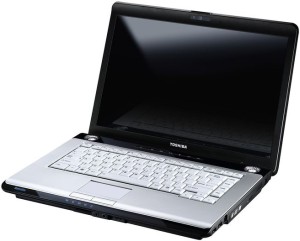
Toshiba Satellite A210-131
Specifications
Price comparison
Average of 1 scores (from 2 reviews)
Reviews for the Toshiba Satellite A210-131
Source: Notebookreview.com
 Archive.org version
In this price bracket the big players this year seem to be the Toshiba Satellite A210/A200, Dell Vostro 1000 and Acer Aspire 47xx and 55xx Gemstone series. All are good choices. Where I see the Toshiba having an edge over the Vostro 1000 is in the buyer's ability to walk into a store and touch/feel the notebook. Things like keyboard and design are very personal and hard to convey in a small web photograph. Aesthetically the Toshiba is better looking in my opinion. The Vostro can be bought with Windows XP - a vastly superior Operating System for PCs with modest specification like these. The Dell has a more orthodox keyboard layout - for a lot of people this alone could be the clincher. It also comes with a smaller 120GB HDD, but is spins faster. Comparing the A210 to Acer's Aspire, I again think the chassis is nicer on the Toshiba. The two Acer notebooks I found at this price both had Celeron CPUs - one was spec'ed with 512MB RAM and an 80GB HDD. So the Toshiba has an edge in terms of performance and specifications.
Preis gut, Ausstattung gut, Verarbeitung gut
User Review, online available, Medium, Date: 03/27/2008
Rating: price: 80% features: 80% workmanship: 80%
Foreign Reviews
Source: Notebookforum.at
 DE→EN Archive.org version
User Review, online available, Short, Date: 09/25/2007
Rating: Total score: 90% price: 80% workmanship: 50%
Comment
ATI Mobility Radeon HD 2400: This DirectX 10 graphic card from ATI is the direct competitor to the NVIDIA GeForce 8400M GS graphic card for laptops. It features the Avivo HD video engine. The performance is not enaough for DX 10 games and high settings.
Only some 3D games with very low demands are playable with these cards.
» Further information can be found in our Comparison of Mobile Graphics Cards and the corresponding Benchmark List.
AMD Turion 64 X2: AMD Turion 64 X2 is intended to be positioned against the Intel Core Duo was presented in 17. May 2006. The current consumption is not higher than with Centrino-Duo-notebooks (TL-45 with ATI Xpress and Mobility Radeon X300). This means, that approximative the same battery runtime and fan functions can be expected (with this chipset). However, the performance was 20% below the T2300 (1.66 GHz) due to the lower L2 Cache (Core Duo has 2048 Kbyte shared L2 Cache). Nevertheless, the performance is sufficient.
TL-56:
In 90nm (33W TDP) and 65nm (31W TDP) produced dual core processor with a clock rate of 1.8 GHz. The TL-56 is still based on the K8 core and compareable to a slower clocked Core Duo.
» Further information can be found in our Comparison of Mobile Processsors.
 Add as a preferred source on Google