 Deutsch
 Español
 Français
 Italiano
 Nederlands
 Polski
 Português
 Русский
 Türkçe
 Svenska
 Chinese
 Magyar
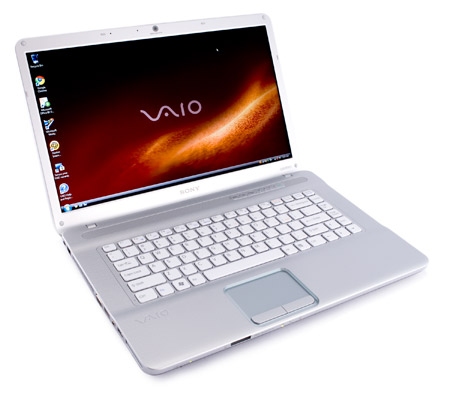
Sony Vaio VGN-NW160J
Specifications
Pricecompare
Average of 1 scores (from 1 reviews)
Reviews for the Sony Vaio VGN-NW160J
Source: CNet
 Archive.org version
Is Blu-ray the future of laptops? If Sony had its way that would certainly be the case. And if all Blu-ray-playing laptops were as well-executed as Sony's Vaio NW160J, that wouldn't be the most daunting consideration. Sony has been packaging its Vaio laptops as design-centric, relatively expensive multimedia machines with a Blu-ray-playing focus for a while now, so it shouldn't be a surprise that the company's new line of slightly higher than midrange laptops, the NW series, culminates with a 15-inch Blu-ray version. Although it's expensive for a 15-inch multimedia laptop, the Blu-ray and game-playing capabilities of the attractive 15.4-inch Sony Vaio NW160J make it a worthy portable entertainment system.
Single Review, online available, Long, Date: 07/29/2009
Rating: Total score: 79% performance: 70% features: 80% mobility: 70%
Comment
ATI Mobility Radeon HD 4570: Lower middle-class GPU that features a low shader count and a 64 Bit memory bus but a high clock speed. Similar to the desktop Radeon 4550. Supports Avivo HD and DirectX 10.1.
Only some 3D games with very low demands are playable with these cards.
» Further information can be found in our Comparison of Mobile Graphics Cards and the corresponding Benchmark List.
Intel Core 2 Duo: This is the Core Duo and Core Solo successor with a longer pipeline and 5-20% more speed without more power consumption. As an addition to the Core Duo design there exists a fourth decoder, an amplified SSE-unit and an additional arithmetical logical unit (ALU).
The Core 2 Duo for laptops is identical to the desktop Core 2 Duo processors but the notebook-processors work with lower voltages (0.95 to 1188 Volt) and a lower Frontside bus clock (1066 vs 667 MHz). The performance of equally clocked notebooks is 20-25% lower than Desktop PCs because of the lower Frontside bus clock and the slower hard disks.
T6500:
Entry level Penryn based dual-core CPU with a small 2MB level 2 cache and FSB800. Similar to the T6570 but without VT-x.
» Further information can be found in our Comparison of Mobile Processsors.
15.50":
15-inch display variants are the standard and are used for more than half of all laptops.
The reason for the popularity of mid-sized displays is that this size is reasonably easy on the eyes, often allows high resolutions and thus offers rich details on the screen, yet does not consume too much power and the devices can still be reasonably compact - simply the standard compromise.
» To find out how fine a display is, see our DPI List.2.7 kg:
With this weight, a laptop is rather heavier than average. Devices in this range shine more with screen size and performance than with mobility.
Sony: Sony Corporation is one of the largest Japanese electronics companies. The company was founded in 1946 under a different name and initially produced rice stoves. The company launched the first transistor radio. In 1958, the company was renamed Sony. Sony is a combination of the Latin word sonus (sound) and the English word sonny (little boy). Today, its core business is consumer electronics. The company is engaged in the development, design, manufacture and sale of electronic equipment, instruments, devices, game consoles and software. Sony operates in the following segments: Gaming and Network Services, Music, Images, Home Entertainment and Sound, Imaging Products and Solutions, Mobile Communications, Semiconductors, Financial Services and Others.
79%: This rating is not earth-shattering. This rating must actually be seen as average, since there are about as many devices with worse ratings as better ones. A purchase recommendation can only be seen with a lot of goodwill, unless it is about websites that generally rate strictly.
» Further information can be found in our Notebook Purchase Guide.