


 Deutsch
 Español
 Français
 Italiano
 Nederlands
 Polski
 Português
 Русский
 Türkçe
 Svenska
 Chinese
 Magyar
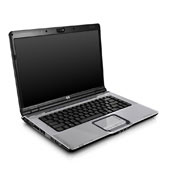
HP Pavilion dv6000
Specifications
Pricecompare
Average of 1 scores (from 1 reviews)
Reviews for the HP Pavilion dv6000
Source: CNet
 Archive.org version
Like all the laptops in the HP Pavilion line, the dv6000's sleek design and shiny finish hold their own next to systems from style-conscious manufacturers such as Apple and Sony. Aside from its good looks, the dv6000 also provides a solid set of entertainment features and high-end components for a fair price. Those components didn't result in record-breaking performance, and its battery life was below average. For these reasons we recommend the Pavilion dv6000 for home users who want a laptop with basic entertainment features and who don't plan to spend a lot of time away from the power outlet. The HP Pavilion dv6000 measures 14 inches wide, 10.1 inches deep, and 1 inch thick--about the same size as the Dell Inspiron E1505 and the PC Club Enpower ENP680.
ausführlicher Test mit Geräteaufbau und Testwerten und Bildern; online abrufbar
6.7 von 10
Single Review, online available, Short, Date: 09/26/2006
Rating: Total score: 67%
Comment
ATI Mobility Radeon X1400: ATI Mobility Radeon X1400 is part of the lower middle class. The performance can be compared with an elder X600, but technically it is a X1300, which is scarcely 100 Mhz higher clocked.
Only some 3D games with very low demands are playable with these cards.
» Further information can be found in our Comparison of Mobile Graphics Cards and the corresponding Benchmark List.
Intel Core Duo: Double Core processor with a very good relation of performance to current consumption. The 2 MB L2 Cache are used together by the double. The maximum capacity of 31 watts is only 4 watts more than with the Pentium M (predecessor). Both cores are lowered automatically and independently of each other by speed steps down to 1 GHz. In addition it now supports also SSE3 instructions. At least it is just as fast as a equivalent Pentium M. With applications, which were designed for multi-processors, the performance can be nearly twice as fast as with the Pentium M (e.g. CineBench around 86% fast)
T2500: » Further information can be found in our Comparison of Mobile Processsors.
15.40":
15-inch display variants are the standard and are used for more than half of all laptops.
The reason for the popularity of mid-sized displays is that this size is reasonably easy on the eyes, often allows high resolutions and thus offers rich details on the screen, yet does not consume too much power and the devices can still be reasonably compact - simply the standard compromise.
» To find out how fine a display is, see our DPI List.3 kg:
With this weight, a laptop is rather heavier than average. Devices in this range shine more with screen size and performance than with mobility.
HP: Founded in 1939, the US company is a major server and printer manufacturer and one of the leading IT companies in the world. Until 2015, the company was called Hewlett-Packard Company. After a split, the computer division was renamed HP Inc.
In 2023, HP had an approximate market share of 22% of global PC sales, making it number 2 after Lenovo.
67%: This rating is poor. More than three quarters of the models are rated better. That is rather not a purchase recommendation. Even if verbal ratings in this area do not sound that bad ("sufficient" or "satisfactory"), they are usually euphemisms that disguise a classification as a below-average laptop.
» Further information can be found in our Notebook Purchase Guide.