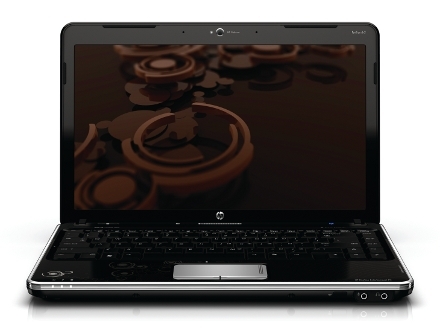
HP Pavilion dv3-2055ea
Specifications

Price comparison
Average of 3 scores (from 3 reviews)
Reviews for the HP Pavilion dv3-2055ea
Source: Trusted Reviews
 Archive.org version
If you're after portability and power then the 13in form factor has long been the best option. There have been numerous excellent examples in this arena over the last year or two, including the now discontinued Dell XPS M1330, the outstanding Sony VAIO Z Series and the latest iteration of the machine that arguably popularised the format, the Apple Macbook. This 13.3in machine delivers on many levels. It's packed full of useful features, particularly that capacious 500GB hard drive, while the design is attractive - if a little showy. This is backed up by decent raw performance and excellent battery life. It's not quite the perfect bargain, but for £750 you couldn't ask for a great deal more.
90, Preis 90, Leistung 80, Ausstattung 90
Single Review, online available, Long, Date: 06/18/2009
Rating: Total score: 90% price: 90% performance: 80% features: 90%
Source: CNet
Archive.org versionHP has been cutting something of a dash with its laptops for quite a while now, and the 13.3-inch Pavilion dv3-2055ea certainly continues the trend. Slim, light and with ports a plenty, HP's Pavilion dv3-2055ea is a very well-specified laptop for the money. It could be quieter and its 3D graphics performance needs to be stronger to live up to the 'entertainment' epithet, but it's still a capable all-rounder with a few features that set it apart from the competition.
70
Single Review, online available, Medium, Date: 06/02/2009
Rating: Total score: 70%
Foreign Reviews
Source: PC Actual
 ES→EN Archive.org version
Single Review, online available, Very Short, Date: 12/01/2009
Rating: Total score: 83% price: 85%
Comment
NVIDIA GeForce G 105M: Higher clocked 9300M GS and therefore a bit faster. Still manufactured in 65nm. Supports Hybrid-SLI with HybridPower and GeForceBoost (in conjunction with the right Nvidia chipset).
Only some 3D games with very low demands are playable with these cards.
» Further information can be found in our Comparison of Mobile Graphics Cards and the corresponding Benchmark List.
Intel Core 2 Duo: This is the Core Duo and Core Solo successor with a longer pipeline and 5-20% more speed without more power consumption. As an addition to the Core Duo design there exists a fourth decoder, an amplified SSE-unit and an additional arithmetical logical unit (ALU).
The Core 2 Duo for laptops is identical to the desktop Core 2 Duo processors but the notebook-processors work with lower voltages (0.95 to 1188 Volt) and a lower Frontside bus clock (1066 vs 667 MHz). The performance of equally clocked notebooks is 20-25% lower than Desktop PCs because of the lower Frontside bus clock and the slower hard disks.
T6400: Entry level dual core processor based on the Penryn core with only 2 MB level 2 cache and a low clock speed.» Further information can be found in our Comparison of Mobile Processsors.
 Add as a preferred source on Google