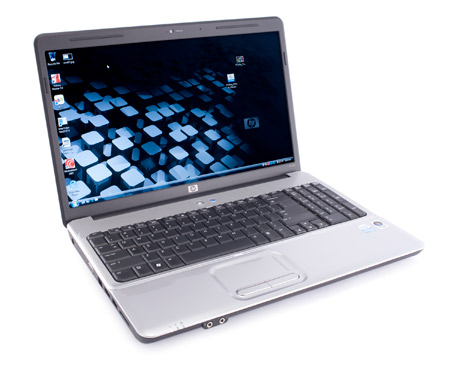
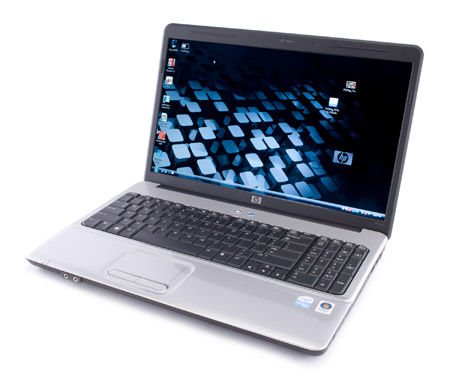
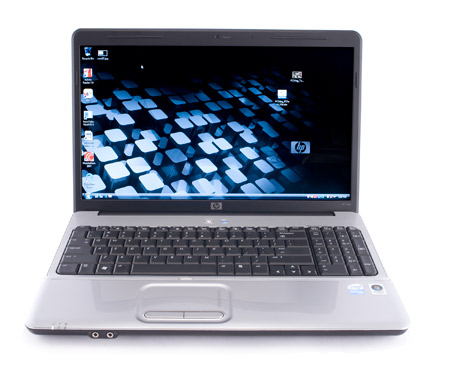
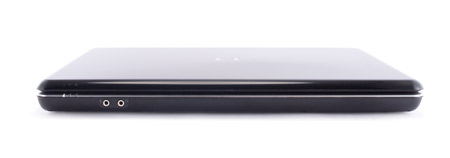
HP G61-410SA
Specifications
Price comparison
Reviews for the HP G61-410SA
Source: Tech Advisor
 Archive.org version
The high build-quality makes the HP G61-410SA a joy to use and with a price of only £399 it’s also a tie with MSI for the lowest-cost option. In terms of raw specification, just about everything about the G61 can be bettered, but you’ll most certainly have to pay for it. By contrast, the only other option at this price from MSI comes with no optical drive and even slower application performance.
Single Review, online available, Short, Date: 05/04/2010
Rating: performance: 80% workmanship: 80%
Comment
Intel Graphics Media Accelerator (GMA) 4500M: The graphics core of the Intel GL40 and GS40 chipset features a slower clocked GMA 4500MHD (400 versus 533 MHz). Because of the slower core speed, full Blu-Ray Logo support is not given and the gaming performance is a bit worse.
Only some 3D games with very low demands are playable with these cards.
» Further information can be found in our Comparison of Mobile Graphics Cards and the corresponding Benchmark List.
Intel Celeron Dual-Core: The Intel Celeron Dual-Core familiy consists out of dual core CPUs for cheap laptops. Compared to the Celeron M single core family the biggest advantage (in addition to the second core) is the Enhanced Speedstep function, which enables the notebook to downclock the CPU in Idle mode. Therefore, the current consumption can be much lower. Compared to the Core (2) Duo or Pentium Dual-Core processors, the Celeron Cual-Core features much less L2 Cache which leads to a lower performance per clock.
T3100: Slow clocked entry level dual core CPU with 64 Bit functions enabled. As the T3100 lacks Speedstep and other power saving functions, the power consumption is higher than of a similar clocked Core 2 Duo / Pentium.» Further information can be found in our Comparison of Mobile Processsors.


 Add as a preferred