 Deutsch
 Español
 Français
 Italiano
 Nederlands
 Polski
 Português
 Русский
 Türkçe
 Svenska
 Chinese
 Magyar
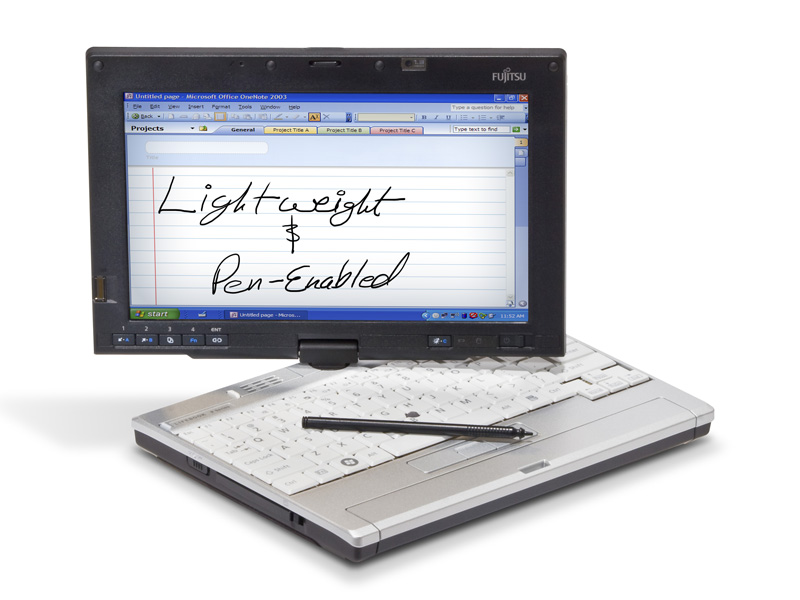
Fujitsu Lifebook P1630
Specifications
Pricecompare
Average of 1 scores (from 1 reviews)
Reviews for the Fujitsu Lifebook P1630
Source: Gadget Zone
 Archive.org version
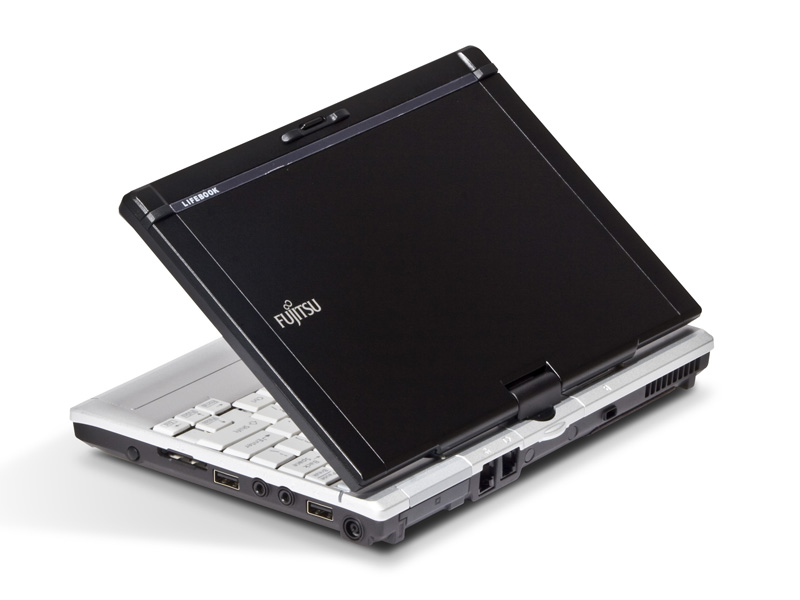
It has the features and build quality we’ve come to expect from the Lifebook series including an LED backlit 8.9" WXGA Transmissive anti-glare screen and integrated 3.5G wireless internet capabilities. Under the hood, an Intel Core 2 Duo SU9300 processor running at 1.2GHz powers the P1360. The Fujitsu Lifebook P1360 is a highly portable tablet PC solution and will suit those that need something that performs well but is also suitable for taking on the road. It performed well and apart from a few small things we didn’t have any major problems with it.
4 von 5, Leistung exzellent
Single Review, online available, Medium, Date: 01/19/2009
Rating: Total score: 80% performance: 95%
Comment
Intel Graphics Media Accelerator (GMA) 4500MHD: Onboard (shared Memory) GPU built in the GM45, GE45 and GS45 chipset (Montevina). Because of two more shaders and a higher core clock, much faster than the old GMA X3100. Still not advisable for gamers (DirectX 10 games not playable or only with very low settings). The integrated video processor is able to help decode HD videos (AVC/VC-2/MPEG2) , e.g., for a fluent Blu-Ray playback with slow CPUs.
Only some 3D games with very low demands are playable with these cards.
» Further information can be found in our Comparison of Mobile Graphics Cards and the corresponding Benchmark List.
Intel Core 2 Duo: This is the Core Duo and Core Solo successor with a longer pipeline and 5-20% more speed without more power consumption. As an addition to the Core Duo design there exists a fourth decoder, an amplified SSE-unit and an additional arithmetical logical unit (ALU).
The Core 2 Duo for laptops is identical to the desktop Core 2 Duo processors but the notebook-processors work with lower voltages (0.95 to 1188 Volt) and a lower Frontside bus clock (1066 vs 667 MHz). The performance of equally clocked notebooks is 20-25% lower than Desktop PCs because of the lower Frontside bus clock and the slower hard disks.
SU9300: Power efficient low voltage processor based on the Penryn 3M core that features all Penryn functions like Virtualization and Trusted Execution.» Further information can be found in our Comparison of Mobile Processsors.
8.90":
Large smartphones and a few small tablets are available for this display size. Unlike most smartphones, you can see more on the screen, more details and use larger resolutions. Such formats are better for people with defective vision. However, such devices are no longer easy to fit in a pocket, and they are probably not quite light either.
» To find out how fine a display is, see our DPI List.Fujitsu: Fujitsu is a Japanese technology group listed on the Nikkei 225 with origins dating back to 1935. Its products and services focus on information technology, telecommunications, semiconductors, networks, computer and communications products and advanced microelectronics.
In 1999, the cooperation with Siemens in the IT sector (servers, notebooks, desktop PCs, etc.) started under the Fujitsu-Siemens brand. 10 years later, this cooperation ended.
80%: This rating is not earth-shattering. This rating must actually be seen as average, since there are about as many devices with worse ratings as better ones. A purchase recommendation can only be seen with a lot of goodwill, unless it is about websites that generally rate strictly.
» Further information can be found in our Notebook Purchase Guide.