


Do old social media posts reveal more about your mental health than you'd like?

People share highly personal information on social media over the course of many years. They write about sleep problems, lack of motivation, anxiety, self-doubt, and their moods. Researchers at George Mason University have now developed an AI-based method that analyzes these posts and uses them to identify potential signs of depression.
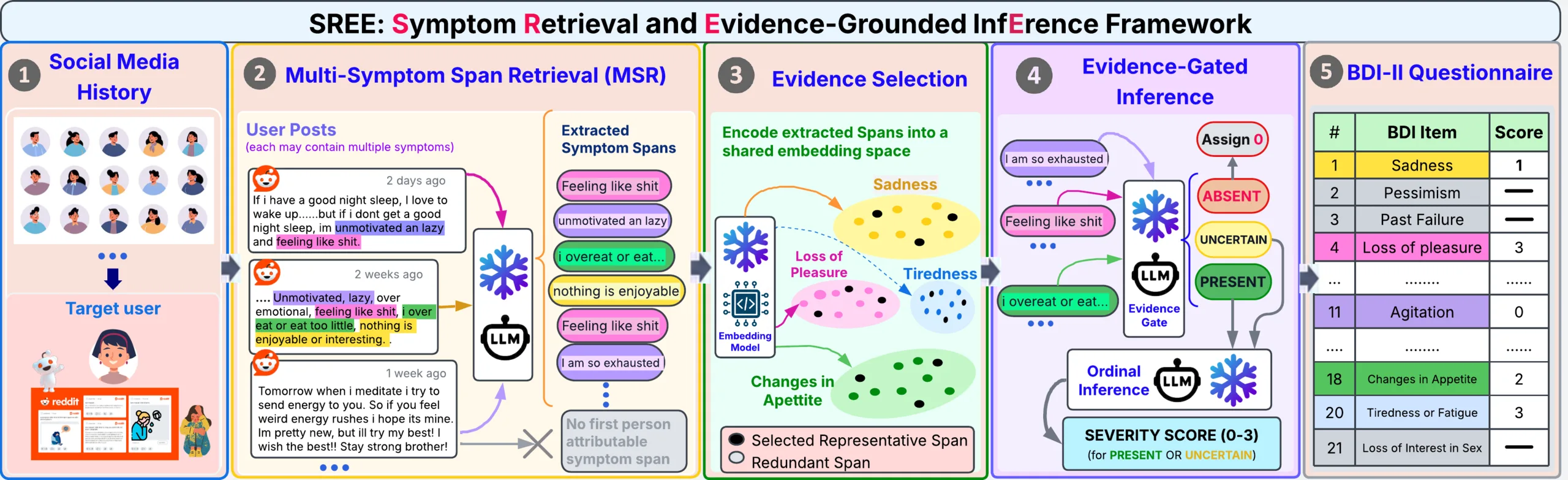
The AI doesn't simply look for posts that sound sad or use negative language. For example, someone who writes that a friend is suffering from depression shouldn't automatically be classified as depressed themselves. That's why the method works in several steps:
- Identifying symptoms: A language model specifically looks for first-person statements that match certain symptoms of depression.
- Selecting relevant statements: Repetitions, incorrect information, and irrelevant content are filtered out. The goal is to retain only the most meaningful passages.
- Evaluating statements: An additional verification step determines whether the identified passages actually provide sufficient evidence of a particular symptom.
- The system then attempts to derive answers to the 21 questions in the standardized Beck Depression Inventory (BDI-II).
Results
Compared with previous methods, the model improved precision (the proportion of retrieved results that are actually relevant) by a relative 70 percent. However, the actual precision increased only from 10 to 17 percent. The F1 score (a measure of how many retrieved results are relevant and how many of all relevant results the AI actually identifies) rose to 27 percent. Despite the relatively low overall scores, the new approach represents a significant improvement over previous methods.
The study also demonstrates how effectively large volumes of social media posts can be filtered to identify content relevant to specific and complex tasks, such as detecting symptoms of depression.
What the AI can't do:
At this stage, the AI cannot reliably identify people with depression, let alone do so with any degree of certainty. This means the method is not currently suitable for diagnostic purposes. What is interesting, however, is that personal information can still be extracted from posts written years ago — details we may not even remember sharing.
Source
 Add as a preferred source on Google


