




CL1 wetware computer plays Doom as its living brain cells form data centers that sip power unlike Nvidia GPUs
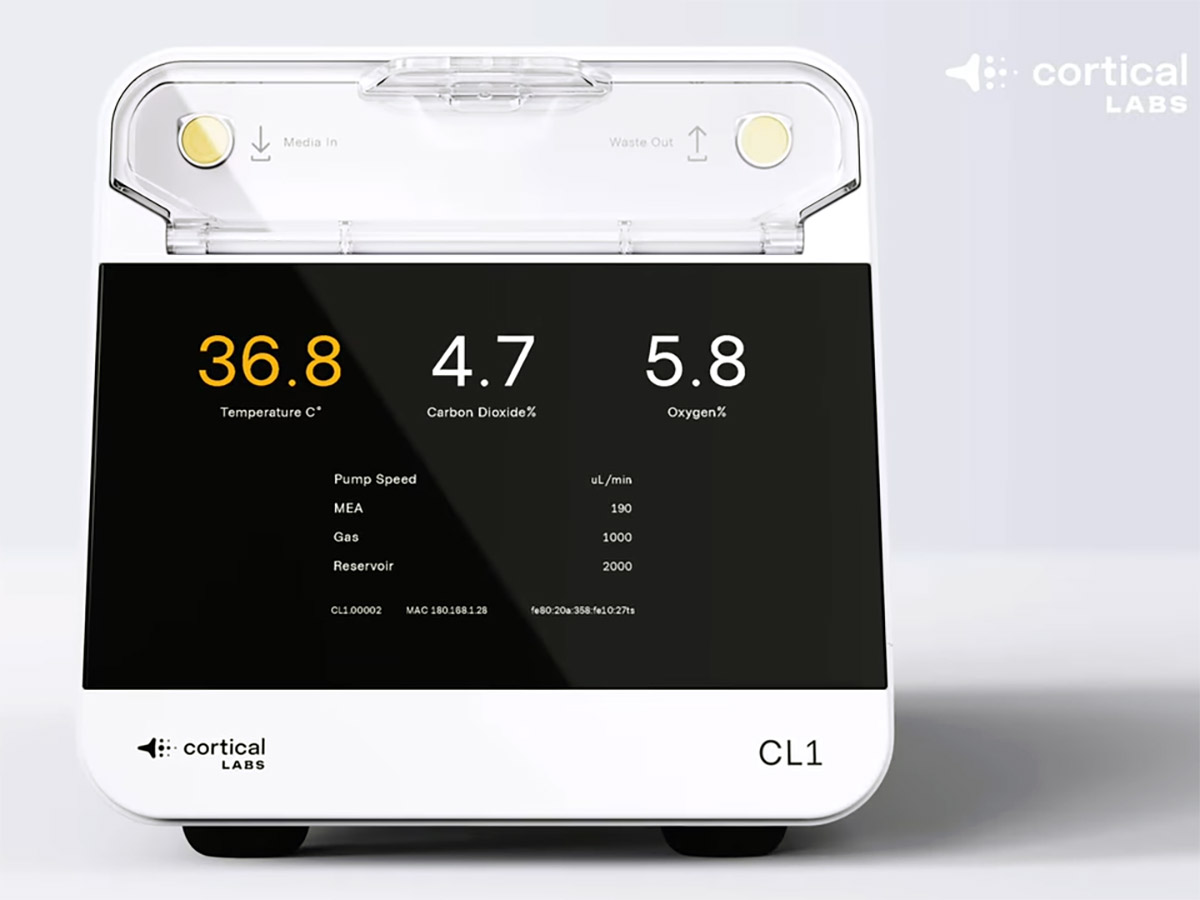
The biotech startup Cortical Labs has unveiled what it calls the world's first biological data centers. Instead of racks of power-hungry Nvidia GPUs, they run on living human brain cells incorporated in silicon chips that draw as little as 30 watts each.
The hardware at the heart of these centers is the CL1, a "wetware" biological computer that was first announced at MWC 2025. Each unit houses roughly 800,000 neurons grown in a lab from human stem cells. A nutrient-rich solution keeps them alive, while a multielectrode array feeds them electrical signals and collects their responses. The CL1's display shows the neuron's vitals as the system controls temperature, gas mixture, and waste filtration to keep the human brain cells usable for up to six months.
The CL1 is a self-contained computing system that costs around $35,000, and a whole rack of them only consumes 850 to 1,000 watts, keeping up with the big power-sipping promise of the so-called wetware computing. In comparison, a single Nvidia GPU in a typical AI data center runs on 6,000 watts. With skyrocketing energy costs and an AI infrastructure that guzzles power, the electrical grids are feeling the strain, and Cortical Labs is pitching its biological compute as a fundamentally different processing concept that is way more sustainable than silicon-based GPUs.
The kicker is that the neurons don't need to be trained in the traditional sense, as they adapt and rewire themselves in response to stimuli, a human brain feat that has served mankind well for millennia. The company's earlier DishBrain prototype taught itself to play simple games like Pong, for example, while the latest CL1 unit can already navigate considerably more complex titles like Doom all on its own, as demonstrated in the video below.
Cortical Labs calls this hybrid approach Synthetic Biological Intelligence, or SBI, and runs it through a proprietary Biological Intelligence Operating System (biOS). It says that the software can mediate between the neurons and the tasks they're being asked to perform. Researchers can access the system remotely via the newly launched Cortical Cloud, whose operational model is ingeniously called Wetware-as-a-Service. For $300 per unit a week, scientists from around the globe can deploy and test code directly on the living neural networks and gauge their performance.
Cortical Labs has opened its first such facility in Melbourne only as a proof of concept. In Singapore, however, it is currently building a much larger one in partnership with the local DayOne Data Centers provider. Needless to say, the company's two-dimensional neuron layers are simplistic compared to actual brain architecture, but the biological data centers are an interesting application of wetware organic computing running on neurons rather than transistors.
Get the Nvidia GeForce RTX 5080 Founders Edition GPU on Amazon
Source(s)
 Add as a preferred source on Google


