




Apple A9 vs Apple A7
Apple A9
► remove from comparison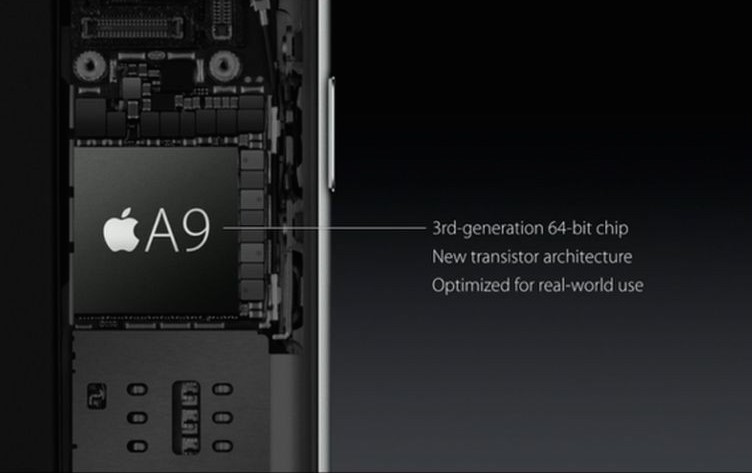
The Apple A9 is a high-end dual-core ARM SoC for smartphones. It was announced in Sept. 2015 in the new iPhone 6s and 6s Plus. Technical details were not published, but the CPU part should be about 70% and the GPU 90% faster than the previous Apple A8. Therefore, the performance should be on par with high-end Android SoCs in 2015.
It is based on the third generation of Apples 64 Bit architectures (Cyclone 3?) and uses a "new transistor technology". It is manufactured at Samsung in 14nm (slightly smaller die) and TSMC at 16nm (both FINFET 3D transistors). A performance difference of both versions are not noticable.
Furthermore, the chip now integrates the M9 motion coprocessor and a 4K video de- and encoder (as the iPhones 6s supports 4K video recording). The integrated graphics card should be still based on PowerVR technology.
The power consumption could be lower than the A8 due to the new process technology and the fact that the iPhones now got a smaller battery (due to the haptic engine part).
Apple A7
► remove from comparison
The Apple A7 is a high-end ARM SoC launched in September 2013 alongside the iPhone 5S. The chip can also be found in the iPad Air. It is one of the first ARM SoCs to implement the 64-bit ARMv8 ISA. The two CPU cores are clocked at 1.3 GHz (iPad Air: 1.4 GHz) and are based on Apple's Cyclone architecture. Furthermore, the chip also integrates a PowerVR Series 6 (Rogue) G6430 GPU and a 2x 32-bit LPDDR3 memory controller.
Architecture
Cyclone is the successor to the Swift architecture, which was used in the previous generation Apple A6/A6X SoCs (iPhone 5/iPad 4). The architecture is likely still a superscalar out-of-order design, but with significant revisions. Besides the new ARMv8 ISA, the chip offers various cryptography extensions (AES, SHA), extended registers and improved SIMD instructions. In combination with many other improvements like larger L1 caches and other optimizations, the performance per clock has been increased by about 50 percent. Even greater gains can be reported using 64-bit software.
Performance
Despite the low clock speed and only two CPU cores, the Apple A7 competes with other high-end ARM SoCs such as the Qualcomm Snapdragon 800. In software with poor parallelization like browser benchmarks, the A7 can outperform the entire ARM competition and be on par with the AMD A4-5000 or Intel Atom Z3770.
Graphics
The SoC integrates a PowerVR Series 6 (Rogue) G6430 GPU with 4 clusters. The G6430 offers more than twice the computing power of the SGX543MP3 in the Apple A6 and supports OpenGL ES 3.0 for the first time. The exact clock rate has not yet been confirmed, but it is probably in the 400 MHz range resulting in more than 100 GFLOPS. In the iPad Air, the GPU is clocked slightly higher at presumably about 450 MHz. Compared with other mobile graphics solutions, the G6430 performs similar to the tablet version of the Snapdragon 800 / Adreno 330 and is thus one of the fastest GPUs in its class. Therefore, even the most demanding iOS games of 2013 will run fluently.
Power Consumption
The A7 can be found in the Apple iPhone 5S, which offers a very long battery life despite its relatively low battery capacity. The chip is produced in a 28nm HKMG (High-K Metal Gate) process by Samsung and should have an estimated maximum power consumption of less than 2 - 3 W. In the iPad Air, the SoC should have a slightly higher TDP due to higher clock rates and less throttling.
| Model | Apple A9 | Apple A7 |
| Codename | Cyclone 3 | Cyclone |
| Clock | 1800 MHz | 1300 - 1400 MHz |
| Cores / Threads | 2 / 2 | 2 / 2 |
| Technology | 14/16 nm | 28 nm |
| Features | ARMv8 Instruction Set | ARMv8 Instruction Set, PowerVR G6430 (4 Cluster Rogue), 2x 32 Bit LPDDR3-1333 Memory Controller |
| iGPU | Apple A9 / PowerVR GT7600 | |
| Architecture | ARM | ARM |
| Announced | ||
| L1 Cache | 256 KB | |
| L2 Cache | 1 MB | |
| L3 Cache | 4 MB | |
| Transistors | > 1000 Million | |
| Die Size | 102 mm2 |
Benchmarks
Average Benchmarks Apple A9 → 100% n=10
Average Benchmarks Apple A7 → 58% n=10
 - Average benchmark values for this graphics card
* Smaller numbers mean a higher performance
1 This benchmark is not used for the average calculation


 Add as a preferred