




HP Pavilion dv6000z
Specifications
Price comparison
Reviews for the HP Pavilion dv6000z
Source: Notebookreview.com
 Archive.org version
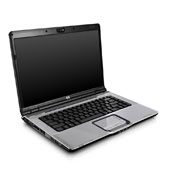
The HP dv6000z has lots to recommend about it. It has a very attractive look with HP's new Imprint Finish. The Turion64 X2 provides decent performance and multitasking. It has all the connection one could ask for and has a marvelous glossy screen. The big question for it is going to be price. Configured at a price of $1491 before tax, it is venturing into the world of the Fujitsu N3000, Compal HEL30 or even the HP's nc8430 which offer better specs or quality for near the same price. It is certainly possible to get this notebook in the $1000 range by not choosing all the upgrades. If one can keep the price down, I think it makes a very good option for a multimedia DTR that can travel bit.
umfangreicher Erfahrungsbericht eines Benutzers; online abrufbar
Preis/Leistung mässig, Leistung anständig, Display mässig
Single Review, online available, Short, Date: 09/11/2006
Rating: price: 70% performance: 80% display: 70%
Comment
NVIDIA GeForce Go 7200: The NVIDIA GeForce Go 7200 is a dedicated graphics card for notebooks but is only as fast as modern integrated graphic chips.
These graphics cards are not suited for Windows 3D games. Office and Internet surfing however is possible.
» Further information can be found in our Comparison of Mobile Graphics Cards and the corresponding Benchmark List.
AMD Turion 64 X2: AMD Turion 64 X2 is intended to be positioned against the Intel Core Duo was presented in 17. May 2006. The current consumption is not higher than with Centrino-Duo-notebooks (TL-45 with ATI Xpress and Mobility Radeon X300). This means, that approximative the same battery runtime and fan functions can be expected (with this chipset). However, the performance was 20% below the T2300 (1.66 GHz) due to the lower L2 Cache (Core Duo has 2048 Kbyte shared L2 Cache). Nevertheless, the performance is sufficient.
TL-56:
In 90nm (33W TDP) and 65nm (31W TDP) produced dual core processor with a clock rate of 1.8 GHz. The TL-56 is still based on the K8 core and compareable to a slower clocked Core Duo.
» Further information can be found in our Comparison of Mobile Processsors.
 Add as a preferred source on Google


