 Deutsch
 Español
 Français
 Italiano
 Nederlands
 Polski
 Português
 Русский
 Türkçe
 Svenska
 Chinese
 Magyar
HP Pavilion dv3-2230ea
Specifications
Pricecompare
Average of 1 scores (from 1 reviews)
Reviews for the HP Pavilion dv3-2230ea
Source: Electricpig
 Archive.org version
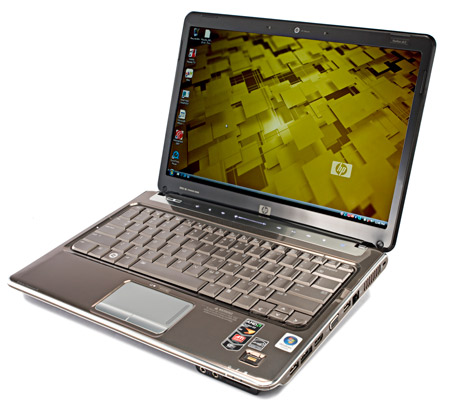
The words “acquired taste” were seemingly invented for the HP Pavilion dv3-2230ea. Loading it up with a swirly design that has the distinct look of flowers isn’t going to be everyones idea of a lush laptop. But aside from the rather off kilter looks, how does this touchscreen machine hold up? Read our HP Pavilion dv3-2230ea review now and find out. An average laptop given the edge by a touch panel.
Single Review, online available, Medium, Date: 02/02/2010
Rating: Total score: 60%
Comment
NVIDIA GeForce G 105M: Higher clocked 9300M GS and therefore a bit faster. Still manufactured in 65nm. Supports Hybrid-SLI with HybridPower and GeForceBoost (in conjunction with the right Nvidia chipset).
Only some 3D games with very low demands are playable with these cards.
» Further information can be found in our Comparison of Mobile Graphics Cards and the corresponding Benchmark List.
Intel Core 2 Duo: This is the Core Duo and Core Solo successor with a longer pipeline and 5-20% more speed without more power consumption. As an addition to the Core Duo design there exists a fourth decoder, an amplified SSE-unit and an additional arithmetical logical unit (ALU).
The Core 2 Duo for laptops is identical to the desktop Core 2 Duo processors but the notebook-processors work with lower voltages (0.95 to 1188 Volt) and a lower Frontside bus clock (1066 vs 667 MHz). The performance of equally clocked notebooks is 20-25% lower than Desktop PCs because of the lower Frontside bus clock and the slower hard disks.
T6600: Entry level Core 2 Duo dual core processor with a small 2MB level 2 cache and without virtualization functions.» Further information can be found in our Comparison of Mobile Processsors.
13.30":
There are hardly any tablets in this display size range anymore. For subnotebooks, on the other hand, it is the standard format.
The advantage of subnotebooks is that the entire laptop can be small and therefore easily portable. The smaller display also has the advantage of requiring less power, which further improves battery life and thus mobility. The disadvantage is that reading texts is more strenuous on the eyes. High resolutions are more likely to be found in standard laptops.
» To find out how fine a display is, see our DPI List.HP: Founded in 1939, the US company is a major server and printer manufacturer and one of the leading IT companies in the world. Until 2015, the company was called Hewlett-Packard Company. After a split, the computer division was renamed HP Inc.
In 2023, HP had an approximate market share of 22% of global PC sales, making it number 2 after Lenovo.
60%: Such a poor rating is rare. There are only a few notebooks that were rated even worse. The rating websites do not give a purchase recommendation here.
» Further information can be found in our Notebook Purchase Guide.