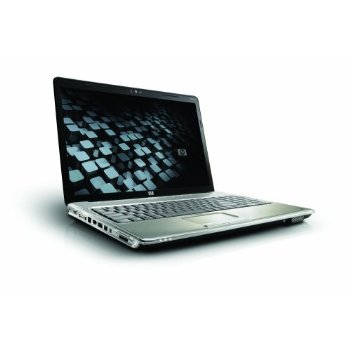
HP Pavilion dv5-1235dx
Specifications

Price comparison
Average of 1 scores (from 2 reviews)
Reviews for the HP Pavilion dv5-1235dx
Source: Fudzilla
 Archive.org version
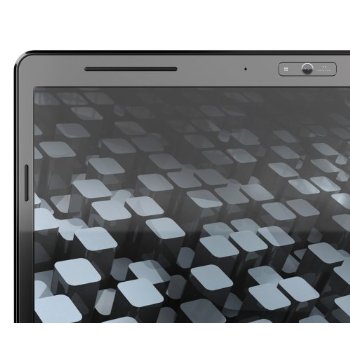
Basically, the DV5 is a no thrills notebook that desperately tries to be different. In some respects, it manages to stick out from the mass of cheap 15-inchers, but it also has some shortcomings. First of all, the glossy touchpad is pretty uncomfortable to use, and it can be downright annoying. The screen is also a bit disappointing. At 1280x800, it lacks a bit of resolution by today's standards, but that's the least of its problems. It's too glossy, and simply lacks brightness and contrast.
Single Review, online available, Long, Date: 07/17/2009
Rating: display: 40%
Source: CNet
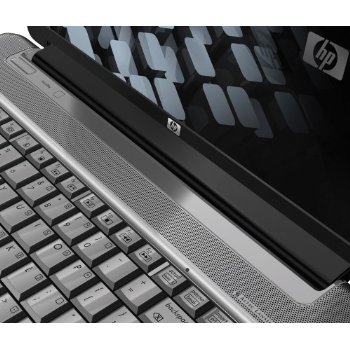
Archive.org versionHP's Pavilion dv line of multimedia laptops, available in 14-, 15-, and 17-inch versions, are all attractive systems aimed at mainstream consumers with a heavy diet of videos, music, and other forms of media. To this end, they share features such as Altec Lansing speakers, HDMI outputs, and touch-sensitive media control buttons, along with mirror-finish accents. HP's attractive multimedia-friendly Pavilion dv5-1235dx has a great battery life, but at the cost of having one of the biggest, ugliest battery packs we've seen
70, Mobilität 80
Single Review, online available, Long, Date: 03/10/2009
Rating: Total score: 70% mobility: 80%
Comment
Intel Graphics Media Accelerator (GMA) 4500MHD: Onboard (shared Memory) GPU built in the GM45, GE45 and GS45 chipset (Montevina). Because of two more shaders and a higher core clock, much faster than the old GMA X3100. Still not advisable for gamers (DirectX 10 games not playable or only with very low settings). The integrated video processor is able to help decode HD videos (AVC/VC-2/MPEG2) , e.g., for a fluent Blu-Ray playback with slow CPUs.
Only some 3D games with very low demands are playable with these cards.
» Further information can be found in our Comparison of Mobile Graphics Cards and the corresponding Benchmark List.
Intel Core 2 Duo: This is the Core Duo and Core Solo successor with a longer pipeline and 5-20% more speed without more power consumption. As an addition to the Core Duo design there exists a fourth decoder, an amplified SSE-unit and an additional arithmetical logical unit (ALU).
The Core 2 Duo for laptops is identical to the desktop Core 2 Duo processors but the notebook-processors work with lower voltages (0.95 to 1188 Volt) and a lower Frontside bus clock (1066 vs 667 MHz). The performance of equally clocked notebooks is 20-25% lower than Desktop PCs because of the lower Frontside bus clock and the slower hard disks.
T6400: Entry level dual core processor based on the Penryn core with only 2 MB level 2 cache and a low clock speed.» Further information can be found in our Comparison of Mobile Processsors.