 Deutsch
 Español
 Français
 Italiano
 Nederlands
 Polski
 Português
 Русский
 Türkçe
 Svenska
 Chinese
 Magyar
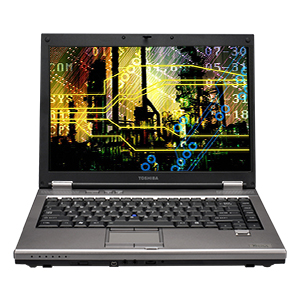
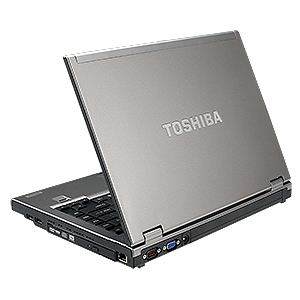
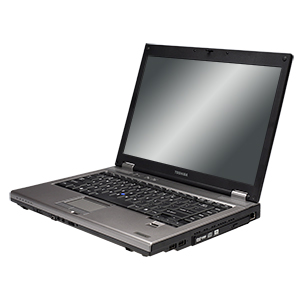
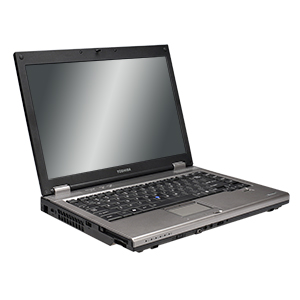
Toshiba Tecra M9L Series
 Processor: Intel Core 2 Duo T5670, Intel Core 2 Duo T7100
Graphics Adapter: Intel Graphics Media Accelerator (GMA) X3100
Display: 14.10 inch
Weight: 2.3kg, 3kg
Price: 800, 1600 euro
Average of 1 scores (from 2 reviews)
Toshiba Tecra M9L
Specifications
Notebook: Toshiba Tecra M9LProcessor: Intel Core 2 Duo T7100
Graphics Adapter: Intel Graphics Media Accelerator (GMA) X3100 128 MB
Display: 14.10 inch, 16:10, 1280 x 800 pixels
Weight: 3kg
Price: 1600 euro
Links: Toshiba homepage Toshiba notebook section
Pricecompare
Reviews
Source: IT Reviews
 Archive.org version
Toshiba's Tecra range of business notebooks may not be as well known as its Satellite range, but the Tecra product line is similarly being refreshed with the latest technologies on a constant basis. The latest additions to the Tecra line-up are the A9 and M9 series. The M9L-12T sits bang in the middle of the six-model M9 family and uses the latest Intel Santa Rosa mobile technology.
The latest Centrino platform, code-named Santa Rosa, features a new Core 2 Duo processor with an 800MHz FSB instead of the previous core's 667MHz, and a host of onboard power-saving features including dynamically switchable FSB speeds (so when the notebook is in a low power state, such as in DVD playback, the FSB throttles back), EDS (Enhanced Deeper Sleep) and Dynamic Acceleration Technology, an advanced version of Intel's Smart Cache technology.
Ausstattung gut
Single Review, online available, Medium, Date: 08/17/2007
Rating: features: 80%
Toshiba Tecra M9L
Specifications
Notebook: Toshiba Tecra M9LProcessor: Intel Core 2 Duo T5670
Graphics Adapter: Intel Graphics Media Accelerator (GMA) X3100 128 MB
Display: 14.10 inch, 16:10, 1280 x 800 pixels
Weight: 2.3kg
Price: 800 euro
Links: Toshiba homepage Toshiba notebook section
Pricecompare
Average Score:
Reviews
Source: Techradar
Archive.org versionThe Toshiba Tecra M9L-1B7 is a good all-round machine aimed at those who need to be mobile for good portions of the day. It won't suit those looking for a multimedia tool; however, if you're looking for a machine to use on the daily commute as well as in the office, this is worth considering.
3.5 von 5, Mobilität sehr gut, Leistung gut, Display gut
Single Review, online available, Short, Date: 09/02/2008
Rating: Total score: 70% performance: 80% display: 80% mobility: 90%
Comment
Toshiba: Toshiba Corporation is a Japanese conglomerate or technology group. The company was established in 1939 and in 1978 Toshiba became the official company name. The company's products and services include power, industrial and social infrastructure systems, elevators and escalators, electronic components, semiconductors, hard drives, printers, batteries, lighting, logistics and information technology. Toshiba was one of the largest manufacturers of personal computers, consumer electronics, home appliances and medical equipment.
These graphics cards are not suited for Windows 3D games. Office and Internet surfing however is possible.
Intel Graphics Media Accelerator (GMA) X3100: Intel Graphics Media Accelerator (GMA) X3100 is an integrated (onboard) graphic chip on a Mobile Intel 965GM chipset. It is the successor of GMA 950 and features a fully programmable pipeline (supports Aero Glass fully and DirectX 10 with newest drivers). The peformance of the X3100 is clearly better than the GMA 950, still demanding modern games won't run fluently.
» Further information can be found in our Comparison of Mobile Graphics Cards and the corresponding Benchmark List.
Intel Core 2 Duo: This is the Core Duo and Core Solo successor with a longer pipeline and 5-20% more speed without more power consumption. As an addition to the Core Duo design there exists a fourth decoder, an amplified SSE-unit and an additional arithmetical logical unit (ALU).
The Core 2 Duo for laptops is identical to the desktop Core 2 Duo processors but the notebook-processors work with lower voltages (0.95 to 1188 Volt) and a lower Frontside bus clock (1066 vs 667 MHz). The performance of equally clocked notebooks is 20-25% lower than Desktop PCs because of the lower Frontside bus clock and the slower hard disks.
T7100: Entry level to mid-range (at the time of annoucement) dual core processor based on the Merom core.
T5670: Slow clocked dual core processor based on the Merom-2M core without virtualization functions.
» Further information can be found in our Comparison of Mobile Processsors.
» To find out how fine a display is, see our DPI List.
2.3 kg:
3 kg:
With this weight, a laptop is rather heavier than average. Devices in this range shine more with screen size and performance than with mobility.
70%: This rating is poor. More than three quarters of the models are rated better. That is rather not a purchase recommendation. Even if verbal ratings in this area do not sound that bad ("sufficient" or "satisfactory"), they are usually euphemisms that disguise a classification as a below-average laptop.
» Further information can be found in our Notebook Purchase Guide.