




Toshiba Folio 100
Specifications
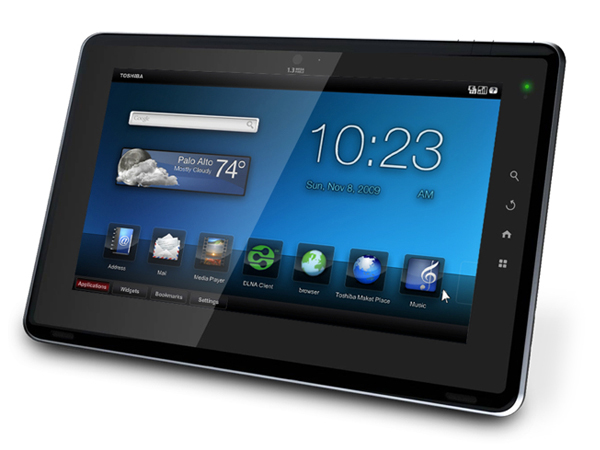
Toshiba Folio 100
Processor
Nvidia Tegra 2 (250) 2c/2t 2 x 1 GHz, T20 Harmony
Graphics adapter
Display
10.10 inch 16:9, 1024 x 600 pixel, glossy: yes
Weight
760 g ( = 26.81 oz / 1.68 pounds) ( = 0 oz / 0 pounds)
Price
400 Euro
Price comparison
Average Score:
Average of 2 scores (from 3 reviews)
Average of 2 scores (from 3 reviews)
price: - %, performance: - %, features: 80%, display: - % mobility: - %, workmanship: 50%, ergonomy: 60%, emissions: - %
Reviews for the Toshiba Folio 100
Toshiba Folio 100 review: First look
Source: It Pro Archive.org version
We find it a little odd that Toshiba is using Android on the Folio 100, while using Windows 7 on the Libretto W100. Nevertheless, the Folio could be very promising if app developers take advantage of its features, such as the Tegra processor and the HDMI and USB ports.
Single Review, online available, Short, Date: 09/02/2010
Rating: workmanship: 50%
Source: It Pro
Archive.org versionWe find it a little odd that Toshiba is using Android on the Folio 100, while using Windows 7 on the Libretto W100. Nevertheless, the Folio could be very promising if app developers take advantage of its features, such as the Tegra processor and the HDMI and USB ports.
Single Review, online available, Short, Date: 09/02/2010
Rating: workmanship: 50%
Foreign Reviews
Die Tablet-Invasion
Source: Connect - 5/11
Comparison, , Medium, Date: 04/01/2011
Rating: Total score: 80% features: 80% ergonomy: 60%
Source: Connect - 5/11
Comparison, , Medium, Date: 04/01/2011
Rating: Total score: 80% features: 80% ergonomy: 60%
Comment
NVIDIA GeForce ULP (Tegra 2): In Tegra 3 SoC integrated ultra low power GPU. Depending on the model clocked at 300 to 400 MHz.
These graphics cards are not suited for Windows 3D games. Office and Internet surfing however is possible.
» Further information can be found in our Comparison of Mobile Graphics Cards and the corresponding Benchmark List.
2 (250): SoC (System on a Chip) with a integrated Corex A9 Dual-Core, GeForce ULP and other dedicated subprocessors (Audio, Video).» Further information can be found in our Comparison of Mobile Processsors.
 Add as a preferred source on Google


