


 Deutsch
 Español
 Français
 Italiano
 Nederlands
 Polski
 Português
 Русский
 Türkçe
 Svenska
 Chinese
 Magyar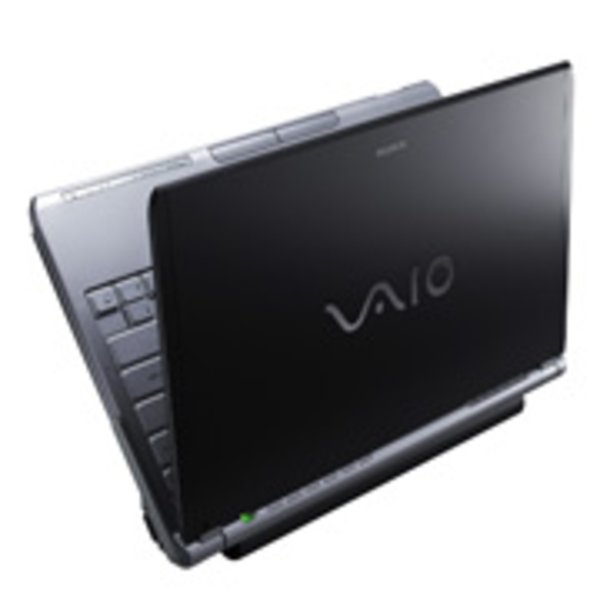
Sony Vaio VGN-TX850p
Specifications
Pricecompare
Reviews for the Sony Vaio VGN-TX850p
Source: Notebookreview.com
 Archive.org version
I would highly recommend the Sony VAIO TX850p for the travelling user (or one who, like me, just likes small devices), who isn't power-hungry, who is versed in computer cleanup and doesn't mind giving their machine a little TLC. I would not recommend this laptop to someone with a budget, gamer, a user who deals with the manipulation of multimedia (i.e. video encoding, audio compression, etc.), or an inexperienced or clumsy user.
umfangreicher Erfahrungsbericht eines Benutzers; online abrufbar
Preis/Leistung teuer, Display exzellent, Ergonomie sehr gut, Mobilität gut, Verarbeitung mangelhaft
Single Review, online available, Short, Date: 06/06/2007
Rating: price: 40% display: 95% mobility: 80% workmanship: 50% ergonomy: 90%
Comment
Intel Graphics Media Accelerator (GMA) 950: Intel Graphics Media Accelerator 950 is an integrated (onboard) graphic chip on Mobile Intel 945GM chipset. It is a faster clocked version of the GMA 900 and supports no hardware T&L (Transform & Lightning) accelleration (which is required for some games).
These graphics cards are not suited for Windows 3D games. Office and Internet surfing however is possible.
» Further information can be found in our Comparison of Mobile Graphics Cards and the corresponding Benchmark List.
Intel Core Solo: Single core version of the Core Duo and successor of the Intel Pentium M; Because of the 65nm reduced structure width also smaller current consumption than Pentium M (maximally 27 Watts); the performance is comparable with the equivalent clocked Pentium M (somewhat faster because of a few improvements).
U1400: » Further information can be found in our Comparison of Mobile Processsors.
11.10":
This is a standard display format for tablet computers or small convertibles. You see more on the screen than on a smartphone but you can't use big resolutions well. On the other hand, mobility is not a problem.
» To find out how fine a display is, see our DPI List.Sony: Sony Corporation is one of the largest Japanese electronics companies. The company was founded in 1946 under a different name and initially produced rice stoves. The company launched the first transistor radio. In 1958, the company was renamed Sony. Sony is a combination of the Latin word sonus (sound) and the English word sonny (little boy). Today, its core business is consumer electronics. The company is engaged in the development, design, manufacture and sale of electronic equipment, instruments, devices, game consoles and software. Sony operates in the following segments: Gaming and Network Services, Music, Images, Home Entertainment and Sound, Imaging Products and Solutions, Mobile Communications, Semiconductors, Financial Services and Others.
» Further information can be found in our Notebook Purchase Guide.
Reviews and price comparison on Sony Laptops at Ciao
Price comparison on Sony Laptops at Idealo