


 Deutsch
 Español
 Français
 Italiano
 Nederlands
 Polski
 Português
 Русский
 Türkçe
 Svenska
 Chinese
 Magyar
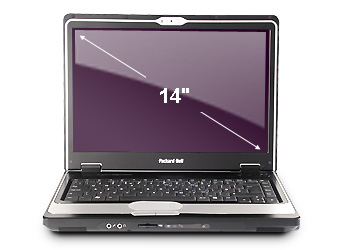
Packard Bell EasyNote GN Skype Edition
Specifications
Pricecompare
Average of 2 scores (from 3 reviews)
Reviews for the Packard Bell EasyNote GN Skype Edition
Source: vnunet.com
 Archive.org version
Packard Bell’s Easynote is based on a 1.6GHz Core 2 Duo processor, which can’t match the 1.8GHz and 2GHz processors used by some of its rivals. Even so, the Easynote’s performance is strong enough to cope with office software, digital photography and video editing.
minimal ausgestatteter Kurz-Test; online abrufbar
(von 5): 4, Preis/Leistung 4, Ausstattung 4, Ergonomie 3, Leistung mäßig
Single Review, online available, Very Short, Date: 02/06/2007
Rating: Total score: 80% price: 80% performance: 60% features: 80% ergonomy: 60%
Foreign Reviews
Source: PC Plus
 DE→EN Archive.org version
Single Review, online available, Short, Date: 05/21/2007
Rating: performance: 60% display: 80%
Source: Notebook / Organizer / Handy
DE→EN Archive.org versionSingle Review, , Length Unknown, Date: 12/01/2006
Rating: Total score: 80% price: 90% performance: 80%
Comment
Intel Graphics Media Accelerator (GMA) 950: Intel Graphics Media Accelerator 950 is an integrated (onboard) graphic chip on Mobile Intel 945GM chipset. It is a faster clocked version of the GMA 900 and supports no hardware T&L (Transform & Lightning) accelleration (which is required for some games).
These graphics cards are not suited for Windows 3D games. Office and Internet surfing however is possible.
» Further information can be found in our Comparison of Mobile Graphics Cards and the corresponding Benchmark List.
Intel Core Duo: Double Core processor with a very good relation of performance to current consumption. The 2 MB L2 Cache are used together by the double. The maximum capacity of 31 watts is only 4 watts more than with the Pentium M (predecessor). Both cores are lowered automatically and independently of each other by speed steps down to 1 GHz. In addition it now supports also SSE3 instructions. At least it is just as fast as a equivalent Pentium M. With applications, which were designed for multi-processors, the performance can be nearly twice as fast as with the Pentium M (e.g. CineBench around 86% fast)
T2050: » Further information can be found in our Comparison of Mobile Processsors.
15.40":
15-inch display variants are the standard and are used for more than half of all laptops.
The reason for the popularity of mid-sized displays is that this size is reasonably easy on the eyes, often allows high resolutions and thus offers rich details on the screen, yet does not consume too much power and the devices can still be reasonably compact - simply the standard compromise.
» To find out how fine a display is, see our DPI List.Packard Bell: Packard Bell is a subsidiary of Taiwan-based Acer. It is a name used by two different consumer electronics companies. The first was an American radio manufacturer founded in 1926, that later became a defense contractor and manufacturer of other consumer electronics, such as television sets. Teledyne acquired the business in 1978. In 1986, investors bought the name for a newly formed personal computer manufacturer. Originally the company produced discount computers in the US, later computers were produced for the European market. NEC took it over in the late 1990s. Acer acquired it in 2008. In spite of the similarity of their names, there has never been any corporate connection between the original or later Packard Bell and Hewlett Packard, or Bell System. Packard Bell is an international notebook manufacturer. Many years, the company focussed ruggedized laptops.
PB is not present in the smartphone/tablet market and a rather small manufacturer of laptops. There are hardly any reviews since 2015.
80%: This rating is not earth-shattering. This rating must actually be seen as average, since there are about as many devices with worse ratings as better ones. A purchase recommendation can only be seen with a lot of goodwill, unless it is about websites that generally rate strictly.
» Further information can be found in our Notebook Purchase Guide.