 Deutsch
 Español
 Français
 Italiano
 Nederlands
 Polski
 Português
 Русский
 Türkçe
 Svenska
 Chinese
 Magyar
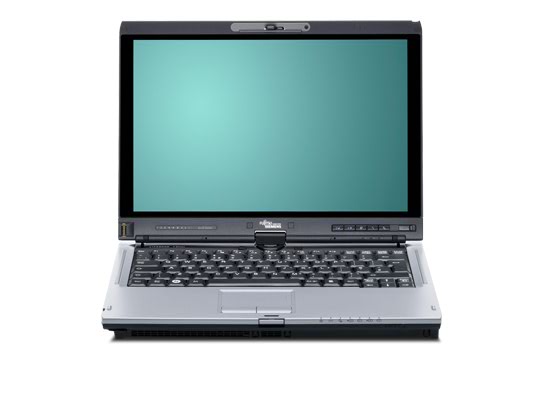
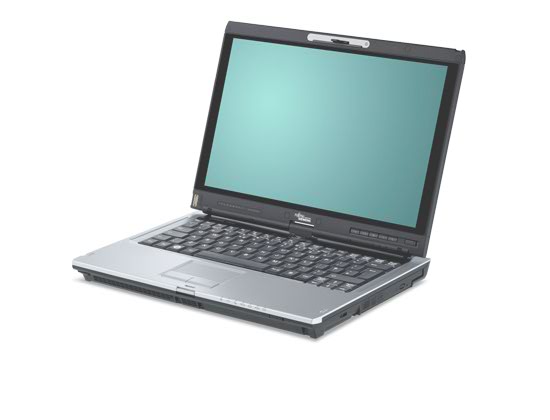
Fujitsu-Siemens LifeBook T5010
Specifications
Pricecompare
Average of 8 scores (from 8 reviews)
Reviews for the Fujitsu-Siemens LifeBook T5010
Source: Good Gear Guide
 Archive.org version
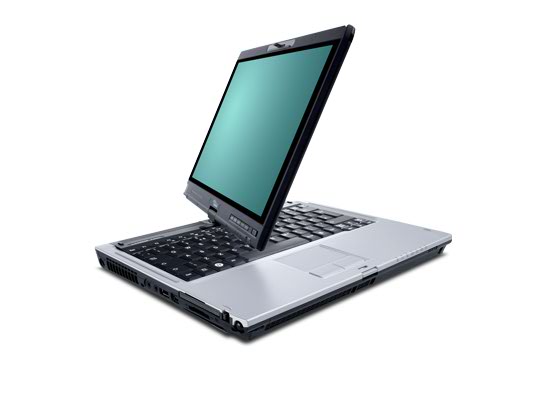
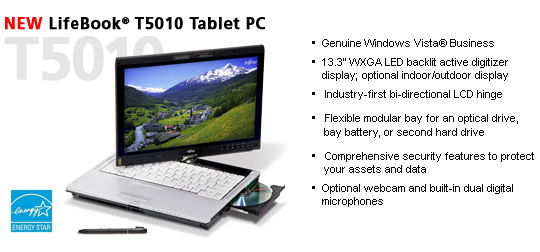
Fujitsu's LifeBook T5010 is a 13.3in tablet-convertible notebook with excellent build quality, good speed and plenty of features. It's powered by an Intel Core 2 Duo T9600 CPU, and has a bright touch screen with Wacom's interface technology built in. If you're on the lookout for a notebook that can be used as a tablet, then the Fujitsu LifeBook T5010 is about as good as it gets. It's fast, very well built and has one of the most responsive and accurate touch screens we've tested. The only downsides are its non-powered USB 2.0 ports and the inclusion of a PC Card slot instead of an ExpressCard/54 slot.
Single Review, online available, Medium, Date: 12/03/2009
Rating: Total score: 90%
Source: Tech Advisor
Archive.org versionThe Fujitsu LifeBook T5010 convertible laptop is built for business. Running on the Centrino 2 vPro chipset and packed to the gills with IT-friendly security features, it's designed to be an efficient portable workstation for the mobile professional. The Fujitsu LifeBook T5010 runs Windows Vista Business Edition on a 2.4GHz P8600 Core 2 Duo CPU. The Fujitsu LifeBook T5010 multitouch tablet-PC hybrid provides security, strength, and efficiency in a ho-hum package.
Single Review, online available, Medium, Date: 10/26/2009
Rating: Total score: 70%
Source: PC World
Archive.org versionThe Fujitsu LifeBook T5010 convertible laptop is built for business. Running on the Centrino 2 vPro chipset and packed to the gills with IT-friendly security features, it's designed to be an efficient portable workstation for the mobile professional. The T5010 multitouch tablet-PC hybrid provides security, strength, and efficiency in a ho-hum package.
Single Review, online available, Medium, Date: 10/19/2009
Rating: Total score: 50%
Source: PC Mag
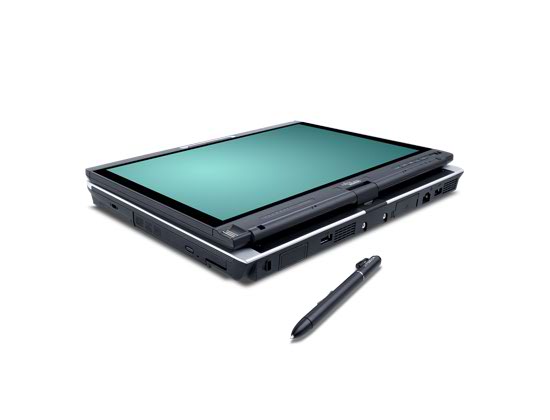
Archive.org versionConvertible tablets are and will remain specialized products that cater to a certain group of people. They have the benefit of having both keyboard and a pen as input devices, with the latter being used in sales, design, and the healthcare industry. It's simply easier to apply a pen to screen while you're on the run and the tablet is resting in your forearm. The Fujitsu LifeBook T5010 (Multitouch) ($1,859 direct) is the hallmark of what a tablet user experience should be. Though pricey ($1,800), the Fujitsu LifeBook T5010 is a convertible tablet that gives you three vital tools for data input: a keyboard, a digital pen, and now, multi-touch.
Single Review, online available, Long, Date: 09/15/2009
Rating: Total score: 70%
Source: Laptop Logic
Archive.org versionOverall, the Fujitsu LifeBook T5010 is an adequate notebook and an excellent tablet, all rolled up into one expensive package. The Intel Core 2 Duo P8600, 2GB DDR3 RAM and 160GB HDD will serve well for everyday tasks and, despite the integrated GPU, probably some casual gaming as well. In tablet mode, the Wacom stylus is responsive and there are enough tablet-friendly features to make its use convenient. The overall size and weight strike a balance between portability and productivity, with a 13.3” display and a weight of 4.5-4.9lbs. Unfortunately, the battery life is nothing exceptional and the price is fairly high, but in return you are getting a tablet that can comfortably be your regular laptop as well.
72, Leistung 40, Ausstattung 80, Mobilität 80
Single Review, online available, Long, Date: 06/03/2009
Rating: Total score: 72% performance: 40% features: 80% mobility: 80%
Source: CNet
Archive.org versionFujitsu Siemens' LifeBook T5010 comes from the same stable as the T1010. Like the T1010, it's a relatively large and heavy 13.3-inch convertible tablet PC. Differences include an active touchscreen rather than the T1010's passive unit, a solid-state hard-drive option and a wider range of processors. The T5010 is available for around £1,700 online. The Fujitsu Siemens LifeBook T5010 is a well-made convertible tablet PC with a sturdy casing and a comfortable keyboard. It's rather heavy for extended use in tablet mode, but benefits from a 13.3-inch screen and decent performance.
75, Leistung 80, Display 80, Mobilität 60
Single Review, online available, Medium, Date: 05/05/2009
Rating: Total score: 75% performance: 80% display: 80% mobility: 60%
Source: Laptop Mag
Archive.org versionThe Fujitsu LifeBook T5010 offers speed, strong Wi-Fi performance, and a good tablet and pen experience. Its $2,079 price has us wishing it had a sleeker design and touchscreen capabilities, like what you’ll find on the 12.1-inch Lenovo ThinkPad X200 Tablet. However, if you like the idea of owning a tablet with an optical drive and want a larger display, the T5010 is a good investment.
3.5 von 5, Leistung gut
Single Review, online available, Medium, Date: 10/07/2008
Rating: Total score: 70% performance: 80%
Source: PC Mag
Archive.org versionOnly a handful of convertible tablets are worthy of being called complete. Tablet makers typically make sacrifices to manage the weight, like ditching the optical drive, opting for a smaller screen, or including a low-powered processor. In doing so, manufacturers tend to hamper an important part of the convertible—the laptop part. Fujitsu LifeBook T5010 is still one of the few convertible tablets to integrate an optical drive and standard voltage parts.
4 von 5, Mobilität mangelhaft
Single Review, , Medium, Date: 08/12/2008
Rating: Total score: 80% mobility: 50%
Comment
Intel Graphics Media Accelerator (GMA) 4500MHD: Onboard (shared Memory) GPU built in the GM45, GE45 and GS45 chipset (Montevina). Because of two more shaders and a higher core clock, much faster than the old GMA X3100. Still not advisable for gamers (DirectX 10 games not playable or only with very low settings). The integrated video processor is able to help decode HD videos (AVC/VC-2/MPEG2) , e.g., for a fluent Blu-Ray playback with slow CPUs.
Only some 3D games with very low demands are playable with these cards.
» Further information can be found in our Comparison of Mobile Graphics Cards and the corresponding Benchmark List.
Intel Core 2 Duo: This is the Core Duo and Core Solo successor with a longer pipeline and 5-20% more speed without more power consumption. As an addition to the Core Duo design there exists a fourth decoder, an amplified SSE-unit and an additional arithmetical logical unit (ALU).
The Core 2 Duo for laptops is identical to the desktop Core 2 Duo processors but the notebook-processors work with lower voltages (0.95 to 1188 Volt) and a lower Frontside bus clock (1066 vs 667 MHz). The performance of equally clocked notebooks is 20-25% lower than Desktop PCs because of the lower Frontside bus clock and the slower hard disks.
P8400:
Middle class dual core CPU with a TDP of 25 Watt. For high end gamer the performance could be not sufficient (for class 1 graphic cards).
» Further information can be found in our Comparison of Mobile Processsors.13.30":
There are hardly any tablets in this display size range anymore. For subnotebooks, on the other hand, it is the standard format.
The advantage of subnotebooks is that the entire laptop can be small and therefore easily portable. The smaller display also has the advantage of requiring less power, which further improves battery life and thus mobility. The disadvantage is that reading texts is more strenuous on the eyes. High resolutions are more likely to be found in standard laptops.
» To find out how fine a display is, see our DPI List.Fujitsu-Siemens: Fujitsu, founded 1935, is a Japanese company specializing in semiconductors, air conditioners, computers (supercomputers, personal computers, servers), telecommunications, and services, and is headquartered in Tokyo. Fujitsu employs around 160,000 people and has 500 subsidiary companies. The partnership with Siemens AG was established in 1999 in the form of Fujitsu Siemens Computers (FSC), one of Europe's largest IT hardware suppliers, and owned 50/50 by Fujitsu and Siemens. 2009, this cooperation was terminated, FSC ended to exist. In future, no laptops will be sold with the brand "Fujitsu-Siemens" but only "Fujitsu".
72.13%: This rating is poor. More than three quarters of the models are rated better. That is rather not a purchase recommendation. Even if verbal ratings in this area do not sound that bad ("sufficient" or "satisfactory"), they are usually euphemisms that disguise a classification as a below-average laptop.
» Further information can be found in our Notebook Purchase Guide.